
5 Step Lightroom Test: Adobe Portfolio Alternatives for Photographers
Compare Adobe Portfolio alternatives with a 5 step Lightroom test. Avoid migration and mobile traps. Try PhotoView for Lightroom publishing.

5 Step Lightroom Test: Adobe Portfolio Alternatives for Photographers
If you shoot for a living, a photography-first platform that publishes straight from Lightroom and keeps client proofing private without any extra plugins might be the strongest Adobe Portfolio alternative for your workflow. That said, if your work leans heavily on written content, ecommerce, or you want total design freedom, a general website builder or a managed WordPress setup will probably serve you better than any photography-specific tool.
TL;DR:
- Lightroom integration remains a key feature for photography-first platforms, with direct publishing saving time and preserving image quality.
- Migration from Adobe Portfolio often requires hours of re-curation, as automated exports rarely preserve project organization and metadata.
- Mobile gallery performance heavily depends on the platform, with photography-focused tools generally offering better load times and layout scaling on phones.
- Free plans in all categories limit storage and branding, making paid tiers necessary once you want a custom domain or more galleries.
- Support quality varies, with photography-specific tools providing targeted assistance, while general builders rely on extensive community resources.
PhotoViewBuild a Lightroom-Ready PortfolioPhotoView helps photographers organize finished work, publish responsive portfolios, and keep website embeds updated from one dashboard.Explore PhotoView
Table of Contents
- What Are the Realistic Adobe Portfolio Alternatives?
- How Do These Categories Compare on the Details That Matter?
- How Do You Actually Test an Alternative Before Committing?
- Why PhotoView Fits the Photographer-First Workflow
- How Do Support and Community Resources Compare?
- Does Mobile Performance Actually Differ Across Platforms?
- Will Your Chosen Platform Still Work as Your Portfolio Grows?
- A Photographer’s Perspective on Choosing the Right Platform
- Try PhotoView for a Lightroom-Ready Portfolio
- Sources
- FAQ
What Are the Realistic Adobe Portfolio Alternatives?
Photographers leaving Adobe Portfolio tend to land in one of four categories, and each one optimizes for a different kind of workflow. Knowing which bucket fits your actual habits, not just your wish list, saves you from re-migrating a year from now.
Photography-first platforms build everything around the image, not the page. These tools handle Lightroom publishing natively, offer private proofing galleries for client review, and preserve color and detail through the upload pipeline instead of compressing everything into a generic content management system. You will not find a blog engine or a shopping cart bolted on. What you get instead is gallery fidelity: images that load fast, display sharp, and stay organized by shoot or client without manual folder wrangling. Photography-focused SaaS platforms typically include client proofing and direct Lightroom integration that general builders can only approximate through third-party plugins. This category fits wedding, commercial, fine art, and travel photographers who publish often and need client-ready galleries fast.
General website builders trade some of that specialization for flexibility. Wix and Squarespace, for instance, handle text-heavy pages, blog sections, and ecommerce checkout far more naturally than a portfolio-only tool. TechRadar’s comparison notes that Adobe Portfolio remains a low-effort choice for Creative Cloud subscribers, but a general builder wins once you need more text handling or product sales built into the same site. The tradeoff for image-heavy portfolios: you will spend more time configuring gallery layouts to look intentional rather than templated.
Managed WordPress with a page builder like Elementor gives you the most design control of any option, at the cost of ongoing maintenance. Elementor’s plugin documentation makes clear this route is popular precisely because it removes template ceilings entirely. You choose your hosting, your plugins, and your exact layout logic. You also become responsible for updates, security patches, and page speed optimization, which is a real time cost most working photographers underestimate until their site slows down or breaks after an update.
Community and discovery platforms solve a different problem altogether: visibility, not ownership. Behance functions primarily as a social discovery and networking space, while a hosted portfolio site is built to be your branded home base with your own domain. TechRadar’s analysis describes this distinction directly: Behance helps you get found, but it was never designed to be the definitive, branded destination you send clients to.
Match the category to your actual goal:
- Showcasing finished work to land clients: a photography-first platform
- Selling prints or licensing images directly: a general builder with ecommerce, or a photography platform with commerce add-ons
- Client proofing on active shoots: a photography-first platform with private galleries
- Getting discovered by other creatives and studios: a community platform, ideally paired with a branded site
How Do These Categories Compare on the Details That Matter?
Once you know your category, the real decision comes down to five practical dimensions: who the platform actually serves best, how it handles your existing workflow, how it presents images, what it costs at scale, and whether you are locked into a template once you pick one.
- Best for: photography-first platforms suit frequent publishers and client-facing shooters; general builders suit multi-service creatives selling products or writing regularly; managed WordPress suits designers who want total control; community platforms suit networking and discovery over ownership.
- Workflow integration: direct Lightroom publishing is common in photography-specific tools and rare or absent in general builders, where you are usually exporting and re-uploading manually.
- Image presentation: photography platforms prioritize gallery grids and full-bleed layouts; general builders often require manual tuning to avoid cropped or slow-loading images.
- Price model: most categories offer a free tier with real limits, then a paid tier once you need a custom domain, more storage, or removed branding.
- Template flexibility: some platforms let you swap templates without rebuilding your site; others force a full content migration every time you want a fresh look.
Migration friction varies more than people expect. Moving off Adobe Portfolio rarely means a clean export. Budget real time for re-curation, since automated exports rarely preserve curated project pages and metadata the way you built them originally. Expect to reassemble project groupings and double-check image sizing by hand.
Free plans across every category share the same pattern: storage caps, no custom domain, and visible platform branding are the norm, not the exception. A paid plan becomes effectively mandatory the moment you want your own domain name or need to publish more than a starter set of galleries.
How Do You Actually Test an Alternative Before Committing?
A free trial only tells you something useful if you run it like a test, not a browse. Here is a five-step routine that surfaces the problems before they cost you a client handoff.
- Run a real Lightroom publish test. Export a shoot the way you actually work, not a cherry-picked sample, and time how long it takes from Lightroom to a live gallery.
- Check the mobile preview immediately. Open the published gallery on your phone before you do anything else. If images crop badly or load slowly on mobile, that is disqualifying, not a minor bug.
- Send yourself a private share link. Test the exact client-proofing flow you would use on a wedding or commercial job, including password protection if the platform offers it.
- Swap templates without starting over. Change your active template and see whether your galleries carry over cleanly or whether you are rebuilding from scratch. Template lock-in is a common long-term cost that only shows up after you have already invested hours in one layout.
- Confirm your export and SEO basics. Check whether you can export your images and metadata later if you ever leave, and confirm the platform generates clean page titles and alt text without manual coding.
While you run through that list, watch for storage overage fees that kick in without warning, mandatory branding that only disappears on higher tiers, and vague restore or export policies buried in the fine print.
Pro Tip: Time your Lightroom publish test with a stopwatch, not a guess. If a full gallery takes more than ten minutes from export to live link, that gap will compound every time you shoot.

Why PhotoView Fits the Photographer-First Workflow
PhotoView was built around the exact workflow most working photographers already have: shoot, cull, publish, share. Lightroom publishing pushes finished images straight from your catalog into a live gallery, and Smart Folders keep that sync automatic instead of manual. Private sharing lets you send proofing links to clients without exposing a gallery publicly, and numerous responsive templates mean you can refresh your site’s look without rebuilding it from scratch.
A typical workflow looks like this: cull and edit a shoot in Lightroom, sync the finished folder to a Smart Folder, publish the gallery, then send a private URL to the client. That whole sequence often takes minutes rather than the hour or more it takes to manually export, resize, upload, and organize images inside a general builder.
PhotoView’s proof points, drawn from its own portfolio publishing solutions:
- Direct Lightroom publishing with no manual re-upload step
- Private galleries built for client proofing, not just public display
- A variety of templates you can swap without a full rebuild
- Storage plans that support mixed media, including video alongside stills
If you need a shopping cart, a blog engine, or pixel-level custom layout control, a general builder or managed WordPress setup will still serve you better. PhotoView is built for presentation and workflow speed, not for running an online store.
How Do Support and Community Resources Compare?
Support quality splits along the same lines as the platform categories themselves. General builders like Wix and Squarespace run large help centers, community forums, and extensive third-party tutorial libraries, simply because their user bases number in the millions. That scale means you will almost always find an answer to a common question, though you are usually self-serving through documentation rather than talking to a specialist who understands photography workflows specifically.
Photography-first platforms tend to run smaller, more specialized support teams. The tradeoff works in your favor when your question is specific to image handling, gallery rendering, or Lightroom sync, since the people answering actually understand the workflow rather than treating your site as a generic web page. Managed WordPress sits in an unusual spot: the core software has enormous community support through forums and plugin documentation, but if something breaks, you are often troubleshooting a specific combination of theme, plugin, and hosting environment that no single support channel fully owns.
Community platforms like Behance offer a different kind of resource entirely: peer feedback and visibility rather than technical support. That is valuable for critique and networking, but it will not help you when a gallery fails to render correctly on a client’s phone.
When you evaluate a platform, ask a direct question through its actual support channel during your trial period. How fast and how specific the answer is tells you more than any marketing page will.
Does Mobile Performance Actually Differ Across Platforms?
It differs more than most photographers expect, and it matters more than almost any other factor, since a large share of client-side gallery views now happen on a phone. General website builders often render acceptably on mobile but were originally designed desktop-first, which means image galleries sometimes crop awkwardly or load slower than they should on a cellular connection.
Photography-first platforms build mobile rendering into the core template logic, since gallery grids and full-bleed image layouts need to scale cleanly without a photographer manually adjusting breakpoints. That distinction shows up the moment you send a private proofing link to a client who opens it on their phone in a coffee shop with mediocre signal.
Dedicated mobile apps are the other piece of this. Some platforms offer companion apps for uploading and managing galleries on the go, which matters if you shoot events and want to push a preview gallery live before you even leave the venue. Others rely entirely on a mobile browser experience, which works fine for viewing but can be clunky for actual gallery management.
Before you commit to any alternative, open your trial gallery on an actual phone, not a browser resize simulation on your laptop. Check load time on a real cellular connection if you can, not just Wi-Fi, since that is closer to how most clients will actually view your work.
Will Your Chosen Platform Still Work as Your Portfolio Grows?
The alternative you pick today needs to handle triple the galleries and video content you might add in three years, not just your current shoot count. This is where storage tiers and template flexibility become long-term decisions rather than launch-day details.
Storage-based pricing, the model most photography-first platforms use, scales naturally as your archive grows: you pay for more space as you need it, rather than hitting a hard feature wall. General builders often price by feature tier instead, which means you might pay for ecommerce capability you never use just to unlock the storage or bandwidth you actually need.
Template flexibility matters just as much as storage. A platform that lets you swap templates without a full rebuild protects you from the slow creep of an outdated-looking site. One that forces a full migration every time you want a refresh effectively charges you in hours, not dollars, and that cost only gets worse as your portfolio expands. Mixed media support is another forward-looking factor: if you shoot stills now but expect to add video reels or motion content later, confirm your platform handles that without a separate tool or workaround.
A Photographer’s Perspective on Choosing the Right Platform
Prioritize workflow alignment over extra features. If you publish often, Lightroom integration will save you more time in a year than any template flourish. Photographers who migrate off Adobe Portfolio typically spend a few focused hours re-curating galleries, not days, once the new platform’s publishing flow actually matches how they already edit. Choose PhotoView if presentation and workflow speed matter more to you than building a store.
— Mitch Russo
Try PhotoView for a Lightroom-Ready Portfolio
PhotoView is the direct alternative for photographers who want their Lightroom catalog to become a live, client-ready gallery without extra export steps or plugin workarounds. You keep the editing workflow you already know, and the publishing step disappears into the background instead of eating your afternoon.
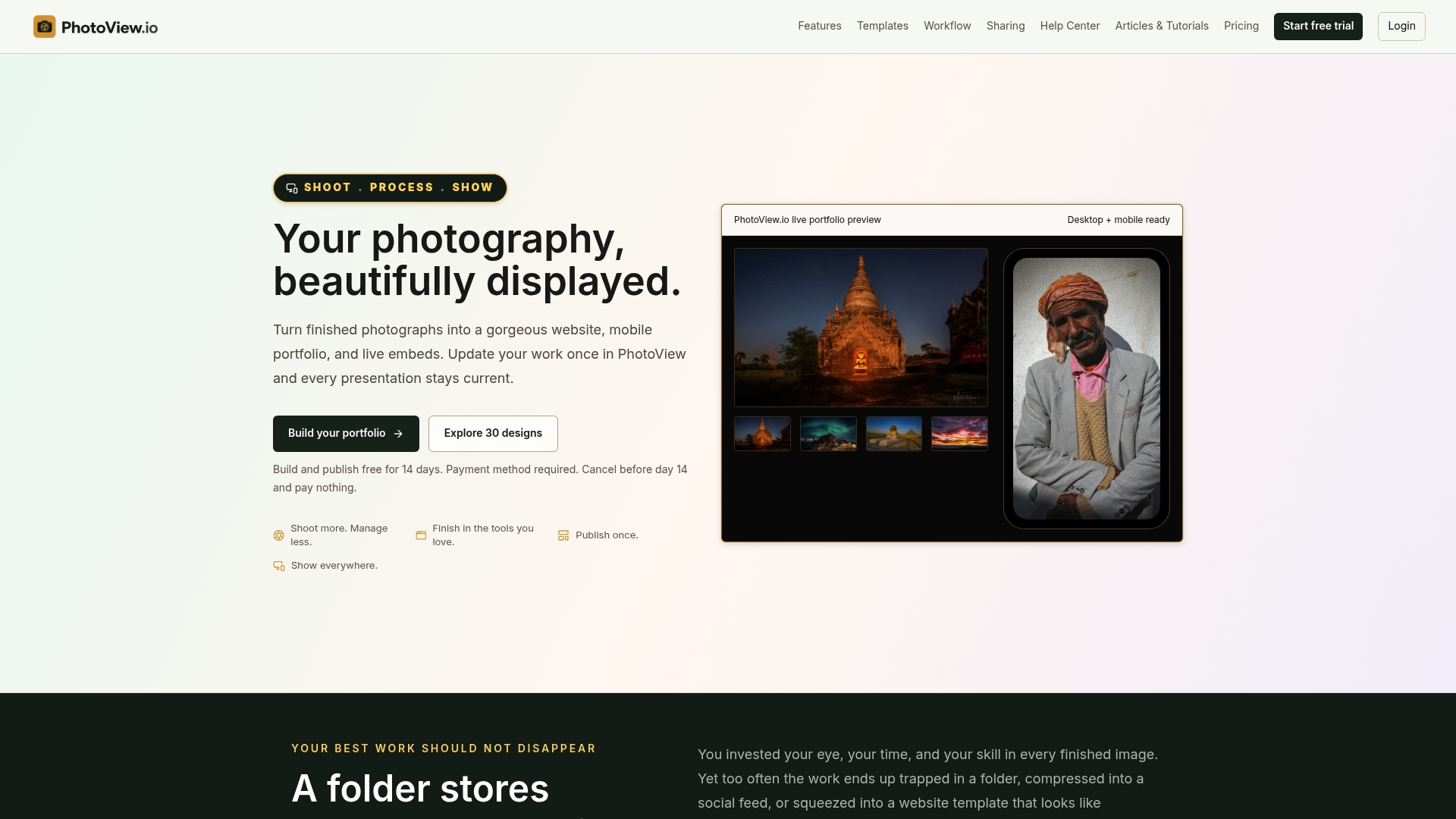
Start by testing the Lightroom publishing integration on a real shoot, then browse the photography website templates to see how your galleries would actually look live. If you are choosing between platforms right now, run that Lightroom test today. It answers the workflow question faster than any comparison chart can.
Sources
For broader market context beyond photography-specific tools, see TechRadar’s roundup of Adobe Portfolio alternatives, Aquent’s free portfolio site comparison, UX Planet’s no-code portfolio options, and Authory’s platform comparison. For SEO tradeoffs on general builders, see this Wix SEO breakdown.
- Top 5 free portfolio websites for creatives
FAQ
What Is the Cheapest Way to Keep an Adobe Portfolio-Style Site?
Free tiers exist across most categories, but they typically limit storage, custom domains, or remove your ability to hide platform branding. A paid plan usually becomes necessary the moment you want a professional domain name.
Is Behance Better Than a Hosted Portfolio Site Like Adobe Portfolio?
They serve different purposes. Behance is built for discovery and networking, while a hosted portfolio site like PhotoView functions as your branded home base with your own domain and full presentation control.
Who Is Adobe’s Biggest Competitor in Portfolio Tools?
There is no single dominant challenger. Photographers choose between photography-first platforms like PhotoView, general builders such as Wix or Squarespace, and managed WordPress, depending on whether they prioritize Lightroom workflow, ecommerce, or design control.
Is Wix or Adobe Portfolio Better for Photographers?
Wix offers more flexibility for text-heavy pages and ecommerce, while Adobe Portfolio stays low-effort for Creative Cloud subscribers who just need a simple gallery. Neither includes native Lightroom publishing or private proofing the way photography-first platforms do.
How Long Does Migrating Off Adobe Portfolio Usually Take?
Plan for a few focused hours rather than a full day, since automated exports rarely preserve your curated project structure and metadata. Most of that time goes toward re-checking image sizing and rebuilding gallery groupings by hand.