
Move Off Behance: Lightroom Ready Alternatives for Photographers
Tired of Behance's noisy feed? Move to portfolio first sites that offer Lightroom publishing, private client proofing, and a clear, painless migration path.

Move Off Behance: Lightroom Ready Alternatives for Photographers
A portfolio-first platform with private proofing and Lightroom publishing is a better alternative to Behance for most working photographers, and PhotoView.io is built around exactly that combination. Behance rewards social exposure and community feedback, but client work needs secure delivery, distraction-free galleries, and a fast publish workflow. The rest of this guide covers how to judge any alternative and how to move your work over without losing momentum.
TL;DR:
- Professional photographers should prioritize platforms with Lightroom publishing and private proofing features to streamline client delivery and reduce manual uploads.
- Storage capacity should match the volume of RAW files and videos typically produced, with higher tiers necessary for frequent or large-volume shoots.
- For targeted client outreach, portfolio-first sites that support easy sharing and embedding are more effective than community hubs with broad discovery but limited commerce tools.
- Platforms with no sales commission and integrated print storefronts help maintain profit margins on client purchases.
- Test templates on mobile devices before switching, ensuring responsive design and fast load times on smartphones, which now carry most viewer traffic.
PhotoViewPresent Your Work Beyond BehancePhotoView helps photographers curate galleries, publish responsive portfolios, and share polished presentations from one organized dashboard.Explore PhotoView
Table of Contents
- How do you choose the right Behance alternative?
- Community hubs, gallery platforms, or website builders?
- How PhotoView.io covers the core needs of a working photographer
- Moving your portfolio off Behance: a step-by-step plan
- What pricing and workflow costs actually look like
- The features that actually separate one photography platform from another
- What pricing structures and commissions really mean for your margins
- Where your work gets seen: audience and exposure by platform type
- How each platform type connects to your social presence
- Do you need a mobile app to manage your portfolio?
- Support and community resources worth checking before you switch
- Why a curated portfolio beats a crowded one
- Ready to move your work off Behance?
- Sources
- FAQ
How do you choose the right Behance alternative?
Start by matching the platform to the job you need it to do, not the feature list on its homepage. A platform built for community exposure and one built for client delivery solve different problems, even when they look similar on the surface.
Weigh these factors before you commit to a new home for your work:
- Presentation quality: look for responsive templates and clean, distraction-free viewing that puts the image first, not the interface.
- Client workflows: private galleries, proofing tools, password protection, and shareable delivery links matter more than social features once you’re booking paid work.
- Production integration: Lightroom publishing or a fast import workflow saves hours every month compared with manually exporting and uploading.
- Commerce and fulfillment: check whether storefronts and print lab integrations are included, and what commission, if any, applies to sales.
- Storage and performance: match storage tiers to your real file volume, including video and RAW exports, not just your current web-ready set.
Discoverability and privacy pull in opposite directions, and that’s fine. If you’re chasing gallery representation or agency attention, some public exposure matters. If your revenue comes from weddings, commissions, or licensing, private delivery and clean proofing matter far more than being found on a community feed.
Pro Tip: Rank your top three priorities before you compare platforms. It keeps you from getting swayed by a feature you’ll never actually use.
Community hubs, gallery platforms, or website builders?
Behance alternatives generally fall into three categories, and each one trades something for something else.
- Community hubs offer discovery and peer feedback, but the tradeoff is a busy interface and few real commerce tools, which makes them a weaker fit once you’re selling directly to clients.
- All-in-one gallery platforms bundle proofing, delivery, and print sales in one place, which suits deliverable-heavy work like weddings, portraits, and commercial shoots where clients need to review and order.
- General website builders give you full control over branding and layout, which fits fine-art and editorial photographers who want a distinct site rather than a templated look.
A wedding studio juggling dozens of client galleries a month needs the second category. A fine-art photographer building a gallery relationship or a personal brand often leans toward the third. A photographer still building a following and looking for feedback might stay in the first a little longer, but should expect to outgrow it once paid work starts.
How PhotoView.io covers the core needs of a working photographer
PhotoView.io maps directly to the priorities most photographers already have: get the work published fast, keep client delivery secure, and stop rebuilding a website every time the portfolio changes.
- Lightroom publishing cuts the export-and-upload cycle down to one step, so a finished edit reaches your published gallery without a detour through your desktop.
- Private sharing keeps client previews and final deliveries behind secure links, which matters when you’re sending proofs before a client has paid the final invoice.
- Templates, more than 30 of them, hand you a distraction-free, mobile-ready layout without touching code, so the photos stay the focus.
- Live embeds keep an existing website’s gallery current from one dashboard, useful for photographers who already have a site built elsewhere and don’t want two places to update.
The practical result is less time spent on site maintenance and more time behind the camera. Clients get a cleaner delivery experience, and setting up a print store or a new gallery takes minutes instead of a rebuild.
PhotoView.io fits a specific set of photographers particularly well: fine-art and travel photographers who want a portfolio-first presentation without managing a full website build, and wedding or commercial studios that need private galleries for client review without complicated third-party plugins. If your current setup involves stitching together a website builder, a separate proofing tool, and a manual Lightroom export routine, consolidating into one dashboard is the clearest win.
Moving your portfolio off Behance: a step-by-step plan
Migrating doesn’t need to take a weekend of stress if you work through it in order.
- Audit and cull your existing portfolio down to your strongest 15 to 30 images overall, with a moderate number per project or gallery.
- Export originals, keeping captions and metadata intact so context doesn’t get lost in the move.
- Choose a template and set up your custom domain, then check load speed on both desktop and mobile.
- Configure Lightroom publishing and private galleries, and run a test delivery to a friend or colleague before sending anything to a real client.
- Switch your links, update social bios, and watch early load times and client feedback for the first couple of weeks.
Pro Tip: Don’t migrate your whole archive at once. Move your best current work first, then backfill older galleries once the new site is live and tested.
What pricing and workflow costs actually look like
Subscription pricing on portfolio platforms usually scales with storage and feature access rather than per-image charges. PhotoView.io’s plans, for example, run from Starter at $3.99 per month up through Premier at $11.99 per month, each billed annually at a lower effective rate, with higher tiers unlocking more storage and additional galleries rather than gated features.
- Storage tiers typically determine how much RAW and video content you can host, more than which core features you get access to.
- Commission versus subscription matters if you sell prints: a flat subscription with no cut of sales protects margin better than a platform that takes a percentage of every print order.
- Time savings from automated proofing and delivery is real ROI, even when it doesn’t show up as a line item, because every hour not spent chasing client approvals is an hour back behind the camera.
The features that actually separate one photography platform from another
Client proofing and private sharing are the two features that matter most once you’re doing paid work, since they determine how smoothly a client reviews and approves images before final delivery. Password-protected galleries and expiring share links solve the basic problem of keeping unfinished or unpaid work away from the public.
Lightroom publishing removes a manual step that costs real time: exporting, renaming, and re-uploading finished edits. A direct publish workflow means the gallery updates the moment you’re done editing.
Templates decide how the work actually looks once it’s live. Responsive, mobile-ready templates matter more than they used to, since most portfolio traffic now arrives on a phone rather than a desktop browser. A custom domain keeps the site under your own brand instead of a subdomain that signals “free plan.”
Storefronts and print fulfillment integrations turn a portfolio into a revenue channel, not just a display case. Storage limits, meanwhile, quietly determine whether you’ll be paying for an upgrade in six months. Video, RAW files, and high-resolution exports eat storage fast, so check the real numbers against your typical shoot volume rather than assuming the base tier will cover you indefinitely.

What pricing structures and commissions really mean for your margins
Most photography portfolio platforms price around storage volume and feature tiers, and PhotoView.io offers several subscription plans including a Custom tier for high-volume studios without a published price. The core difference to watch for across any platform is whether print or product sales carry a commission on top of your subscription.
A platform that takes a percentage of every print sale effectively taxes your best months the hardest, since a bigger order means a bigger cut. A flat subscription model, in contrast, keeps your margin the same whether you sell one print or fifty in a given week.
Category review data shows photographers generally prefer platforms that bundle proofing, storefronts, and delivery in one workspace over stitching together a website builder with separate plugins for each function, largely because it reduces the administrative overhead of running multiple tools. That consolidation is worth factoring into any pricing comparison, since a cheaper subscription that requires three additional tools may cost more in time than a slightly pricier all-in-one plan.

Where your work gets seen: audience and exposure by platform type
Community hubs built for creative discovery put your work in front of a broad, mixed audience of casual browsers, other creators, and occasionally recruiters or art directors. That exposure can help early-career photographers get feedback and visibility, but it also means your paid client work sits next to unrelated creative fields, diluting the audience that actually books photographers.
Portfolio-first platforms trade that broad exposure for a targeted one: the people who see your site are the people you send there directly, through a link, a domain, or a social bio. Industry commentary notes that photographers focused on bookings and print sales increasingly prioritize a distraction-free, private presentation over community discovery, since the goal shifts from being found to converting an interested lead.
Website builders sit in between: they offer no built-in audience at all, which means all traffic has to come from your own marketing, SEO, or social presence, but they give you complete control over how that audience experiences the work once they arrive.
How each platform type connects to your social presence
Behance ties naturally into other Adobe products and a built-in creative community, which is part of its appeal for discovery. Portfolio-first platforms take a different approach: rather than hosting a community feed, they focus on making your work easy to share and embed wherever your audience already is.
PhotoView.io’s live embed feature lets you keep a gallery current on an existing website while also pushing updates out through social campaign tools, so a finished shoot can go live on your site and reach your audience without manually updating multiple platforms. That matters because most photographers’ actual traffic comes from Instagram bios, email signatures, and direct client referrals rather than in-platform discovery.
Website builders generally require more manual work to keep a portfolio and social presence in sync, since there’s no built-in publishing bridge between the two. If your workflow depends on posting to social media and then linking back to a full portfolio, check whether a platform automates that connection or leaves you updating each channel by hand.
Do you need a mobile app to manage your portfolio?
Most photography traffic now arrives on a phone, which makes mobile-responsive templates non-negotiable regardless of which platform you choose. That’s a different requirement from having a dedicated mobile app for managing the portfolio itself.
PhotoView.io focuses on mobile-ready presentation templates so viewers get a clean experience on any device, alongside desktop tools for uploading, organizing, and publishing work. For most working photographers, the more important mobile question isn’t whether you can edit your site from a phone, it’s whether the person viewing your gallery on a phone sees the same quality experience as someone on a laptop.
Community hubs and general website builders vary widely here: some render well on mobile by default, others require manual optimization for every template change. Test any platform’s templates on your own phone before committing, since a portfolio that looks sharp on a desktop monitor can lose detail or load slowly on mobile data.
Support and community resources worth checking before you switch
Support quality varies more between platforms than most photographers expect, and it’s worth testing before a client deadline depends on it. Hands-on reviews of gallery-focused platforms note strong client delivery experiences paired with tighter customization limits, a common trade-off across the category, so check whether support documentation covers the specific workflow you rely on, like Lightroom publishing or custom domain setup.
Community hubs often lean on peer forums and public discussion threads for troubleshooting, which works well for general questions but can be slower for account-specific issues. Dedicated portfolio platforms and website builders more often offer direct support channels, since their audience is paying subscribers rather than a mixed community of casual users.
Before switching, check response times, whether phone or live chat support exists, and whether the platform maintains a help center with setup guides for the features you’ll actually use, particularly proofing, delivery links, and domain configuration.
Why a curated portfolio beats a crowded one
Clients don’t book photographers because they scrolled through a hundred images. They book because ten or fifteen images made a clear, confident case for your work. A disciplined edit matters more than any feature difference between platforms, and a cluttered site can undermine even genuinely strong photography.
Distraction-free presentation converts better than social exposure once your goal shifts from being discovered to being booked. Before comparing platforms further, spend an afternoon cutting your galleries down to your strongest, most defensible work, then test a portfolio-first workflow with a short trial to see how it actually feels to use.
— Mitch Russo
Ready to move your work off Behance?
If you’re tired of exporting from Lightroom, uploading manually, and juggling a separate tool for client proofing, PhotoView.io puts all three in one dashboard so your portfolio stays current without the extra steps.
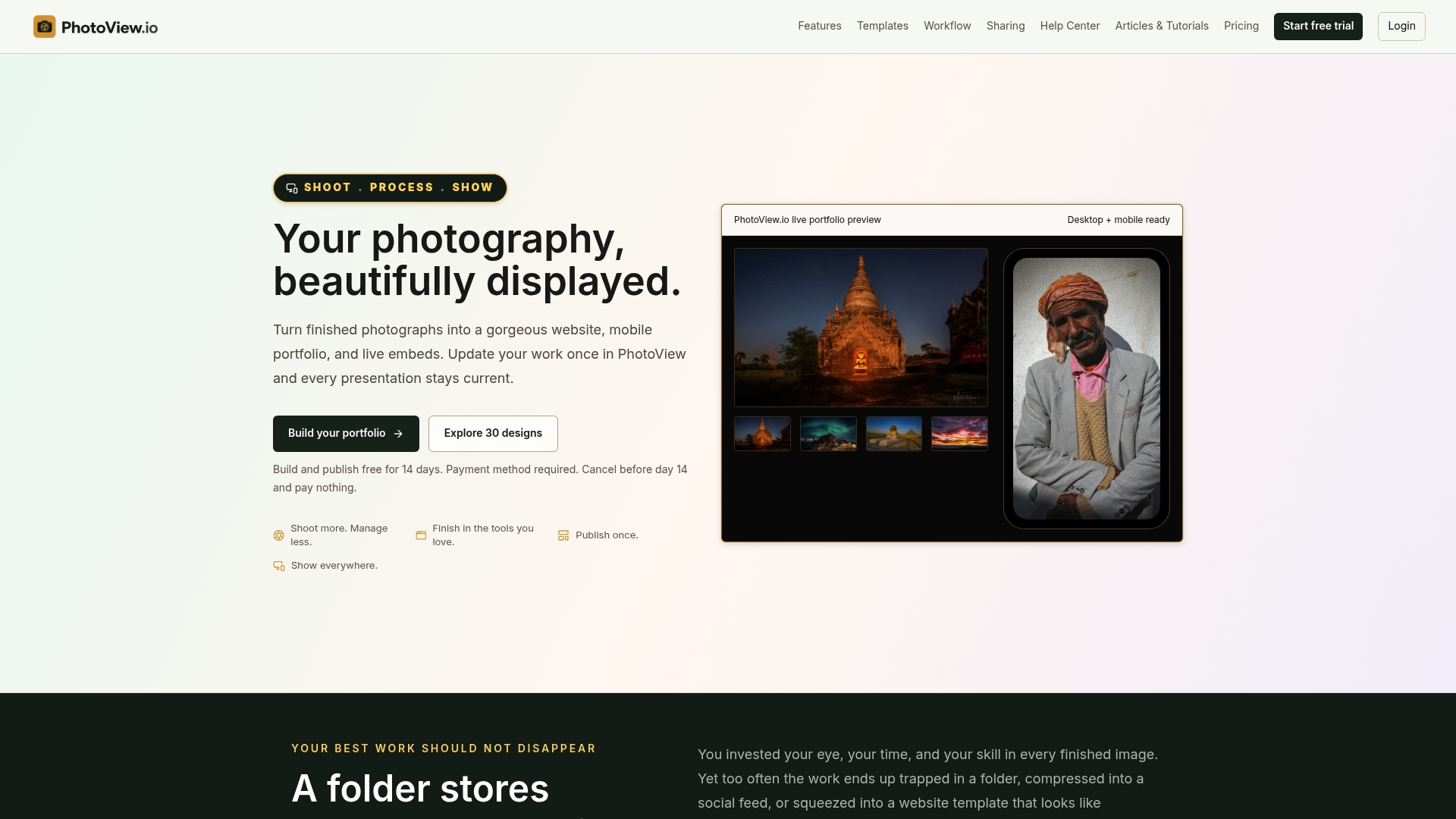
- Browse photography website templates built for distraction-free, mobile-ready presentation.
- Check the Lightroom publishing feature to see how direct publishing fits your editing workflow.
- Explore private photo sharing for secure client delivery and proofing.
Sources
FAQ
What is the best portfolio site for photographers?
The best fit depends on your priorities: platforms built around client proofing and Lightroom publishing, like PhotoView.io, suit working photographers who need private delivery and a fast publish cycle. Fine-art photographers focused on brand control often prefer a general website builder instead, while those still building an audience may lean toward a community hub for feedback and exposure.
What is the best platform for photographers overall?
There isn’t a single best platform for every photographer, since the right choice depends on whether you need community exposure, client proofing, or full brand customization. Photographers doing paid client work, such as weddings or commercial shoots, generally benefit most from an all-in-one gallery platform that combines proofing, delivery, and print sales in one workspace.
What is the 15 to 30 rule in photography portfolios?
The guideline recommends keeping a full portfolio to around 15 to 30 strong images total, with 8 to 12 per individual project or gallery. The idea is to show only your strongest, most defensible work so a viewer can quickly understand your specialty rather than scrolling through everything you’ve ever shot.
Is Pixieset good for a photography portfolio?
Pixieset earns strong marks for its client delivery experience, but hands-on reviews note a lower customization ceiling compared with more design-flexible platforms. It’s a solid fit if proofing and delivery speed matter most to you, but less ideal if you want a highly branded, custom-look portfolio site.