
PhotoView Tops Best Online Photo Galleries for Portfolio Photographers
PhotoView leads this roundup for portfolio photographers, with live embeds, Lightroom publishing, and 30+ templates. Compare 12 top gallery platforms side...

PhotoView Tops Best Online Photo Galleries for Portfolio Photographers
For photographers who deliver client work and sell prints, PhotoView is the strongest pick for portfolio-first presentation, live embeds, and Lightroom publishing, while ShootProof leads on zero-commission print sales and Pixieset wins on polished, bundled client galleries. The right choice depends on whether you’re optimizing for how your work looks online or how fast you can process an order. The full breakdown, including pricing and proofing details, is below.
TL;DR:
- PhotoView is ideal for photographers prioritizing a unified, portfolio-first online presence with live embeds and seamless Lightroom publishing.
- ShootProof remains the best choice for print sales without commissions, especially for high-volume, high-resolution work metered by photo count.
- Platforms like SmugMug and PhotoShelter excel at managing large archives and metadata-heavy licensing, respectively, but may slow workflows for portfolio-focused users.
- Migrating between gallery platforms can be complex, requiring careful export of metadata and test migrations to prevent data loss and broken client links.
- Before choosing, photographers should thoroughly evaluate export options, privacy controls, lab integrations, mobile support, and support responsiveness to match their specific workflow needs.
PhotoViewPresent Your Best Work BeautifullyPhotoView helps photographers organize, curate, and publish portfolios, galleries, and mobile-ready presentations from one dashboard.Explore PhotoView
Table of Contents
- What Are the Best Online Photo Galleries Right Now?
- Comparing 12 Photo Gallery Platforms Side by Side
- How to Choose the Right Gallery Platform for Your Workflow
- Switching Providers: What to Expect and How to Avoid Losing Work
- Proofing Features That Actually Matter for Client Delivery
- Security and Privacy: What to Verify Before You Trust a Platform
- Mobile Access and App Support for Photographers on the Move
- Getting Help When Something Goes Wrong
- Speed, Uptime, and Reliability When It Counts
- Branding and Customization: How Much Can You Make It Yours?
- Why PhotoView Fits Portfolio-First Photographers Best
- Ready to Try PhotoView? Here’s What to Test First
- Sources
- FAQ
What Are the Best Online Photo Galleries Right Now?
Six platforms consistently rise above the rest, and each earns its spot for a different reason. You don’t need to test all fourteen contenders in this roundup. You need to know which one or two fit how you actually work.
PhotoView tops this list for photographers who think about their online presence as a portfolio first and a delivery tool second. If your priority is a cohesive, branded presentation that updates once and syncs everywhere, including live embeds on your own site, this is the platform built around that exact job. It combines Lightroom publishing, Smart Folders for automated organization, and 30+ portfolio templates with private sharing for client delivery, so you’re not juggling a separate tool for your public site and your client galleries.
- Best overall for portfolio-first work: PhotoView, because it treats your website and your client galleries as one connected system instead of two separate products bolted together.
- Best for zero-commission print sales: ShootProof, which charges 0% commission on all paid tiers and meters by photo count rather than storage.
- Best for traditional proofing workflows: Pic-Time, which pairs consistent client-facing presentation with integrated e-commerce built specifically around the approval-and-order cycle.
Three more platforms deserve a look depending on your specialty:
- SmugMug suits photographers who need to organize enormous archives with per-gallery privacy and download controls. If you shoot high-volume events and need granular control over who can see and download what, SmugMug’s gallery-first structure handles that scale well.
- PhotoShelter is built for commercial and editorial photographers who need metadata-heavy publishing and licensing workflows. If a magazine or agency needs to search your archive by keyword, caption, or usage rights, PhotoShelter’s metadata support is the differentiator.
- Pixpa works for photographers on a budget who want a website, gallery, and store bundled into one affordable package, without needing separate tools for each function.
Aftershoot’s roundup of proofing-focused platforms points out that proofing-oriented tools like Pixellu remain popular for photographers who want a dedicated selection-and-approval layer rather than a full website builder. This distinction matters when you’re choosing: some platforms want to be your whole online presence, while others want to be the fastest way to get a client to pick their favorites and pay an invoice.
Shotkit’s 2026 roundup reinforces the same shortlist of category leaders, naming ShootProof, Pixieset, SmugMug, Pic-Time, CloudSpot, and PhotoShelter as the platforms photographers search for most often. That consensus is useful context, but it isn’t a ranking by fit. A platform’s popularity tells you it’s well-supported and unlikely to disappear. It doesn’t tell you whether its pricing model or proofing tools match your specialty.
Pro Tip: Before committing to any platform, ask yourself whether you’re solving a presentation problem or a transaction problem. Photographers who confuse the two end up paying for e-commerce features they never use, or settling for a bare-bones proofing tool when they actually needed a portfolio site.
Comparing 12 Photo Gallery Platforms Side by Side
Pricing model and billing metric are where most photographers get surprised after they’ve already uploaded a season’s worth of client work. Pixieset meters by storage while ShootProof meters by photo count, and that single structural difference changes which platform makes financial sense depending on whether you shoot high-resolution commercial work or high-volume weddings. The table below lines up the dimensions that actually drive a purchase decision.
| Platform | Best For | Pricing Model | Billing Metric | Proofing Features | Print Store & Commission | Integrations | Migration/Export |
|---|---|---|---|---|---|---|---|
| Pixieset | Client-facing presentation with a bundled website | Subscription, storage-tiered | GB storage | Password-protected galleries, favoring | Commission on free tier, 0% on paid plans | Website builder included | Standard export tools |
| ShootProof | Print and album sales | Subscription, photo-count-tiered | Photo count | Client selection, approval rounds | 0% commission on all paid tiers | Invoicing built in | Bulk export supported |
| SmugMug | Large, organized portfolios at scale | Subscription, storage-tiered | GB storage (often unlimited on higher tiers) | Per-gallery privacy and download controls | Print lab partnerships | Broad third-party integrations | Established export tools |
| PhotoShelter | Commercial/editorial licensing and metadata | Subscription, storage-tiered | GB storage | Client approval workflows | Licensing-focused sales | Metadata-heavy publishing | Metadata-preserving export |
| Pic-Time | Consistent client presentation plus e-commerce | Subscription, storage-tiered | GB storage | Selection and approval rounds | Integrated e-commerce | Standard web integrations | Standard export |
| Pixpa | All-in-one site builder with galleries | Subscription, affordable tiers | GB storage | Basic client proofing | Built-in store | Website + blog + store combined | Standard export |
| Zno | Album and print product sales | Subscription or per-order | Varies by plan | Basic gallery delivery | Album/product-focused sales | Print product catalog | Standard export |
| Zenfolio | Established gallery and storefront combo | Subscription, storage-tiered | GB storage | Simple client proofing | Storefront with commission options | Standard integrations | Long-standing export tools |
| CloudSpot | Fast, simple client delivery | Subscription or free tier | Photo count or storage, plan-dependent | Simple selection tools | Built-in print store | Standard integrations | Straightforward export |
| Pass | Permissioned proofing workflows | Subscription | Plan-dependent | Permissioned access, client selection | Limited/basic | Lightweight, no full site builder | Standard export |
| Pixellu | Proofing-first workflow | Subscription | Plan-dependent | Strong selection and approval tools | Basic | Focused on proofing rather than full sites | Standard export |
PhotoView anchors this list because it solves a problem the rest of the category treats as secondary: keeping one body of work current everywhere it appears. Update a gallery once, and it reflects across your website, mobile view, and any embedded instance on an external site. Lightroom publishing pushes finished edits straight into your galleries, Smart Folders keep new imports organized automatically, and private sharing handles client delivery without forcing you into a separate proofing app. The four-tier structure (Starter, Growth, Studio, Premier) scales with storage needs rather than photo count, which matters if you shoot in RAW or deliver high-resolution commercial files.
Pixieset built its reputation on how good client galleries look out of the box. The bundled website builder means you can run a full online presence from the same account, and its commission structure only bites on the free tier. Migration in and out uses fairly standard export tools, so it’s not a difficult platform to trial and leave if it doesn’t fit.
ShootProof is the print-sales specialist. Because it meters by photo count instead of storage, a small number of high-resolution files costs the same as a large batch of compressed web images, which rewards photographers who upload selectively rather than dumping full shoots.
SmugMug has been around long enough to have genuinely mature gallery organization tools. Per-gallery privacy settings and download permissions let you hand different access levels to different clients without building separate sites. It suits photographers with large back catalogs more than photographers who need a single cohesive portfolio narrative.
PhotoShelter leans commercial and editorial. Its metadata support means keywords, captions, and usage rights travel with every image, which matters when a picture editor or licensing client needs to search your archive quickly. It’s less about pretty presentation and more about making a large body of work searchable and licensable.
Pic-Time pairs a clean, consistent client experience with e-commerce baked in from the start. Approval rounds and ordering happen in the same flow, which reduces the back-and-forth that slower platforms create between “client picks favorites” and “client pays for prints.”
Pixpa is the budget all-in-one option. You get a website, galleries, and a store without needing three separate subscriptions, though the proofing tools are more basic than dedicated proofing platforms like ShootProof or Pixellu.
Zno focuses on album and premium print products rather than general-purpose galleries. If most of your revenue comes from physical albums rather than digital downloads, its product catalog is built around that transaction, not around portfolio presentation.
Zenfolio is one of the longest-running names in this category, and it shows in the maturity of its storefront and gallery combination. It won’t win on cutting-edge design, but the commission and proofing options are well-documented and predictable.
CloudSpot optimizes for speed. If you want to shoot on Saturday and have a client gallery live and sellable by Monday with minimal setup, CloudSpot’s simplicity is the point, not a limitation.
Pass strips things down to permissioned proofing. There’s no full website builder here, just a lightweight way to control exactly who sees which images and let clients make selections. It fits photographers who already have a website elsewhere and just need a secure delivery layer.
Pixellu is a proofing specialist that Aftershoot’s roundup calls out specifically for strong selection and approval workflows. It’s not trying to be your website; it’s trying to be the fastest, cleanest way to get client feedback on a shoot.
The split across this entire list comes down to two competing priorities: platforms built around client experience and presentation versus platforms built around sales and transaction economics. Almost every complaint photographers have about the “wrong” platform traces back to picking one optimized for the other priority.
How to Choose the Right Gallery Platform for Your Workflow
Start by naming your actual job, not your wish list. A wedding photographer processing 40 galleries a year has a different problem than a fine art photographer maintaining one flawless portfolio. Match your priority (portfolio presentation, proofing speed, or print revenue) to the feature set that actually serves it, rather than chasing every feature a platform advertises.
Run this checklist during any free trial before you commit:
- Export formats. Can you pull full-resolution originals and metadata back out if you leave? SLR Lounge’s buyer guide flags this as one of the most common choice criteria photographers overlook until it’s too late.
- Commission percentage. Some platforms take a cut on the free tier and drop it on paid plans; others charge 0% everywhere. Know which one you’re signing up for.
- Lab partners. If you sell prints, check which labs are integrated and whether your preferred paper stocks and products are available.
- File-size handling. Test with your actual largest files, not a sample image. High-resolution commercial or fine art work can hit limits that a small test upload never reveals.
- Privacy controls. Confirm you can password-protect, disable downloads, or restrict access per gallery, not just account-wide.
- Embed and Lightroom publishing options. If you maintain a separate site, test whether a gallery actually embeds cleanly, and whether you can publish directly from your Lightroom catalog.
Red flags during a trial: no visible export option anywhere in settings, commission terms that require digging through a help center article to find, and migration documentation that’s vague about what happens to your existing client links.
Pro Tip: Test the exact file types and sizes you deliver in real client work, not a handful of optimized JPEGs. A platform that handles a 5-megabyte sample beautifully can choke on a batch of 45-megapixel RAW exports.
Switching Providers: What to Expect and How to Avoid Losing Work
Migrating gallery platforms is harder than it looks because large files, embedded metadata, and client history don’t move cleanly between systems. Switching is often the most disruptive part of choosing a new platform, and photographers who skip planning tend to lose organized album structures or break links they’ve already shared with clients.
Follow this sequence to avoid surprises:
- Export originals and all associated metadata before canceling anything on your current platform.
- Migrate one active client job first as a test case, not your entire archive at once.
- Validate print lab and product settings on the new platform before announcing the switch to clients.
- Keep a read-only archive of your old account active during the transition window.
- Schedule the actual cutover during a slow period, not mid-wedding-season.
Give yourself two to four weeks for a full migration if you have years of client galleries to move. During your trial period on the new platform, verify that export tools and lab fulfillment actually work end to end before you migrate anything beyond your test job.
Proofing Features That Actually Matter for Client Delivery
Password protection is table stakes now, but the platforms worth using go further with per-gallery access controls, not just one password for an entire account. That distinction matters when you’re delivering multiple client jobs simultaneously and can’t afford a mix-up.
Selection and approval workflows separate proofing-first platforms from portfolio-first ones. ShootProof and Pixellu build entire feature sets around clients marking favorites, requesting revisions, and finalizing an order, sometimes across multiple correction rounds. Handover.photo takes this further by tying selection, payment, and file release into a single locked flow, where clients can’t download final files until payment clears, an approach worth knowing about even if your chosen platform doesn’t work this way natively.
Watermarking protects proofs during the selection phase, and most established platforms apply it automatically to preview images while keeping final delivered files clean. Correction rounds, meaning how many times a client can request edits before you charge extra, vary widely by platform and are worth confirming before you quote a job, not after a client asks for a fourth revision.
If your workflow depends heavily on structured proofing with a paper trail, platforms that produce traceable, exportable proofing records reduce disputes over what a client actually approved and when.

Security and Privacy: What to Verify Before You Trust a Platform
Encryption in transit and at rest should be a baseline assumption for any platform handling client images, but data ownership terms deserve more scrutiny than most photographers give them. Read the terms of service for what happens to your images if you cancel: some platforms retain copies for a grace period, others delete immediately.
GDPR compliance matters even for U.S.-based photographers if you shoot destination work involving European clients. Check whether the platform offers a data processing agreement and lets clients request deletion of their gallery data on request.
Per-gallery privacy controls, meaning the ability to password-protect or restrict access to one gallery without affecting your entire account, separate mature platforms from bare-bones ones. This matters most for commercial and editorial photographers whose contracts often specify confidentiality windows before images can be made public.
Ask directly during any trial: who owns the uploaded files, what happens to them on cancellation, and whether the platform can produce a data processing agreement if a client requests one. A platform that can’t answer clearly isn’t one to build a client-facing business on.
Mobile Access and App Support for Photographers on the Move
Most platforms in this category offer mobile-responsive galleries rather than dedicated native apps, which matters more than it sounds. A responsive gallery that loads fast on a client’s phone at a coffee shop is often more useful than a clunky app they have to download first.
For photographers, mobile import capability, meaning uploading directly from a phone or tablet without routing through a desktop first, has become a real workflow differentiator. If you shoot events and want to push a same-day preview gallery live before you’ve even opened a laptop, check whether the platform supports direct mobile upload rather than requiring a desktop sync first.
Client-side mobile experience matters just as much. Test how a gallery actually renders and scrolls on a phone during any trial, not just on a desktop browser where most demos happen.
Getting Help When Something Goes Wrong
Response times and support channels vary more across this category than most photographers expect going in. Some platforms offer live chat with fast turnaround, others rely primarily on email tickets and a searchable help center, and a few maintain active user forums where photographers troubleshoot alongside official support staff.
Test support responsiveness during your trial period, not after you’ve committed and have a client deadline riding on a fix. Send a real question and see how long it actually takes to get a useful answer, not an automated acknowledgment.
Community resources matter more than they get credit for. A platform with an active user forum or Facebook group means you can often solve a workflow question faster by searching what other photographers have already asked, rather than waiting in a support queue.
Speed, Uptime, and Reliability When It Counts
Upload speed matters most in the moment you least want to think about it, mid-wedding, hotel Wi-Fi, trying to get a same-day preview gallery live before the reception ends. Platforms handling large RAW or high-resolution files at scale tend to perform more consistently than smaller providers without established infrastructure.
Download speed on the client side matters just as much, especially for high-resolution commercial delivery where a client is pulling dozens of full-size files at once. A slow download experience reflects on you, not just the platform, so test this during a trial with files sized like your actual deliverables.
Uptime matters most during peak wedding and event seasons when thousands of photographers are uploading and clients are checking galleries simultaneously. Established platforms with years of infrastructure investment tend to handle seasonal load better than newer entrants still scaling their backend.
Branding and Customization: How Much Can You Make It Yours?
Custom domains matter more than most photographers realize until a client asks why their gallery link looks like a random string of characters instead of your studio’s name. Platforms offering custom domain support let your galleries live under your own web address instead of a generic subdomain.
Template variety and depth of customization separate platforms that feel genuinely yours from ones that feel like everyone else’s account with a different logo swapped in. PhotoView offers over 30 responsive portfolio templates specifically because photographers work across wildly different visual styles, from minimalist fine art to bold commercial work, and one template rarely fits both.
White-labeling, removing all platform branding so a client only ever sees your name, is worth confirming explicitly rather than assuming. Some platforms include it on every tier; others reserve it for higher-priced plans.
Why PhotoView Fits Portfolio-First Photographers Best
The gap between platforms in this category isn’t really about who has more features. It’s about what job each one assumes you’re trying to do. Most gallery platforms assume you’re primarily processing transactions: getting a client to pick photos, approve them, and pay. PhotoView assumes you’re primarily building a body of work that has to look consistent everywhere someone encounters it.
That distinction shows up in how the features connect. Lightroom publishing means your edited images move into your galleries without a separate export-and-upload step. Smart Folders keep new work organized automatically instead of demanding manual sorting after every shoot. Custom domains and live embeds mean your portfolio can appear on your own website and stay current without you rebuilding anything.
Where this matters most is for travel, fine art, and commercial photographers whose entire pitch depends on presentation quality, not proofing speed. If your business runs on selling prints in volume, a platform metered by photo count with zero commission might serve you better. This roundup is built for the photographer whose work is the product.
— Mitch Russo
Ready to Try PhotoView? Here’s What to Test First
PhotoView’s plans scale by storage, not photo count, which means the tier you pick depends on how much work you’re actively hosting, not how many images you deliver per client. Starter runs $3.99 per month or $39.99 per year, suited to photographers just building out a first portfolio. Growth ($5.99/month or $59.99/year) and Studio ($7.99/month or $79.99/year) step up storage for active working photographers with growing archives. Premier ($11.99/month or $119.99/year) covers heavier storage needs, and a Custom plan is available for high-volume users who need pricing tailored to their storage footprint.
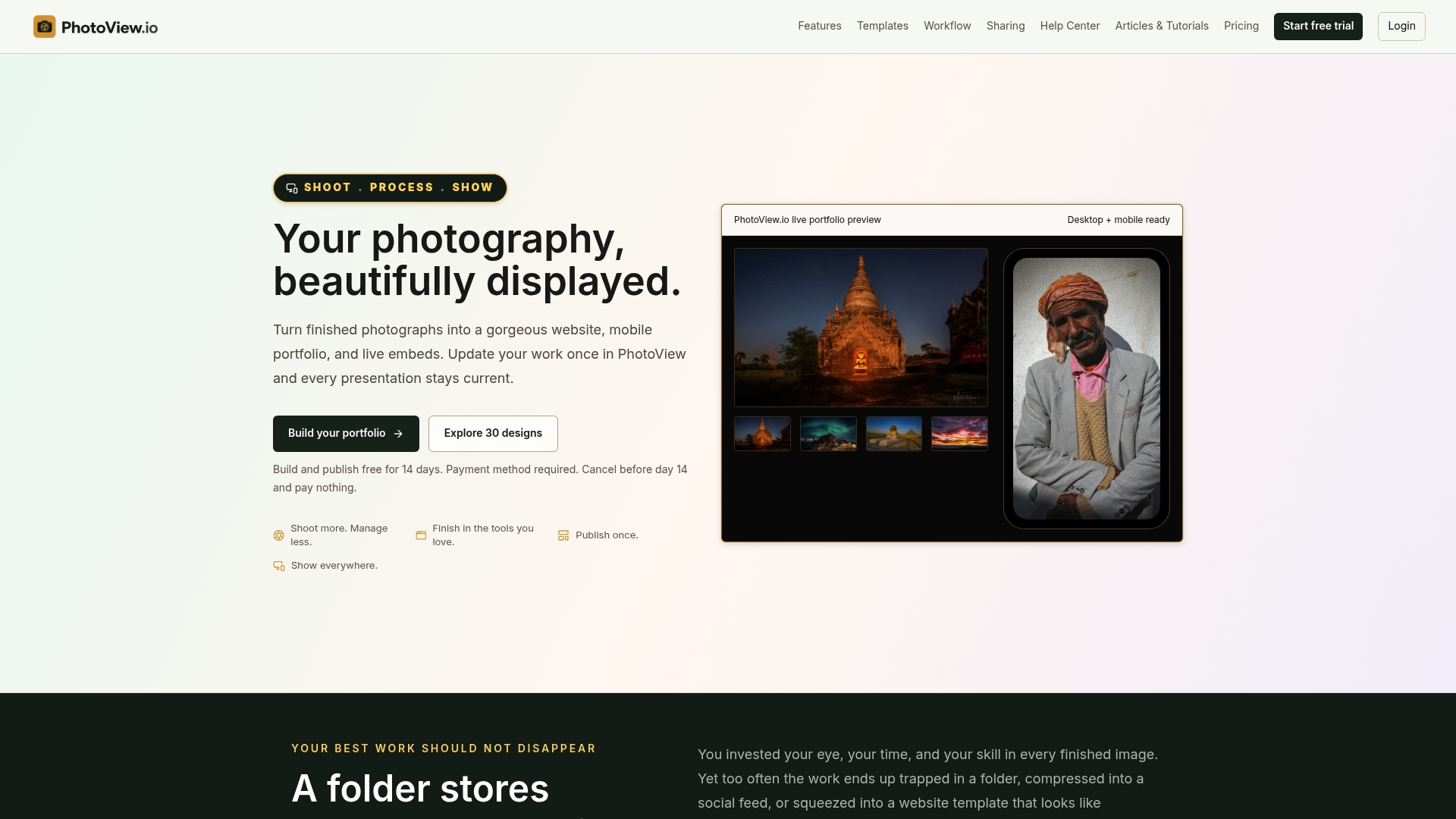
Every tier includes all 30+ templates and Lightroom publishing, so you’re not paying more to unlock the features that actually make a portfolio look professional. During your trial, publish one gallery straight from your Lightroom catalog using the Lightroom publishing workflow, then test embedding that same gallery on an external page to confirm it updates live. Finally, run a private sharing link through the full client experience, from access to download, using the private sharing tools built for photographers. If all three work the way your workflow needs, you’ve found your platform. Start your trial at Photoview.
Sources
Aftershoot’s roundup of proofing-focused galleries covers platforms built specifically around client selection workflows. SLR Lounge’s buyer guide breaks down trial testing and migration concerns in depth. Framekit’s Pixieset vs. ShootProof comparison details the commission and billing-metric differences that shape long-term cost. Handover.photo’s payment-locked gallery flow offers a useful contrast for photographers considering alternative delivery models. Photographers looking to get found beyond gallery platforms can also explore photography-specific SEO services.
- 17 Best Online Proofing Galleries for Photographers in 2026
- Best Online Galleries for Photographers (Updated)
- Pixieset vs ShootProof in 2026: Which Is Better? | Framekit
- Best online galleries for photographers
- Handover
FAQ
What Is the Best Website for Online Photo Galleries?
For portfolio-first photographers who need live embeds and integrated Lightroom publishing, PhotoView is the strongest overall pick. Photographers focused primarily on print sales often prefer ShootProof for its 0% commission structure, while those wanting a bundled, polished client experience lean toward Pixieset.
Is There a Better Site Than Shutterfly for Client Delivery?
Shutterfly is built primarily for consumer photo printing rather than professional client delivery, proofing, or sales workflows. Platforms like PhotoView, ShootProof, and Pixieset offer the private sharing, proofing tools, and print commission structures that Shutterfly simply wasn’t designed for.
What Is the Best Photo Gallery Platform to Use for Client Proofing?
It depends on whether you want proofing built into a full website platform or as a standalone tool. Pixellu and ShootProof specialize in dedicated proofing and approval workflows, while PhotoView integrates private sharing and gallery delivery directly into a broader portfolio and website platform.
What Are the Top Photo Gallery Sites Photographers Actually Use?
The most consistently cited platforms across major editorial roundups are PhotoView, ShootProof, Pixieset, SmugMug, Pic-Time, PhotoShelter, Zenfolio, CloudSpot, Pixpa, Pass, Pixellu, and Zno. Which one is “top” depends entirely on whether your priority is portfolio presentation, print sales, or proofing speed.
How Much Does PhotoView Cost Compared to Other Gallery Platforms?
PhotoView’s plans start at $3.99 per month or $39.99 per year for the Starter tier, scaling up through Growth, Studio, and Premier based on storage needs. All tiers include the full template library and Lightroom publishing, unlike platforms that gate design and integration features behind higher-priced plans.