
Photography Website Builders That Publish Directly From Lightroom
Find portfolio first photography website builders that publish from Lightroom, include private client galleries, and slash delivery time so you can shoot...

Photography Website Builders That Publish Directly From Lightroom
This platform is well suited for photographers who want a portfolio-first website with integrated business tools. It excels for anyone who needs Lightroom publishing, private client galleries, and proofing to work together from one dashboard, instead of stitching together separate apps for editing, delivery, and sales.
TL;DR:
- PhotoView offers direct Lightroom publishing, enabling photographers to upload images without manual export or re-upload, reducing delivery time to minutes.
- The platform includes over 30 responsive templates, private client galleries, and live embeds that automatically update on external sites, enhancing showcase consistency.
- It supports scalable storage plans and custom domain options, with security features such as encryption, password protection, and automatic gallery expiration for client privacy.
- Photographers should test image quality, proofing flow, and mobile performance during trial to ensure the platform aligns with their workflow and client experience.
- For high-volume shooters, PhotoView’s integrated systems cut administrative work by linking editing, gallery delivery, and sales into one streamlined dashboard.
PhotoViewPublish Your Portfolio From LightroomPhotoView brings Lightroom publishing, responsive portfolios, private galleries, and live embeds together in one dashboard.Explore PhotoView
Table of Contents
- What Are the Best Photography Website Builders by Type?
- How Do You Choose the Right Platform? A Decision Checklist
- How Workflow Needs Differ Across Photography Businesses
- Does PhotoView Cover the Full Checklist? A Feature Breakdown
- How Do You Launch a Photography Website Fast?
- How Good Is Customer Support Across Photography Platforms?
- How Well Do These Builders Connect With Other Tools?
- Do These Platforms Work Well on Mobile?
- How Secure Are Client Galleries and Photo Storage?
- Should You Hire a Developer or Use a Platform Like PhotoView?
- Ready to Build Your Photography Website With PhotoView?
- Sources
- FAQ
What Are the Best Photography Website Builders by Type?
Before you compare individual tools, understand the three categories you’re actually choosing between. Each solves a different problem, and picking the wrong category wastes more time than picking the wrong template inside the right one.
General-purpose design builders prioritize visual flexibility. You get drag-and-drop layout control and thousands of design combinations, which is great if you want a site that looks nothing like anyone else’s. The tradeoff: photography-specific needs like proofing, print fulfillment, and client galleries usually require third-party plugins or workarounds. Time to launch runs two to four weeks if you want something polished. Pricing generally falls within a moderate monthly subscription range.
Photography-specialist platforms build around the photographer’s actual workflow instead of generic business needs. Gallery templates, image delivery, and client proofing come standard, and design-heavy portfolios versus business-ready platforms is the real trade-off buyers face here. Launch time drops to days rather than weeks because the scaffolding already exists. Pricing often varies based on storage needs rather than fixed feature tiers.
Connected workflow ecosystems go a step further by linking your editing software directly to your published site. Publish from Lightroom, and the gallery updates without a manual export and re-upload cycle. This category matters most for photographers who shoot large volumes: weddings, events, and commercial work where dozens or hundreds of images move through the pipeline weekly.
Here’s how the three stack up at a glance:
- Design-led general builders: best for photographers whose priority is a unique visual identity over integrated business tools; two to four weeks to launch; $16 to $40 per month.
- Photography-specialist platforms: best for photographers who need galleries, proofing, and selling tools working together out of the box; days to launch; pricing scales with storage volume.
- Connected workflow ecosystems: best for high-volume shooters who want editing software to publish straight to a live site without manual re-exports; same-day updates once configured; pricing varies by storage and features.
Most photographers researching top photography website tools eventually realize the real question isn’t “which builder has the prettiest templates.” It’s “which one removes the most repetitive work from my week.”
How Do You Choose the Right Platform? A Decision Checklist
Feature lists on marketing pages are easy to write and hard to verify. The only way to know if a platform actually fits your workflow is to run it through a structured trial before you commit to an annual plan. Here’s the order to test things in, and why that order matters.
- Image quality and delivery speed. Upload a full-resolution RAW export, not a pre-compressed sample, and check how the gallery renders on a phone over cellular data. A platform that handles this well is running real CDN delivery with retina support, not just standard image hosting.
- Client proofing mechanics. Can a client favorite images, leave comments, and place a print order without creating an account first? Test the exact flow a client would use, start to finish.
- Storage terms. Confirm whether storage is unlimited, tiered, or capped per gallery, and ask what happens to your images if you downgrade or cancel. This is where photographers get burned months after signing up.
- Lightroom or editing workflow integration. Ask specifically whether publishing happens through a plugin, a direct API connection, or a manual export. The difference between these three determines whether delivery takes minutes or hours per client.
- E-commerce and print fulfillment. If you sell prints, ask which print labs are integrated and who handles fulfillment. Some platforms handle payment but leave production entirely to you.
- SEO and site speed. Ask whether the platform generates clean URLs, alt text fields, and sitemap files automatically, or whether that’s manual work.
- Mobile presentation. Load your test gallery on at least two different phone models. Templates that look great on a laptop sometimes break on smaller screens.
- Backup and data ownership. Ask directly: if you cancel tomorrow, can you export your full-resolution originals, or only what’s currently published?
Reviewers who evaluate these platforms consistently recommend running specific trial tasks rather than trusting headline features, and that advice holds up. A features page will tell you a platform “supports client proofing.” It won’t tell you the proofing flow requires four clicks and a forced account signup that half your clients will abandon.
Pro Tip: Ask every platform the same question during a trial: “Show me exactly what a client sees from the moment they click my gallery link to the moment they’ve selected prints.” If the answer takes more than three steps to explain, your clients will feel that friction too.
Red flags worth walking away from: vague answers about storage limits, no clear export path for your original files, and proofing tools that require a separate paid add-on you weren’t told about upfront. The minimum acceptable answer to “can I get my files back” is always yes, with no extra fee attached.
How Workflow Needs Differ Across Photography Businesses
The right platform depends heavily on what you actually shoot, because the friction points differ by specialty.
The solo portrait photographer typically needs a clean portfolio, a booking inquiry form, and a way to deliver a private gallery after each session. The biggest time-sink here isn’t the website itself, it’s re-exporting images for delivery after every edit pass. A platform with Lightroom publishing removes that step entirely: export once, publish once, done.
The wedding or event photographer deals with volume and privacy at the same time. A single wedding can produce several hundred final images that need to reach one couple securely, without becoming publicly searchable. This is where per-gallery access controls, image expiration settings, and batch print ordering matter more than template variety. Private client galleries with expiration controls reduce order confusion and protect couples from having their wedding photos indexed by search engines before they’ve even seen them.
The fine art or product seller cares most about image fidelity and site speed, since a slow-loading gallery kills sales momentum before a buyer ever sees the print options. Compression controls and CDN delivery aren’t nice extras here. They directly affect whether a $400 print sells or the buyer bounces.
Across all three scenarios, the same features keep showing up as the actual time-savers:
- Direct Lightroom publishing that skips manual export and re-upload cycles.
- Live embeds that update automatically wherever the gallery is displayed, including external sites.
- Print lab integration that removes you from the fulfillment chain entirely.
- Retina-quality image delivery with compression settings you control, not settings fixed by the platform.
Connected systems that sync editing software with delivery and client tools cut down the administrative overhead of managing separate tools for editing, galleries, and client communication. That overhead is the real cost most photographers underestimate when they’re comparing monthly subscription prices instead of hours spent per week on file handling.
Does PhotoView Cover the Full Checklist? A Feature Breakdown
Running PhotoView against the decision checklist above shows where it earns its place among photography portfolio builders, and where its design choices reflect a specific philosophy: less time managing tools, more time shooting.
- Templates: over 30 responsive portfolio templates built specifically for photography presentation, covering everything from minimalist grid layouts to cinematic full-bleed designs.
- Lightroom publishing: direct publishing from Lightroom to a live gallery, removing the manual export and re-upload step that eats into delivery time on every single client job.
- Smart Folders: automated organization that routes images into the right galleries as you import them, instead of manual filing after every shoot.
- Private sharing: client galleries with controlled access, built for delivering finished work without making it public before a client has seen it.
- Custom domains: your own domain name attached to the portfolio, rather than a subdomain that signals “built on a template” to potential clients.
- Live embeds: galleries that stay current on external sites automatically, so a portfolio embedded on a separate business site never goes stale.
- Storage options: plans scaled by storage volume, with custom plans available for photographers shooting high-resolution video alongside stills.
Consider a wedding photographer’s actual week after the ceremony. Images come off the card, get culled and edited in Lightroom, then need to reach the couple fast, ideally within days, not weeks. Publishing directly from Lightroom means the edited set goes from desktop to a private, password-protected gallery without a separate upload step. The couple gets a link, favorites their top selections, and can order prints straight from the gallery. No email attachments, no separate file-transfer service, no second login for the photographer to manage.
A practical Lightroom-to-website pipeline built around a proofing-sized export preset and Smart Folders for client deliveries can cut per-client delivery time down to minutes rather than the hour or more that manual exporting and uploading usually takes. That’s not a marginal improvement. Multiplied across a full wedding season, it’s the difference between a photographer editing at midnight every night and one who actually gets evenings back.
For photographers weighing portfolio-first platforms against general builders, the case for a connected system comes down to this: every manual step you remove from delivery is time you get back for shooting, editing, or simply not working past dinner.
How Do You Launch a Photography Website Fast?
Getting a site live doesn’t need to take months. Here’s the order that avoids the most common stalling points.
- Decide your domain situation first. If you already own a domain, confirm the platform supports custom domain connection before you commit. If you don’t, register one alongside signup so your gallery links and business cards match from day one.
- Settle your print and delivery policy before building galleries. Decide whether you’re selling prints directly, delivering digital files only, or both. This affects which gallery type you build first.
- Prepare your galleries. Organize your best work into two to three portfolio galleries by category (weddings, portraits, commercial) rather than one long undifferentiated scroll.
- Set client access rules. Configure private gallery links, expiration dates if needed, and decide whether clients need a password or a unique link is enough.
- Connect payments if you’re selling. Link your print fulfillment or digital payment processor before you promote the site publicly, not after your first sale inquiry arrives.
- Test across devices. Load the finished site on a phone, tablet, and desktop before sharing the link anywhere. Check that gallery load times hold up on mobile data, not just office WiFi.
- Publish and share the live link. Once tested, connect the domain fully and start directing traffic, whether from social bios, email signatures, or existing client communications.
Timeline and cost vary sharply by ambition level. A minimal single-page portfolio with a contact form can go live in a single afternoon on most photography-specialist platforms. A full business-ready site with client galleries, print sales, and custom domain setup usually takes three to seven days once your images are organized and edited. Photographers running separate tools for editing, delivery, and client management often spend hundreds to a few thousand dollars annually across those disconnected subscriptions. Consolidating onto one platform tends to bring that total down while also cutting the manual export and re-upload work between tools.
How Good Is Customer Support Across Photography Platforms?
Support quality varies more between platforms than most feature comparison charts suggest, and it matters more than photographers expect until the first time something breaks during a client delivery deadline.
General-purpose design builders often route support through large-scale help centers and community forums, which work fine for common questions but move slowly on anything specific to photography workflows. A support agent handling requests for florists, bakers, and photographers alike isn’t going to know why your Lightroom publish failed at 11 p.m. before a client presentation.
Photography-specialist platforms tend to staff support with people who actually understand gallery proofing, print fulfillment, and image delivery issues, because that’s the entire scope of what they handle. Response times matter here more than in most software categories: a broken client gallery link the morning of a big reveal isn’t a minor inconvenience, it’s a business problem.
When you’re comparing platforms, ask directly what support channels exist (chat, email, phone) and what the typical response window looks like during business hours versus weekends. Wedding and event photographers work weekends constantly, so a platform that only staffs support Monday through Friday creates a real gap. Also ask whether help documentation covers your specific workflow questions, like Lightroom publishing errors or gallery access troubleshooting, rather than generic “how to build a page” tutorials that don’t apply to a photography-specific setup.
How Well Do These Builders Connect With Other Tools?
Integration depth separates platforms that save time from ones that just relocate the work. The strongest photography website platforms connect directly to editing software, so finished images move from Lightroom to a published gallery without a manual detour through your desktop’s export folder.
Social media integration matters just as much for discoverability. Automated social campaign tools that pull from your existing galleries let you promote new work without manually resizing and reposting images across Instagram, Facebook, and Pinterest every time you publish something new. That’s a meaningful time save for photographers who post consistently to stay visible to potential clients.
Beyond editing software and social platforms, look at whether a builder connects to print labs, payment processors, and CRM tools you might already use for booking and invoicing. A platform that only integrates with itself forces you to keep managing separate systems for the parts of your business it doesn’t cover. If discoverability through search is part of your growth plan, pairing a strong portfolio platform with dedicated photography SEO strategies can help convert portfolio traffic into actual bookings rather than just page views.
The practical test: ask how many manual steps sit between finishing an edit and having that image live everywhere it needs to be, including your social channels and your site. Fewer steps means more shooting time.
Do These Platforms Work Well on Mobile?
Mobile presentation isn’t optional anymore. A large share of the people viewing your portfolio, whether it’s a potential client or someone forwarded a gallery link, will open it on a phone first.
Test this yourself rather than trusting a template preview. Load a sample gallery on your own phone over cellular data, not office WiFi, and check whether images load in a reasonable time or whether you’re staring at spinners. Templates that look flawless on a 27 inch monitor sometimes break down into cramped, slow-loading messes on a five-inch screen.
Dedicated mobile apps add another layer of convenience, particularly for photographers who want to review incoming bookings, check gallery views, or upload quick previews from a phone between shoots. Not every platform offers a native app, and for some photographers that’s a dealbreaker; for others who mostly work from a desktop, it matters less. Decide which category you fall into before you weigh this feature heavily in your final choice.
Client-facing mobile experience matters just as much as your own. If a bride is choosing prints from her phone on the way to work, the proofing and ordering flow needs to work cleanly at that screen size, with no pinch-zooming required to see detail in a photo she’s about to pay for.

How Secure Are Client Galleries and Photo Storage?
Security concerns two separate things: protecting your original image files from loss, and protecting your clients’ private photos from unauthorized access.
For your own files, ask directly what backup redundancy looks like. Are your originals stored in multiple data center locations, or a single point of failure? What happens to your library if you miss a payment or want to cancel? A platform that makes export difficult during cancellation is a warning sign worth taking seriously before you upload years of work.
For client-facing security, password-protected galleries and expiring share links matter most for anyone delivering sensitive content, which in practice means almost every wedding, family, or boudoir photographer. Ask whether gallery links can be set to expire automatically, whether you can revoke access after delivery, and whether client photos are indexed by search engines by default or kept private unless you choose to publish them publicly.
Encryption in transit and at rest should be a baseline expectation, not a premium add-on. If a platform can’t clearly explain how client data is protected between upload and delivery, treat that as a minimum acceptable answer failure, the same way you would for a vague storage policy.
Should You Hire a Developer or Use a Platform Like PhotoView?
Custom development makes sense in narrow situations: a large multi-language e-commerce operation, a highly unusual navigation concept no template supports, or integrations so specific that no existing platform covers them. If that’s your situation, you already know it, because you’ve hit a wall trying to force a template to do something it wasn’t built for.
For almost everyone else, a platform wins on speed and total cost. Custom builds carry ongoing maintenance: security patches, hosting renewals, and a developer relationship you need to maintain indefinitely. A platform absorbs that maintenance burden for you. The real question isn’t “which option is more impressive.” It’s “which one gets me back to shooting faster, and keeps me there.” For the vast majority of working photographers, that answer is a platform built for the job, not a custom system built from scratch.
— Mitch Russo
Ready to Build Your Photography Website With PhotoView?
If everything on that checklist matters to you, portfolio templates, Lightroom publishing, private client galleries, and live embeds that never go stale, this platform brings all these features into one dashboard instead of multiple subscriptions.
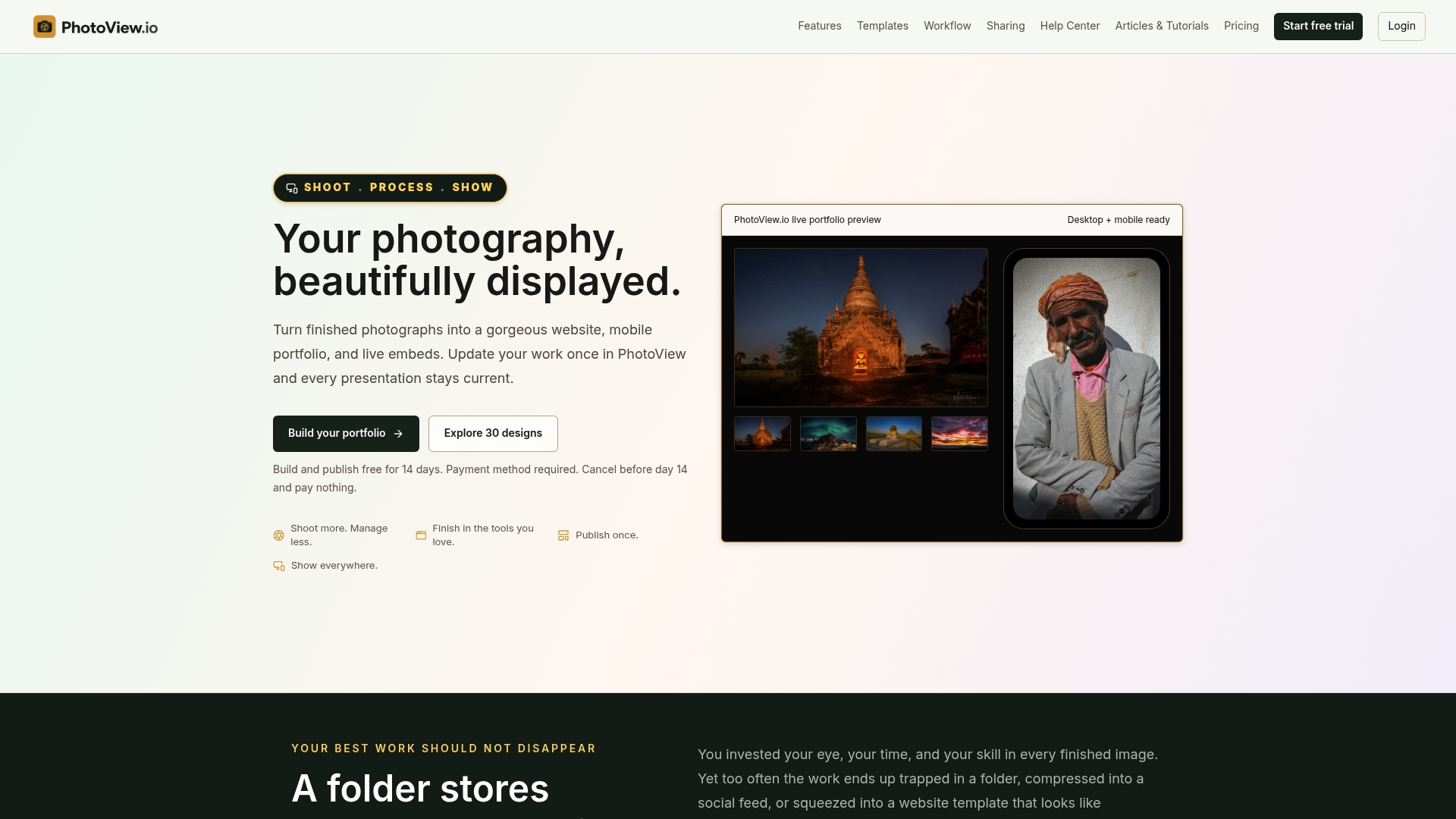
You can preview the design options first through the photography website templates gallery, or go straight to setting up your workflow with the Lightroom publishing solution if delivery speed is your biggest pain point right now. Wedding and event photographers who need secure client delivery should look at the private photo sharing tools built specifically for that handoff. Whichever entry point fits your current bottleneck, the full picture of what’s included lives on the PhotoView solutions page, where you can start a trial and import your first gallery to see how it fits your actual workflow before committing to anything.
Sources
- Best Website Builder for Photographers: 7 Standout Picks
- VSCO One: All-in-One Photography Platform for Photographers
FAQ
What website do most photographers use?
Most photographers split between design-led general builders for pure portfolio display and photography-specialist platforms when they need proofing, print sales, or client galleries built in, rather than added on through plugins.
Is Wix or Squarespace better for photographers?
Both are general-purpose design builders best suited to photographers who prioritize visual customization over integrated business tools, since neither was built specifically around photography workflows like proofing and print fulfillment.
How much does it cost to build a photography website?
Costs vary by platform type, but photographers running separate tools for editing, delivery, and client management often spend hundreds to a few thousand dollars a year across those combined subscriptions, a total that consolidated platforms tend to reduce.
What is the best website for a photography business?
The best fit depends on your workflow, but photographers who want portfolio templates, private client galleries, and direct Lightroom publishing working together from one dashboard get the most value from a platform like PhotoView built specifically around that pipeline.