
Portfolio Secure Photo Hosting & Lightroom for Photographers
Portfolio first secure photo hosting for photographers: Lightroom publishing, passphrase protected expiring galleries, responsive templates, plans from...

Portfolio Secure Photo Hosting & Lightroom for Photographers
For professional and passionate photographers, the best secure photo hosting is a portfolio-first platform that combines private, permission-controlled galleries with the presentation tools a website needs, not a consumer cloud backup service. PhotoView fits that category directly, pairing Lightroom publishing, private sharing, and responsive templates in one dashboard. The sections below break down exactly what to check before you commit.
TL;DR:
- Only platforms with private, passworded galleries and link expiry controls can truly protect client collections from unauthorized access or leaks.
- Lightroom publishing integration allows automatic gallery updates, reducing manual upload time and preventing version mismatches.
- Verify that storage plans accommodate high-resolution files like RAWs and TIFFs without hidden resolution caps or conversion issues.
- Ensure customer support offers quick response times for urgent security issues, such as revoked links or compromised galleries.
- A seamless, invisible security setup with expiring links and passphrases enhances client experience while maintaining control over the portfolio.
PhotoViewPresent Your Work With ConfidencePhotoView brings secure galleries, Lightroom publishing, and responsive portfolio templates together in one dashboard for photographers.Explore PhotoView
Table of Contents
- Why secure, portfolio-first hosting matters for pro photographers
- Core security and privacy features to require
- Workflow integrations that matter for Lightroom publishing and client delivery
- Storage, file support, performance, and pricing considerations for pros
- How to choose: a checklist and exact vendor questions
- Customer support quality and response times related to security issues
- Balancing security with a smooth client experience
- How PhotoView meets the photographer’s security checklist
- Sources
- FAQ
Why secure, portfolio-first hosting matters for pro photographers
Consumer cloud storage was built to back up snapshots, not to protect a client’s wedding gallery or a brand’s unreleased product shots. When you send finished work through a generic sharing link, you lose control over who sees it, who downloads it, and how long that access lasts. A leaked gallery before a product launch or a wedding album shared publicly before the couple wants it seen creates a real reputation problem, not just an inconvenience.
Full-resolution files also carry licensing weight. If a client can download an unwatermarked, unrestricted, high-resolution file straight from your public site, you have effectively given away the usage rights you may still be selling separately.
Portfolio-first hosts are built around a different job: presenting your best work publicly while keeping client deliveries and review sets locked down. That distinction matters most in three areas.
- Client galleries need private access, not public discovery.
- Full-resolution originals need delivery controls, not open download links.
- Public portfolios need branded, fast-loading presentation, not folder-style file dumps.
Consumer backup tools solve none of these problems because they were never designed to.
Core security and privacy features to require
Before you sign up for anything, confirm the platform gives you real control over who sees what and for how long. Treat this as a checklist during any trial.
- Private, passworded galleries with per-link permissions so you can set different access rules for different clients.
- Link expiry dates so review galleries and client downloads close automatically instead of staying live forever.
- Download controls and watermarking options that let you show full-size previews without handing over usable files.
- Access logging or activity trails so you can see who viewed or downloaded a gallery, plus team permission levels if you work with assistants or second shooters.
- Clear encryption practices in transit and at rest, along with a stated backup and retention policy for your originals.
Pro Tip: Ask a vendor to walk you through setting an expiring, passphrase-protected gallery live during your trial. If they cannot show you in under five minutes, the feature probably is not built for real client workflows.
Workflow integrations that matter for Lightroom publishing and client delivery
The feature checklist only pays off if it fits into how you actually edit and deliver work. That is where publishing integrations separate a real portfolio host from a glorified file locker.
Lightroom Classic’s publish services let you publish and update galleries directly from your catalog, syncing only the images you have changed rather than forcing a full re-upload every time you tweak an edit. PhotoView documents this workflow as a direct Lightroom-to-portfolio publishing path built for photographers who do not want to manage uploads twice.
- Publish services keep your web gallery and your Lightroom catalog in sync automatically.
- Smart Folders and separate gallery types let you keep public portfolio work, internal review sets, and client downloads from ever mixing.
- Private delivery mechanics like passphrase-protected links and temporary full-resolution downloads mean a client can grab their files without that link staying open indefinitely.
Together, these integrations remove the manual re-upload step that causes version mismatches, missed edits, and wasted evenings.
Storage, file support, performance, and pricing considerations for pros
Feature lists mean little until you translate them into capacity and cost. Start with file support: confirm whether the platform stores your actual RAW files and high-resolution JPEGs or only generates smaller web derivatives while your originals live elsewhere. PhotoView’s storage approach is built around keeping a photographer’s finished photo and video library organized in one place rather than splitting originals across separate backup tools.
Storage models vary. Fixed quotas are predictable but can force upgrades mid-project; tiered plans scale with your library; “unlimited” claims almost always carry fine print about file type or resolution limits, so ask directly before you rely on one.
Performance matters just as much as capacity. A content delivery network and responsive image loading determine whether a client browsing your gallery on a phone waits three seconds or thirty.
- Confirm whether RAW and TIFF files are stored natively or converted on upload.
- Ask whether “unlimited” storage has hidden resolution or file-count caps.
- Test gallery load speed on mobile data, not just office Wi-Fi.
Well-designed, fast-loading portfolios directly affect client perception. Design-focused industry research argues that visual design quality plays a significant role in influencing small-business discovery decisions, which is a direct argument for paying for a platform built around presentation rather than raw storage alone.
For a working wedding photographer or small studio, budgeting for photo hosting means matching storage tier to your annual shoot volume rather than guessing.
How to choose: a checklist and exact vendor questions
Once you have the feature and pricing picture, use a short non-negotiables list before you commit to any platform.
- Private galleries with per-link permissions and expiry dates.
- Direct Lightroom publishing so you never re-upload finished edits.
- Custom domain support so client-facing links carry your brand, not the vendor’s.
- Team roles if you work with second shooters, retouchers, or studio staff.
- A clear, written retention and backup policy for your original files.
When you get a vendor on a call, ask specific questions instead of general ones: How long do expired gallery links stay accessible before they actually lock? Does publishing from Lightroom update existing galleries or create duplicates? Where are backups stored, and how often do they run? What happens to my files if I cancel?
Treat vague answers as a red flag. If a sales rep cannot describe their backup schedule or link expiration behavior in plain terms, assume the feature is thin or unbuilt.
Customer support quality and response times related to security issues
Security features only matter if support responds quickly when something goes wrong. A client locked out of a gallery the night before a wedding, or a passphrase link that will not expire on schedule, is not a problem you want sitting in a support queue for days.
Before committing to a platform, ask what channels are available for urgent issues: live chat, email, or phone, and what response time they commit to for account or access problems specifically, not just general product questions. Ask whether security-related requests, like revoking a compromised link or resetting gallery access, get handled faster than routine billing questions.
It is reasonable to test this during a trial period rather than take a sales page’s word for it. Send a real support question about privacy settings or access controls and time the reply. A platform built for working photographers should treat a locked-out client gallery as a time-sensitive issue, not a ticket that waits in a general queue.

Balancing security with a smooth client experience
Publishing once and letting it sync everywhere sounds like a convenience feature, but it is really a security feature. Every manual re-upload is another chance to leave an old, unprotected gallery live somewhere you forgot about.
The best setups pair expiring links and passphrases with an interface that does not make clients feel interrogated. A client downloading their wedding photos should not need a tutorial. Set the expiration window generously, communicate it clearly, and let the passphrase do its job quietly in the background.
The right security setup should be invisible to your client and automatic for you.
— Mitch Russo
How PhotoView meets the photographer’s security checklist
PhotoView was built specifically for photographers who want to spend more time shooting and less time rebuilding a website every time a new gallery goes live. Its Lightroom publishing workflow syncs your catalog directly to your live site, so an edit you make once appears everywhere it needs to.
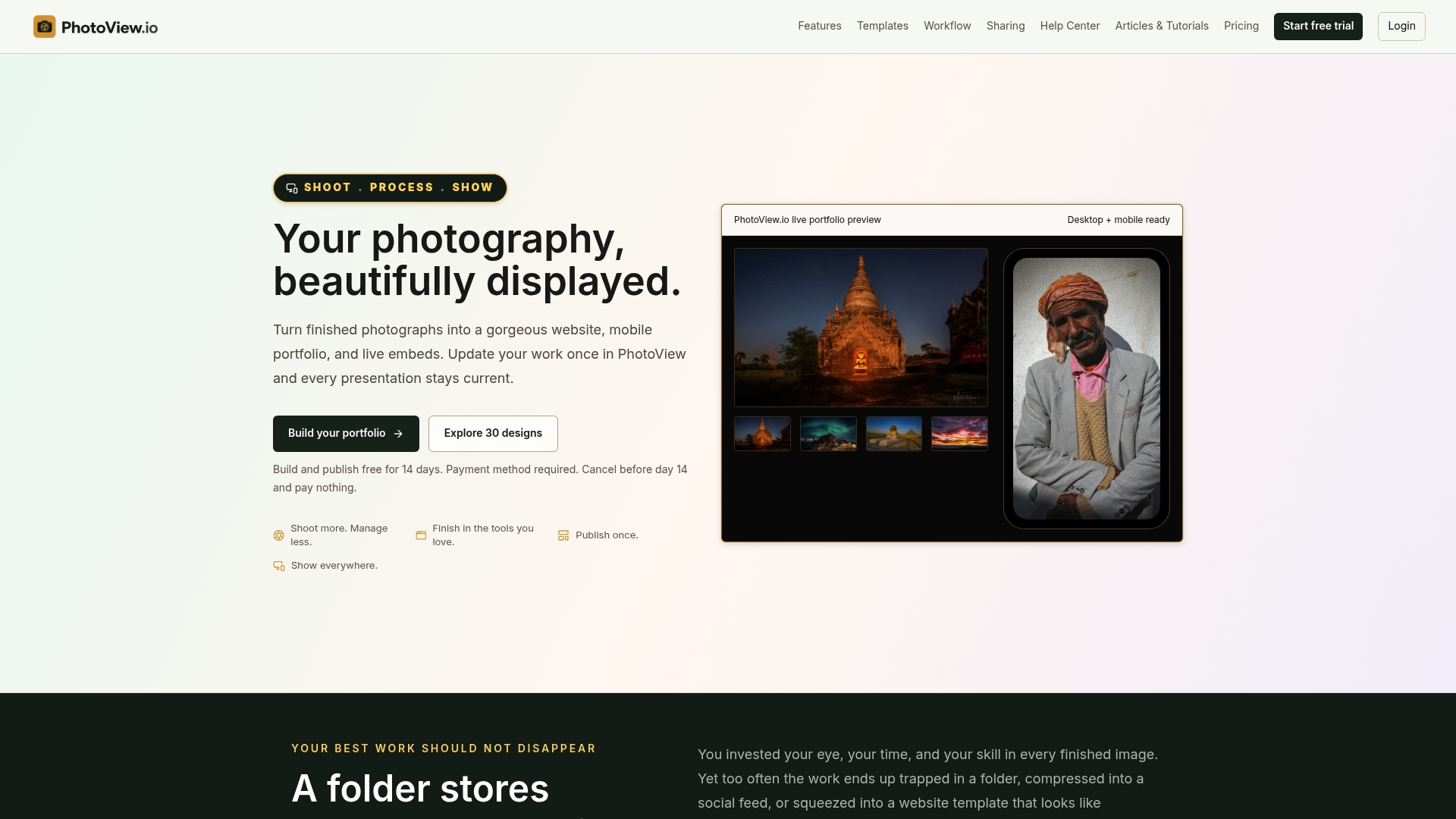
The private sharing tools give you passphrase-protected galleries built for client delivery, not just casual sharing. Combined with Smart Folders, multiple gallery types, and 30 or more responsive portfolio templates, the platform maps directly onto the checklist covered above.
- Publish from Lightroom once and update your live site automatically.
- Set private, passphrase-protected galleries for client review and delivery.
- Choose from responsive templates without touching code or rebuilding pages.
- Keep embeds on external sites current from the same dashboard you use for your portfolio.
Plans run from the Starter tier at $3.99 per month (or $39.99 per year) up through Growth, Studio, and Premier, each priced by storage volume, with custom plans available for high-volume studios. If your current setup means juggling a backup service, a separate gallery tool, and a website builder, it is worth seeing what one dashboard looks like instead. Start a trial and see how your existing Lightroom catalog publishes straight to a live portfolio.
Sources
The workflow and feature claims in this article draw on Lightroom Classic’s publish services documentation, PhotoView’s own solutions overview, and industry research on design’s role in small-business discovery. Photographers researching booking and visibility alongside hosting can also review SEO guidance for photographers.
- Digital presence for SMB growth: 75% judge by design
FAQ
What makes photo hosting “secure” for professional photographers?
Secure hosting for photographers means private, permission-controlled galleries rather than open sharing links: passphrase protection, expiring access, and download restrictions on full-resolution files. It also means clear encryption and backup practices, which you should confirm directly with any vendor before trusting them with client work.
Does Lightroom publishing actually save time over manual uploads?
Yes. Lightroom Classic’s publish services update only the images you have changed instead of re-uploading an entire gallery, which cuts down on both time spent and version mismatches between your catalog and your live site.
How much does secure photo hosting typically cost?
Pricing usually scales with storage volume rather than a flat rate. PhotoView’s plans start at $3.99 per month for the Starter tier and range up to $11.99 per month for the Premier tier, with custom pricing available for studios needing more storage.
Can clients download full-resolution files without a vendor limiting access?
That depends entirely on the platform’s controls. A well-built portfolio host lets you set expiring, passphrase-protected download links for client galleries so full-resolution files stay available only for a limited window rather than indefinitely.
What should I ask a hosting vendor about backups and data loss?
Ask exactly how often backups run, where files are stored, and what happens to your library if you cancel your subscription. A vendor who cannot answer these questions in plain language during a sales call likely has not built the policy out fully.