
Publish Once With Lightroom: Carbonmade Alternatives for Photographers
Compare Carbonmade alternatives for photographers and discover portfolio-first options, including why PhotoView's Lightroom publishing and live embeds cut...

Publish Once With Lightroom: Carbonmade Alternatives for Photographers
PhotoView stands out as the strongest pick for photographers who want portfolio publishing without the upkeep, thanks to Lightroom publishing and live gallery embeds managed from one dashboard. If your priority is designer templates, discovery and community exposure, or full design control, you have real options too: Framekit, Squarespace, Adobe Portfolio, Behance, Webflow, Pixpa and Format each solve a different piece of the puzzle. The right choice depends on how you weigh ownership, workflow, and visibility.
TL;DR:
- PhotoView offers Lightroom publishing and live embeds that automatically update galleries across platforms, scaling storage based on catalog size.
- Platforms like Squarespace, Webflow, Pixpa, and Format prioritize site ownership, with most charging subscription fees and offering diverse features beyond simple portfolios.
- Discovery-focused sites such as Behance enable broad exposure but do not provide full ownership or control over the portfolio content.
- Before switching, photographers should verify media limits, content ownership rights, client proofing, and whether direct publishing from Lightroom is supported, especially during trial periods.
- Moving from Carbonmade involves exporting images, confirming domain transfer procedures, rebuilding key galleries first, and connecting Lightroom publishing if supported, to minimize manual re-uploading.
PhotoViewPublish Your Portfolio From One DashboardPhotoView helps photographers store, curate, publish, and update galleries across responsive websites, mobile presentations, and live embeds.Explore PhotoView
Table of Contents
- A quick shortlist: what each Carbonmade alternative does best
- How these platforms stack up on the trade-offs that matter
- What to check before you commit to a new platform
- Where PhotoView fits into a photographer’s actual workflow
- Moving your work off Carbonmade without losing it
- Portfolio-first tools versus general builders: picking the right class of platform
- Why PhotoView makes sense for photographers who are tired of maintaining a website
- Where this comparison’s facts came from
- Sources
- FAQ
A quick shortlist: what each Carbonmade alternative does best
Carbonmade built its reputation on simple, visual portfolios, but photographers often outgrow it once they need faster publishing, live updates, or client proofing. The platforms below cover the ground Carbonmade leaves open, and each one earns its place on a different job.
PhotoView is built for photographers who want to update their work once and have it show up everywhere, on their website, embedded elsewhere, and on mobile, without rebuilding anything. The standout is Lightroom publishing paired with live embeds: once your source folder changes, every published gallery reflects it automatically. Pricing runs on storage-based subscription tiers rather than a flat fee, which matters once your catalog grows past a few hundred images.
Framekit leans into design out of the box. It focuses on template-driven portfolio layouts aimed at creators who want a gallery that already looks art-directed, without spending hours customizing one from scratch.
Squarespace is the generalist’s choice. It carries many portfolio templates, but it also handles commerce, blogging and multi-page marketing sites, which makes sense if your portfolio is one piece of a bigger, branded web presence rather than the entire point of the site.
Adobe Portfolio ties directly into Creative Cloud. If you already pay for Lightroom or Photoshop, Portfolio comes bundled and publishes straight from those apps into Behance, which Adobe’s own plan documentation frames as a Creative Cloud subscription decision rather than a standalone product purchase.
Behance plays a different role entirely. It is not a replacement for an owned site, it is a discovery layer. G2’s alternatives listing groups Behance with other discovery-first platforms, useful for exposure and community feedback, less useful as the only place your work lives.
Webflow suits designers who want granular visual control and custom interactions and are comfortable working closer to the code layer than a typical template allows. It rewards time invested with a level of design freedom template builders rarely offer.
Pixpa bundles galleries with client proofing and light commerce, a fit for photographers or small studios who need to deliver and sell, not just display.
Format focuses on the portfolio and the client relationship around it, with proofing and presentation workflow built in, which FixThePhoto’s 2026 comparison calls out as a strength for photographers managing client reviews alongside their public-facing work.
Pricing shapes vary as much as the feature sets. Behance runs free as a community platform. Squarespace, Webflow, Pixpa and Format are subscription products priced by plan tier. Adobe Portfolio is bundled into a Creative Cloud subscription rather than sold on its own. PhotoView and Framekit are subscription tools too, with PhotoView’s tiers scaled by storage volume instead of a flat seat price.

How these platforms stack up on the trade-offs that matter
Choosing between these platforms comes down to a handful of decisions: how much control you keep over your own site, how publishing actually works day to day, whether discovery matters to you, and what you are willing to pay for it.
| Platform | Best for | Standout | Ownership and control | Publishing and workflow | Discovery and community | Pricing shape |
|---|---|---|---|---|---|---|
| PhotoView | Photographers who need low-maintenance, integrated publishing | Lightroom publishing and live embeds from one dashboard | Custom domain, exportable galleries, full template control | Lightroom publishing, live embeds, mixed-media galleries | Not community-based, built around an owned site | Subscription by storage tier |
| Framekit | Creators who want designer-made templates fast | Portfolio templates built by designers | Limited customization beyond template structure | Template-based, manual updates | Minimal discovery features | Subscription |
| Squarespace | Creators needing a branded site with commerce | Polished templates plus ecommerce and marketing tools | Custom domain support, broad page control | General CMS workflow, not photo-specific | No built-in discovery network | Subscription by plan |
| Adobe Portfolio | Existing Creative Cloud users publishing from Lightroom | Integration with Creative Cloud apps and Behance | Custom domain available, design tied to Creative Cloud ecosystem | Direct Lightroom publishing into Portfolio and Behance | Behance integration for exposure | Bundled with Creative Cloud subscription |
| Behance | Designers and illustrators prioritizing discoverability | Large creative community and public discovery | No standalone site ownership, profile lives on Behance | Manual project uploads | Strong built-in discovery and feedback | Free |
| Webflow | Designers wanting granular visual control | High-fidelity visual control and animation capabilities | Full custom domain and design control, closer to code | Manual, design-intensive workflow | No built-in discovery network | Subscription by plan |
| Pixpa | Studios wanting galleries plus selling and delivery | Integrated galleries plus commerce and delivery tools | Custom domain support | Gallery uploads with proofing and store features | Limited discovery, owned-site focused | Subscription by plan |
| Format | Photographers needing proofing and client galleries | Built-in client proofing and presentation workflow | Custom domain support | Portfolio plus client proofing workflow | Limited discovery, owned-site focused | Subscription by plan |
Ownership tips the scale toward PhotoView, Squarespace, Webflow, Pixpa and Format, all of which keep your site on your own domain under your control. Discovery tips toward Behance, where exposure matters more than ownership. Workflow efficiency, specifically how little manual work it takes to keep a gallery current, favors PhotoView’s Lightroom publishing and Adobe Portfolio’s Creative Cloud pipeline over platforms built around manual uploads.
What to check before you commit to a new platform
A template gallery looks the same in a screenshot regardless of what is happening underneath it. The real differences show up after you publish, so work through this list before you sign up for anything.
- Confirm who owns the domain and whether you can export your content if you ever leave.
- Check media limits: file size caps, video support, and how many images or galleries a plan actually allows.
- Test client proofing if you need it, not every “portfolio” tool treats proofing as a real feature rather than an afterthought.
- Ask whether the platform supports Lightroom or another DAM tool for direct publishing, or whether every update means a manual re-upload.
- Verify private sharing options if you deliver client galleries that should not be public.
- Look at basic SEO and analytics support, since a beautiful gallery nobody can find or measure is a liability for working photographers.
- Read the domain and export terms closely. Vague wording here usually means friction later.
To verify most of this, open a free trial where one exists, upload a real gallery, and view it on your phone before you view it on your laptop. Mobile behavior reveals problems template previews hide. For Lightroom integration specifically, check whether the platform publishes directly from a Lightroom collection or only accepts a manual export, since that distinction determines how much maintenance you sign up for.
Pro Tip: Upload your largest, busiest image (a dense wedding reception shot or a high-detail landscape) during any trial. If a platform compresses it badly or loads it slowly on mobile, assume it will do the same to your full catalog.
Red flags worth walking away from: no custom domain option, media or export that gets locked behind a higher tier after you have already uploaded your catalog, visible glitches on mobile preview, or pricing pages that hide transaction fees until checkout. WIRED’s portfolio roundup notes that the trade-off between quick visual presentation and broader site features is often where these gaps hide, a specialist tool that nails the gallery experience may skip features a general builder takes for granted, and the reverse is just as common.
Where PhotoView fits into a photographer’s actual workflow
The checklist above maps closely onto what PhotoView was built to handle. Here is how its features line up against the criteria that matter most for photographers choosing a new platform:
- Lightroom publishing lets you push a collection straight to your live site without a separate export step, addressing the “manual re-upload” problem directly.
- Live embeds keep galleries current on an existing website, so a portfolio page built elsewhere still reflects your latest work.
- Private sharing covers client delivery needs without a separate proofing tool.
- Mixed-media galleries support both photos and video in the same curated space, useful for wedding and commercial photographers delivering both.
- Storage-based plans (Starter, Growth, Studio, Premier) scale with catalog size rather than locking features behind an arbitrary page count.
- Over 30 responsive templates are included on every plan, so template access is not a reason to upgrade.
For a closer look at how Lightroom publishing works in practice, PhotoView’s guide on publishing a photography portfolio directly from Lightroom walks through the setup. The broader case for portfolio-first platforms, and why they tend to suit photographers better than general-purpose builders, is covered in more depth in this comparison of photo gallery platforms.
Moving your work off Carbonmade without losing it
Switching platforms is mostly a sequencing problem, not a technical one. Start by exporting or downloading your existing images and project descriptions from Carbonmade before you cancel anything, since once a subscription lapses, access to hosted files can disappear with it.
Next, decide on your new domain setup. If you are keeping your existing domain, check how the new platform handles domain transfers or DNS changes, most portfolio builders walk you through this, but the exact steps differ. Squarespace’s own help documentation on portfolio pages, for example, covers project organization and domain behavior that is worth checking against whichever platform you choose.
Rebuild your galleries in order of importance rather than all at once. Move your strongest, most recent work first so your new site has something worth showing while you finish migrating the rest. If your new platform supports direct publishing from Lightroom or another DAM tool, set that connection up before you migrate, it saves you from manually re-uploading the same images twice.

Finally, redirect or update any links pointing to your old Carbonmade portfolio, on your resume, email signature, and social profiles, so visitors land on the new site instead of a dead page.
Portfolio-first tools versus general builders: picking the right class of platform
The honest answer to “which platform is best” is that it depends on what you are actually building. A portfolio-first platform wins when your job is rapid publishing: you shoot, you cull, you want the gallery live without touching code or rebuilding a page. Lightroom publishing and live embeds exist because photographers’ real bottleneck is maintenance, not design.
A general builder wins when your site has to do more than show photos: multi-page marketing content, a blog, an online store, or custom integrations a template-driven tool was never built to handle. Webflow and Squarespace earn their keep here, not because they display images better, but because they do more outside the gallery.
The mistake is picking based on which one has prettier templates. Pick based on what you will actually maintain six months from now. A portfolio that updates itself when you publish a new Lightroom collection stays current. A portfolio you have to remember to manually refresh usually does not, and a stale portfolio undersells you more than a plain one ever will.
— Mitch Russo
Why PhotoView makes sense for photographers who are tired of maintaining a website
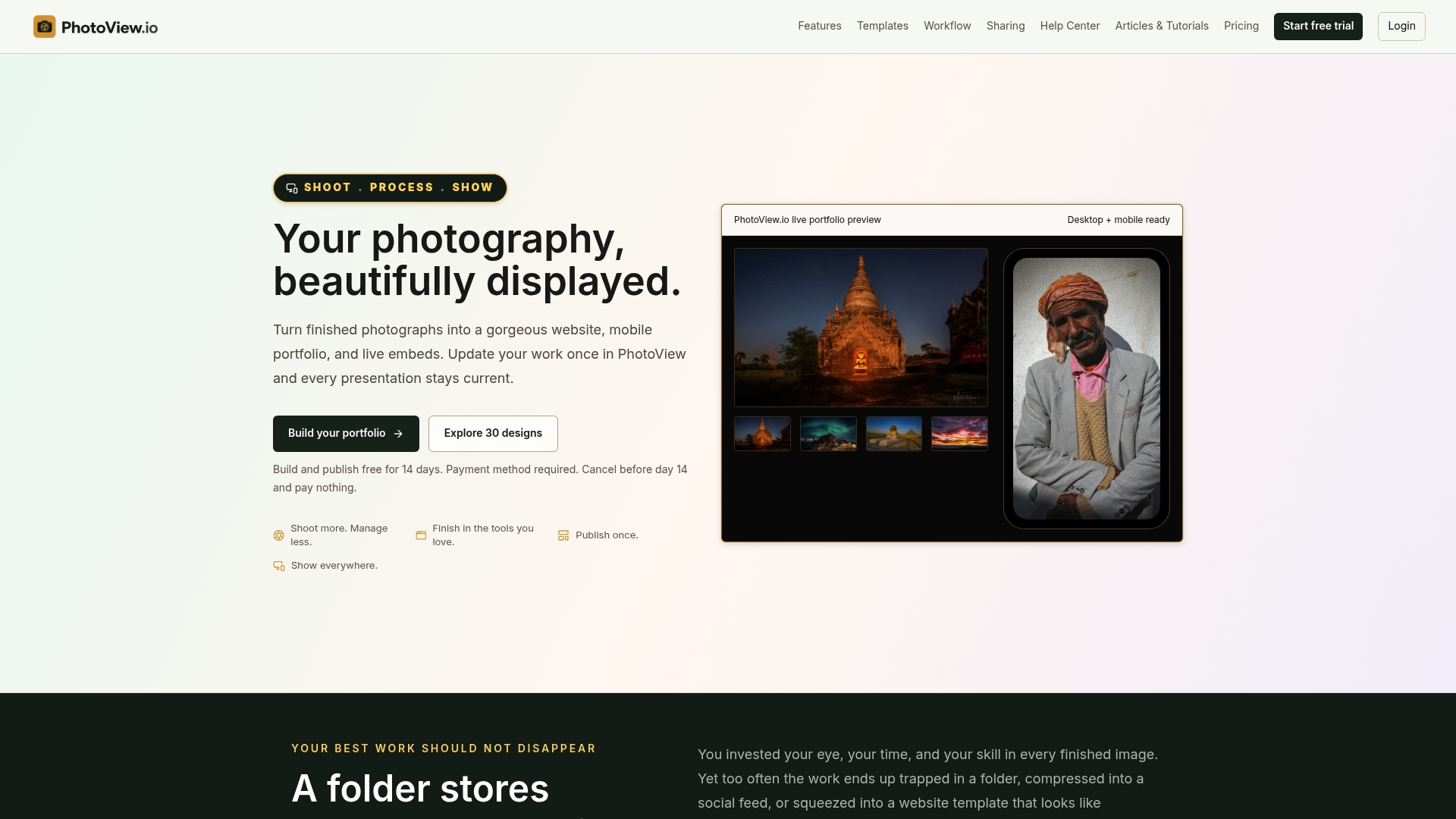
If you have made it this far, you already know the real cost of a Carbonmade alternative is not the subscription price, it is the hours you spend rebuilding galleries every time your work changes. PhotoView was built around the opposite workflow: update your source once, and let it show up everywhere your work needs to appear.
- Publish directly from Lightroom instead of manually exporting and re-uploading every update.
- Keep live embeds current on an existing site without touching that site’s code.
- Choose from more than 30 responsive templates included on every plan, no upcharge for design.
- Scale storage as your catalog grows, starting with affordable monthly and yearly plans and scaling up through higher tiers.
A custom-pricing option is also available for photographers with high-volume storage needs, details on request through PhotoView’s plans page. If design control matters more than publishing speed for your situation, a service like Coleman Web Design can build something fully custom, though it comes with the time and cost of a bespoke build rather than a ready template.
Start a trial and publish your first Lightroom collection to see how little maintenance a portfolio can actually require.
Where this comparison’s facts came from
- G2’s Carbonmade alternatives page groups competing tools by category, useful for separating discovery platforms from owned-site builders.
- FixThePhoto’s 2026 comparison tested multiple alternatives and matched them to specific photographer and designer use cases.
- WIRED’s portfolio roundup lays out the trade-off between specialist portfolio tools and general site builders.
- Adobe’s Creative Cloud plan documentation clarifies how Adobe Portfolio’s value depends on your existing subscription tier.
Sources
- Carbonmade competitors & alternatives | G2
- 11 Best CarbonMade Alternatives Worth Switching To
- The best websites to show off your portfolio of work | WIRED
- Changes to Creative Cloud for individuals plans including students and teachers plans | Adobe Account
FAQ
What does Carbonmade cost per month?
Carbonmade’s own pricing is not listed in the sources used for this comparison, so check Carbonmade’s current pricing page directly before comparing it against alternatives. What matters more for your decision is comparing total cost against storage limits and publishing features, not just the sticker price.
What is the cheapest way to get Adobe Portfolio?
Adobe Portfolio is bundled into a Creative Cloud subscription rather than sold as a standalone product, so the cheapest route is through whichever Creative Cloud plan you already need for apps like Lightroom or Photoshop. If you do not already use Creative Cloud apps, paying for the bundle just to get Portfolio usually costs more than a dedicated portfolio platform.
What is the best portfolio site overall?
There is no single best portfolio site, the right one depends on whether you prioritize ownership, publishing speed, discovery, or design control. For photographers who want to publish once from Lightroom and have it update everywhere without manual rebuilding, PhotoView is the strongest fit among the options covered here.
What are the best Adobe-compatible portfolio platforms?
Adobe Portfolio itself is the most tightly integrated option since it publishes directly from Lightroom and connects to Behance for added exposure. Outside Adobe’s own ecosystem, platforms like PhotoView and Format also support Lightroom-based publishing workflows, so you are not locked into a Creative Cloud subscription just to get that convenience.
How do I migrate my portfolio from Carbonmade to a new platform?
Export or download your existing images and project details from Carbonmade before canceling the account, then set up your domain and rebuild your strongest galleries first on the new platform. If your new platform supports direct Lightroom publishing, connect that before migrating the rest of your catalog to avoid uploading the same images twice.