
Photographers: 5 Step AI Caption Workflow and Ready to Use Prompts
Tool-agnostic, 5-step workflow to turn photos into post-ready AI captions. Includes ready-to-copy prompts, before/after edits, accessibility and privacy tips.

Photographers: 5 Step AI Caption Workflow and Ready to Use Prompts
AI can turn any photo into a handful of caption ideas in seconds, but the drafts rarely work as-is. Expect fast scaffolding, not finished copy: you still need to edit for accuracy, add a real story detail, and match the length and tone of the platform you’re posting to. Below, we walk through the exact workflow, prompt templates, and legal reminders that turn a quick AI draft into something worth posting.
TL;DR:
- AI generates usable caption drafts quickly, but editing is essential to add story details, improve accuracy, and match platform tone and length.
- Crafting specific prompts with subject, mood, audience, and a unique detail produces much better captions than generic instructions.
- Different platforms require tailored caption styles and formats, making rewriting necessary when repurposing content across channels.
- AI alt text often describes just visible objects and needs manual enhancement to provide context and emotional meaning for accessibility.
- Before uploading sensitive images, verify AI privacy policies, ownership rights, and disclose any paid partnerships or free product mentions in captions.
PhotoViewPresent Your Best Work BeautifullyKeep refined captions alongside securely stored photos, curated galleries, and mobile-ready presentations from one organized dashboard.Visit PhotoView
Table of Contents
- How to generate a caption from a photo step by step
- Proven prompt templates and examples to get better AI captions
- Adapting captions for Instagram, TikTok, LinkedIn, and X
- Making AI alt text and captions work for accessibility
- Privacy and disclosure rules worth knowing before you post
- Using AI captions without losing your photographic voice
- What AI captioning gets overrated, and what actually matters
- PhotoView: a home for your refined captions and finished galleries
- FAQ
- Sources
How to generate a caption from a photo step by step
Generating a usable caption takes five steps, whether you’re using a dedicated caption tool or a general AI chat assistant.
- Pick your tool and check the basics. Confirm image size limits and read the privacy policy before uploading anything client-related or unreleased.
- Upload the photo or paste a link, then set the platform and tone. Most tools ask you to specify Instagram, TikTok, LinkedIn, or X up front, and that choice shapes the whole draft.
- Add a short prompt describing subject, audience, and voice. A vague prompt gets a generic caption; a specific one gets something closer to post-ready.
- Generate a few options, then pick two or three to edit. Add a detail only you know (where you were standing, what happened right before the shot, why it mattered).
- Copy the final version into your scheduler, or save it for reuse. A caption that works well for one post often becomes a template for similar ones later.
The steps stay the same across tools, but understanding what AI-generated content and its SEO impact means can help you make smarter choices. What changes is how well you write the prompt in step three, which is where most of the quality gap lives.
Proven prompt templates and examples to get better AI captions
A strong prompt gives the AI five things: the subject, the mood or tone, the audience, one narrative detail only you know, and your preferences for length, emojis, and hashtags. Leave any of these out and the output drifts toward generic phrasing.
- Subject: what’s actually in the frame, stated plainly (a sunrise hike, a product shot, a client portrait).
- Mood or tone: playful, reflective, professional, or cinematic.
- Audience: your followers, potential clients, a specific niche community.
- Narrative detail: the one fact a stranger looking at the photo couldn’t know.
- Format preferences: target length, whether you want emojis, and how many hashtags.
A quick Instagram prompt might read: “Write a short, warm caption for a photo of a golden retriever puppy on a beach at sunset. Audience is dog lovers. Mention this is her first time seeing the ocean. Keep it under 150 characters, one emoji, no hashtags.” For a storytelling caption, you’d extend that with more context: “Write a longer, reflective caption for a travel photo of a mountain village at dawn. Audience is travel enthusiasts who follow slow travel content. Mention I’d been hiking for six hours and almost turned back. Include a question at the end to invite comments.”
For accessibility, use a separate prompt built for alt text: “Describe this image for a screen reader. Focus on who is in the photo, what they’re doing, and why it matters, not just the objects visible.”
Here’s the difference editing makes. Raw AI output: “A beautiful sunset over the ocean with waves crashing on the shore.” Edited: “Six hours of hiking led to this. She’d never seen the ocean before, and honestly, neither had I seen her this happy. Where’s your favorite first-time view?” The edited version adds a story and a reason to comment. Canva’s caption guidance and Buffer’s prompt library both point to the same pattern: specific prompts produce specific drafts, and the best captions still get a human pass before posting.
Pro Tip: Keep your three best prompt templates saved in a notes app so you’re not rebuilding them from scratch every time you post.
Adapting captions for Instagram, TikTok, LinkedIn, and X
The same photo needs different captions depending on where it’s posted. Instagram allows a large number of characters, but best practice is to keep key info at the beginning to avoid truncation, but the first line still carries the most weight since longer captions get truncated in feed view, so put your hook and key information first and follow with a short story and a few relevant hashtags.
- Instagram: lead with a hook, add one to two lines of story, close with a few hashtags and an optional emoji or two.
- TikTok: keep it conversational and short, written like you’re talking to a friend, and leave room to reference a trending sound or format.
- LinkedIn: write in full sentences with a professional angle, skip the emoji stack, and use at most one or two hashtags if any.
- X: cut everything down to a single punchy line, and if the thought needs more room, split it into a thread rather than cramming it into one post.
If an AI draft reads well for Instagram but you’re reposting to LinkedIn, don’t just copy and paste. Rewrite the opening line to drop the casual tone and add a sentence of professional context instead.
Making AI alt text and captions work for accessibility
AI-generated alt text is usually accurate but shallow: it describes what’s visible without explaining why the image matters. WCAG guidance on captions makes the distinction clear: alt text should convey the image’s equivalent purpose for someone who can’t see it, not just list the objects in frame. “A dog on a beach” is accurate and incomplete. “A golden retriever puppy experiencing the ocean for the first time, ears back, mid-run toward the waves” gives a non-sighted reader the same emotional context a sighted viewer gets instantly.
- Check who or what matters most in the frame and name it directly.
- Add context the AI can’t infer, like the occasion or the relationship between subjects.
- Avoid repeating information already stated in the surrounding caption text.
Many Americans care about knowing when content is AI-made: [Pew Research found that 76% of U.S. adults](https://www.pewresearch.org/science/2025/09/17/how-americans-view-ai-and-its-impact-on-people-and-society/?eicker.news=) say it’s important to be able to tell whether pictures, videos, or text were made by AI, while 53% say they lack confidence in their own ability to detect it. That gap is exactly why a human edit pass and, where relevant, a brief disclosure matter more than the tool you pick.
Privacy and disclosure rules worth knowing before you post
A few rules keep AI-assisted captions out of compliance trouble. If a caption promotes a paid partnership or a product you received for free, the FTC’s endorsement guidance requires a clear, conspicuous disclosure inside the content itself. A platform’s automated “paid partnership” tag doesn’t reliably satisfy that requirement on its own, so state the relationship plainly in the caption when it applies.
Before uploading anything sensitive, check whether your AI tool stores images or trains on uploads. And if the photo involves a client, a model, or a paid product, confirm you have the rights to post it before any caption goes live, regardless of how good the draft reads.

Using AI captions without losing your photographic voice
AI is scaffolding, not a finished product. The fastest path to a caption that still sounds like you is to generate a few drafts, then rewrite the opening line and add one detail no algorithm could know: the weather that almost ruined the shoot, the three takes it took to get the expression right, the joke that made the moment.
We’ve found the photographers who do this well keep a small bank of refined captions inside the same platform where they manage their images, so a caption that worked once can be reused or adapted for a similar post later instead of rewritten from scratch. That consistency in voice matters more over time than any single clever line.
— Mitch Russo
What AI captioning gets overrated, and what actually matters
The caption generator itself is the least interesting part of this process. Most tools produce similar quality once you give them a decent prompt, so chasing the “best” AI caption tool wastes time that’s better spent writing a sharper prompt or adding a better story detail.
What the conventional advice gets wrong is treating caption length and hashtag count as the main lever. They’re not. The detail that makes a caption worth reading is almost always something only the photographer knows: what happened off-camera, why the shot mattered, what almost didn’t happen. AI can’t generate that because it wasn’t there.
If you only change one thing about how you use these tools, make it this: stop asking for a “better” caption and start feeding the prompt a specific detail from the moment. The output improves more from a sharper input than from switching tools. Editing for voice and disclosure should happen every time, not just when you remember to.

PhotoView: a home for your refined captions and finished galleries
Generating captions is one piece of the workflow. Storing the good ones and getting them in front of the right audience is the other, and that’s where our platform fits. Photographers use PhotoView to store and organize finished photos and videos, publish through responsive portfolio templates, and keep galleries updated from a single dashboard instead of rebuilding a website every time new work goes up.
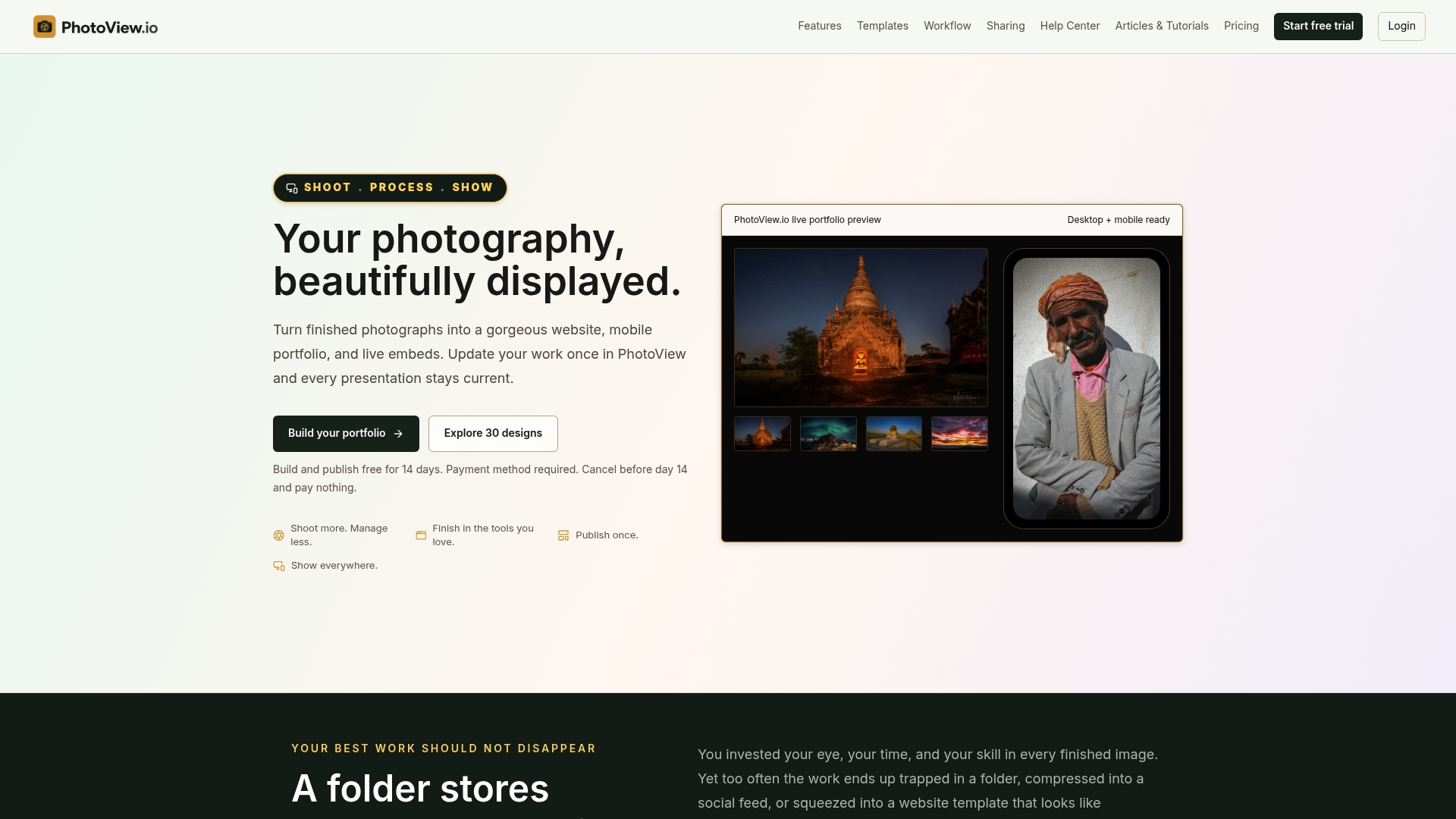
Pairing AI-assisted captioning with PhotoView looks like this in practice:
- Publish directly from Lightroom and keep your portfolio gallery current without manual exports.
- Store your refined captions alongside the matching images in your organized portfolio storage for easy reuse.
- Run social campaign tools to push a finished caption and image out together, instead of managing the two separately.
- Keep private galleries for client review using private sharing built for photographers before anything goes public.
If you’re tired of managing a website alongside your image library, visit the platform’s website to see the plans and start a free trial.
FAQ
Can AI really generate a good caption from just a photo?
AI can generate several usable caption drafts from a single photo almost instantly, especially with a specific prompt describing subject, audience, and tone. The output still works best as a starting point: Canva’s guidance recommends editing in a story detail and placing key information early so it doesn’t get cut off on platforms like Instagram.
How many hashtags should I use with an AI-generated caption?
For Instagram, a few relevant hashtags tend to work better than a long list, according to Canva’s caption best practices. Other platforms like LinkedIn and X generally call for far fewer, often one or none.
Do I need to disclose that a caption was written with AI?
Disclosure isn’t automatically required just because AI helped draft the wording. It becomes a requirement under FTC endorsement guidance when the caption involves a paid partnership or free product, in which case the relationship needs to be stated clearly in the caption itself.
Why does AI alt text sometimes miss the point of a photo?
AI alt text tends to describe only what’s visibly in the frame rather than the image’s purpose or context. WCAG guidance recommends editing alt text to convey who is in the image, what’s happening, and why it matters, not just a literal object list.
What should I check before uploading a private or client photo to an AI caption tool?
Check the tool’s privacy policy to see whether it stores uploaded images or uses them for training before sending anything client-related or unreleased. Confirm you have the rights to post the image in the first place, separate from any caption-writing step.
Sources
- Image to Caption Generator: Create captions with AI | Canva
- How Americans view AI and its impact on people and society | Pew Research Center
- FTC’s endorsement guides — what people are asking
- Understanding: Captions (pre-recorded) — WCAG 2.2
- 350+ Instagram caption ideas (+ how to use AI to write yours) | Buffer