
Lightroom Publishing First: PhotoShelter Alternatives for Photographers
Compare PhotoShelter alternatives that prioritize Lightroom publishing, private proofing, and portfolio presentation. Migrate one test shoot first.

Lightroom Publishing First: PhotoShelter Alternatives for Photographers
For portfolio-first professional photographers, PhotoView is the strongest PhotoShelter alternative, built around Lightroom publishing and client-ready galleries. If proofing and print sales matter more than portfolio design, look at ShootProof or Zenfolio. If you’re managing brand assets across a marketing team, an enterprise DAM like Bynder or Canto fits better than any photographer-first tool.
TL;DR:
- PhotoView offers seamless Lightroom publishing with automatic gallery updates and over 30 responsive templates, ideal for portfolio-focused photographers.
- Platforms like ShootProof and Zenfolio integrate proofing and sales tools, making them better suited for client delivery and e-commerce workflows.
- Metadata preservation during migration is a common failure point, so testing export/import with a representative shoot ensures data integrity before full transition.
- Larger teams or those with strict brand governance should consider enterprise DAMs like Bynder or Canto, which provide workflow automation and asset control.
- Free tools like Flickr and Google Photos are suitable for community sharing but lack the advanced presentation, proofing, or team management features needed by professionals.
PhotoViewPresent Your Work More BeautifullyPhotoView brings Lightroom publishing, responsive portfolio templates, private sharing, and live website updates into one photographer-focused platform.Explore PhotoView
Table of Contents
- What Are the Best PhotoShelter Alternatives for Photographers?
- How Do These Platforms Compare Side by Side?
- How Should You Choose the Right Alternative?
- Why PhotoView Is Built for This Exact Job
- When Does a Portfolio Platform Beat an Enterprise DAM?
- Ready to Move? Here’s What Makes PhotoView the Practical Choice
- Sources
- FAQ
What Are the Best PhotoShelter Alternatives for Photographers?
Photographers leave PhotoShelter for different reasons than marketing teams do. Some want a cleaner, more cinematic way to show finished work. Others need proofing and sales tools baked into client delivery. A few have outgrown a photographer-first tool entirely and need something built for cross-team asset governance. The right pick depends entirely on which of those jobs you’re solving.
Here’s a shortlist worth evaluating, organized roughly by who each one serves best.
PhotoView is a portfolio-first presentation platform built for photographers who want their finished work to look as good as the shoot itself. It publishes directly from Lightroom, so you can push edited selects into a live gallery without exporting, renaming, or re-uploading anything twice. Smart Folders keep galleries updated automatically as you add new images to a source folder, and private sharing lets you send password-protected proofing links to clients without exposing a public URL. PhotoView offers more than 30 responsive templates, custom domains, and mixed-media galleries for photographers who shoot both stills and video. Storage-based subscription tiers scale with your archive, and a free trial lets you test the Lightroom publish workflow before committing.
SmugMug leans hardest into print fulfillment. If a meaningful share of your income comes from selling prints and products directly off your site, SmugMug’s storefront customization and lab integrations are hard to beat. It’s less focused on cinematic portfolio presentation and more on turning a gallery into a functioning shop.
ShootProof is built for the booking-to-delivery pipeline: contracts, proofing galleries, and client sales in one place. Wedding and portrait photographers who need clients to select and pay for images through the same platform they were proofed on tend to gravitate here.
Zenfolio bundles a full website builder with commerce features, positioning itself as an all-in-one option for photographers who want one subscription covering site, sales, and client galleries rather than stitching several tools together.
Adobe Photoshop Lightroom Classic isn’t a hosting platform, but plenty of photographers list it as their real PhotoShelter substitute because so much of their organizational work already happens there. Its catalog system and local library management are strong enough that some photographers skip a separate DAM entirely and just publish selects outward, which is exactly the workflow PhotoView’s Lightroom plugin is built to support.
Flickr remains a legitimate option if community exposure matters more than portfolio polish. PCMag’s testing still ranks Flickr and Google Photos among the top picks for general photo storage, largely on the strength of smart search and simple sharing rather than presentation.
Adobe Bridge is free and Adobe-native, making it a reasonable local metadata manager for teams already deep in Creative Cloud. It won’t publish a public gallery, but it handles batch renaming, keywording, and metadata review well.
Cloudinary is a different animal: a programmatic, automation-heavy DAM built for developers and technical teams. It handles image and video optimization and CDN delivery at scale, which matters if your assets feed a website, app, or ecommerce catalog rather than a photography portfolio.
Canto and Bynder both serve mid-market and enterprise brand teams that need governed asset libraries, not photographer portfolios. Canto focuses on brand portals and metadata search; Bynder adds workflow automation and brand governance for larger marketing organizations.
MediaValet targets large organizations with high-volume media libraries and heavier integration needs, while Dropbox and Google Drive remain the default fallback for teams that just need reliable backup and sharing without any real DAM structure.
For photographers who want zero dependency on any vendor’s cloud, self-hosted projects built on tools like Immich let you keep master files under your own control, trading convenience for full ownership of storage.
How Do These Platforms Compare Side by Side?
The differences that actually matter come down to five questions: how storage is priced, whether client galleries and proofing exist, how well the platform talks to Lightroom, whether it has real DAM structure for teams, and what it integrates with.
| Platform | Storage/pricing model | Client galleries & proofing | Lightroom integration | Team/DAM features | Third-party integrations | Best for |
|---|---|---|---|---|---|---|
| PhotoView | Tiered subscription by storage volume | Private sharing, proofing-ready galleries | Direct publish plugin | Smart Folders, mixed media, access controls | Custom domain, live embeds, social campaigns | Portfolio-first photographers publishing and proofing work |
| SmugMug | Tiered annual plans | Client galleries with print ordering | Plugin support | Basic organization | Print lab integrations | Photographers selling prints and products |
| ShootProof | Tiered plans, storage add-ons | Full proofing, contracts, sales | Plugin support | Limited | Payment processors | Freelancers running bookings through delivery |
| Zenfolio | Tiered plans with commerce | Client galleries, sales | Plugin support | Limited | Basic ecommerce | All-in-one site plus sales |
| Adobe Lightroom Classic | One-time or Creative Cloud subscription | None (local only) | Native | Strong local catalog, no cloud DAM | Adobe ecosystem | Editing and tethered workflows |
| Flickr | Free tier plus paid plans | Basic sharing | None | Minimal | Social sharing | Community exposure, casual hosting |
| Cloudinary | Usage-based, developer pricing | None | None | Programmatic tagging, automation | CDN, APIs, ecommerce platforms | Automated delivery and dev integrations |
| Canto | Tiered by users/storage | None | Limited | Brand portals, metadata governance | CMS, marketing tools | Mid-sized brand teams |
| Bynder | Enterprise custom pricing | None | Limited | Full governance, workflow automation | Extensive enterprise stack | Large enterprises needing brand control |
| Dropbox | Tiered storage subscription | None | None | Minimal | Broad file-sync ecosystem | Simple backup and sharing |
Patterns emerge quickly once you line these up. Storage-only tools like Dropbox and Google Drive are cheap and familiar, but they offer zero presentation layer. Proofing-heavy platforms like ShootProof and Zenfolio add sales infrastructure but rarely match a dedicated portfolio tool on visual presentation. Enterprise DAMs solve governance problems photographers don’t have and charge accordingly.
The migration risk that trips up the most photographers isn’t pricing. It’s metadata. Moving thousands of images between platforms can silently strip IPTC and XMP fields: captions, keywords, GPS data, and creation dates. Research on brand-focused PhotoShelter alternatives flags this as a common failure point, and once metadata is gone, you’re stuck scripting bulk fixes after the fact instead of before.

Pro Tip: Before committing to any platform, migrate one representative shoot first, not your whole archive. Check that captions, keywords, and capture dates survive the round trip intact. If a vendor’s import process quietly drops fields, you’ll want to know that on a 40-image test, not a 40,000-image one.
Teams with ecommerce needs face a related but different problem. Dash’s comparison of DAM alternatives points out that Shopify and WooCommerce integrations, branded client portals, and AI auto-tagging matter far more to ecommerce teams than to individual photographers, which is exactly why those teams end up shopping in a different product category entirely.
How Should You Choose the Right Alternative?
Start by naming the actual job, not the feature list. A wedding photographer proofing 800 images for a couple has a different job than a marketing team managing 40,000 product shots across five brands. Comparative reviews of PhotoShelter competitors consistently split the market into portfolio-first platforms, proofing-focused services, and enterprise DAMs, and mixing up which category you need is the single most common mistake buyers make.
Once you know the job, run every finalist through the same set of questions:
- Can you export everything you own, in a usable format, at any time? If a vendor makes export difficult or slow, that’s a warning sign regardless of how good the interface looks today.
- Does the platform preserve IPTC and XMP metadata on both import and export? Ask for a test account and verify this yourself rather than trusting the sales page.
- How granular are roles and permissions? A solo photographer needs simple private/public toggles; a five-person studio needs actual role-based access.
- Where does the CDN sit, and how fast do galleries load on mobile? Slow-loading portfolios lose client trust fast, especially on a phone at a coffee shop.
- What’s the backup and redundancy story? Ask directly what happens if their storage provider has an outage.
- What does the pricing structure punish? Some platforms charge reasonable base rates but bill aggressively for storage overages or bandwidth spikes.
- What does it integrate with? Lightroom publishing, ecommerce platforms, and CMS embeds matter differently depending on your workflow.
Run a real migration pilot before switching entirely. Pick one shoot that represents your typical file sizes, keyword depth, and folder structure. Import it, export it, and compare the metadata field by field. Test both a public gallery link and a private, password-protected one, since permission bugs often surface only in the private flow. Confirm your Lightroom catalog actually publishes cleanly if that’s part of your workflow, not just that the plugin installs.
Why PhotoView Is Built for This Exact Job
PhotoView’s Lightroom publishing plugin exists because serious photographers already do their organizational work in Lightroom, and a separate upload step is friction that shouldn’t exist. Smart Folders extend that same idea: connect a folder once, and new selects flow into your live gallery without a manual re-upload every time you finish an edit.
The platform’s core strengths line up directly with what photographers actually ask for:
- Direct Lightroom publish, so edited selects go live without export and re-upload steps
- Smart Folders that keep galleries current automatically as your local library changes
- Private, password-protected sharing for client proofing without a public link
- More than 30 responsive portfolio templates plus custom domain support
- Mixed-media galleries for photographers who shoot both stills and motion
- Storage plans that scale with your archive rather than forcing an early upgrade
PhotoView’s free trial is the practical way to test the metadata and Lightroom questions raised earlier before you migrate anything permanent.
When Does a Portfolio Platform Beat an Enterprise DAM?
Team size and asset mix tell you almost everything you need to know here. A solo photographer or a small studio, shooting mostly stills with the occasional video reel, rarely needs role-based governance or automated tagging across thousands of contributors. That’s an expensive solution to a problem you don’t have.
Enterprise DAMs like Bynder, Canto, or MediaValet earn their complexity when you’ve got multiple teams pulling from a shared library, brand compliance requirements, and asset types beyond photography: logos, video, PDFs, templates. If governance and access control keep coming up in your actual complaints about your current tool, that’s the signal to move toward DAM territory, not away from it.
Speed-to-publish is the tiebreaker I’d weigh most heavily. If your business depends on getting new work in front of clients fast, a photographer-first platform with direct Lightroom publishing will almost always beat a DAM’s multi-step approval workflow. Delay migration only when your current tool’s pain is cosmetic. Migrate when it’s structural.
— Mitch Russo
Ready to Move? Here’s What Makes PhotoView the Practical Choice
PhotoView is the alternative built for photographers who want their portfolio to look finished the moment the edit is, not three export steps later. The combination that matters most: publish straight from Lightroom, choose from more than 30 responsive templates, and send clients private proofing links without exposing a public gallery URL.
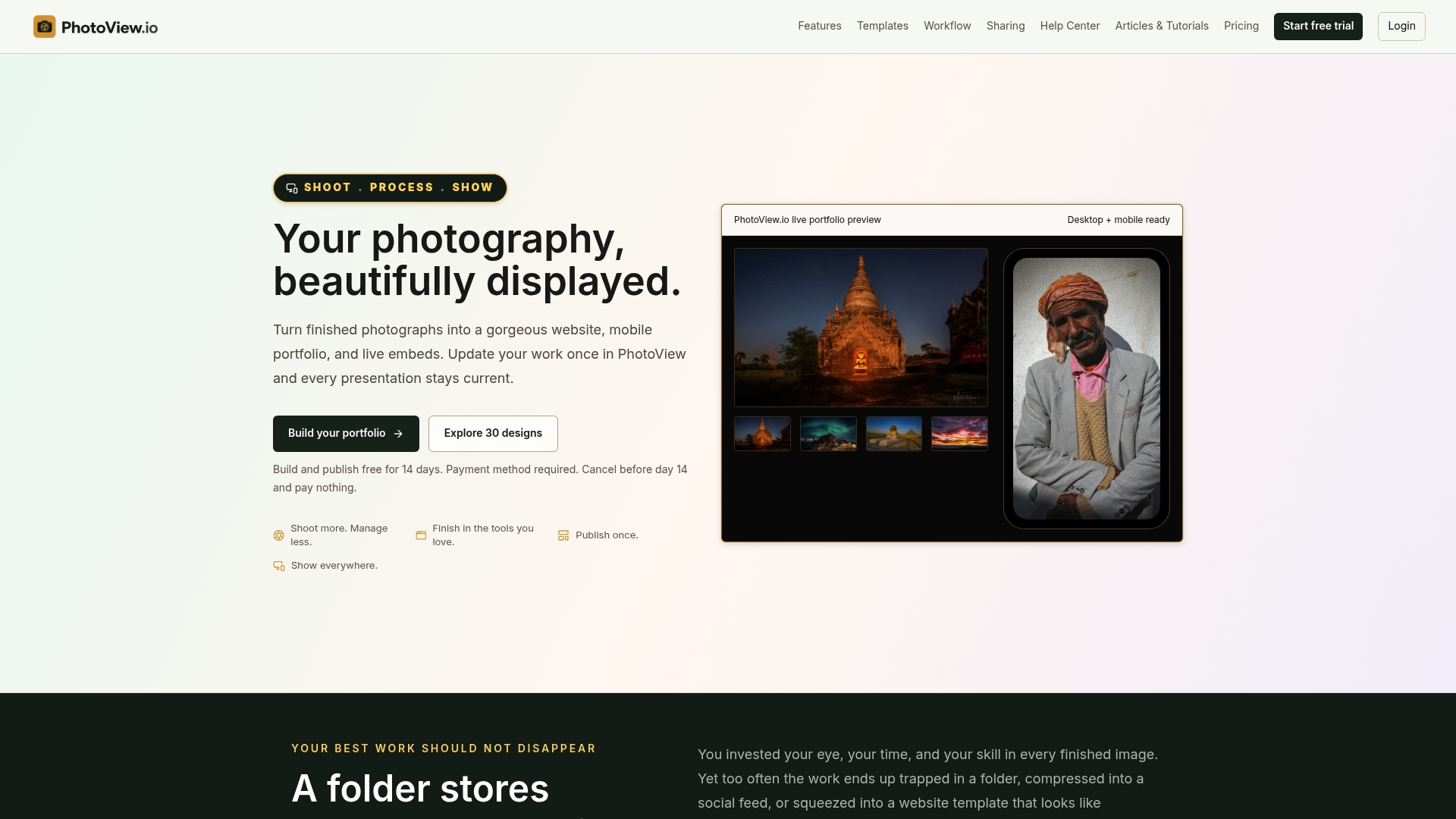
That combination solves the three things this article kept circling back to. Direct Lightroom publishing removes the export-and-reupload friction that eats a photographer’s time. The template library handles presentation without requiring design skills. Private sharing handles proofing without needing a separate proofing tool bolted on. If organic discovery for your published portfolio matters too, pairing your site with photography-specific SEO support rounds out the picture.
Start a free trial and run the exact migration test described earlier: import one representative shoot, check your metadata survives the round trip, and confirm your Lightroom catalog publishes the way you need it to before you commit anything permanent.
Sources
- Best PhotoShelter for Brands alternatives
- The Best Online Photo Storage Services We’ve Tested for 2026 | PCMag
FAQ
Is PhotoShelter Worth It?
PhotoShelter suits photographers who only need basic hosting and sales tools, but many professionals outgrow its photographer-first design once they need broader asset support, deeper Lightroom publishing, or team-level DAM features.
What Is the Best Free Photo Sharing Site?
Flickr and Google Photos remain the top free options for general photo storage and sharing, according to PCMag’s testing, though neither offers the portfolio presentation tools professional photographers typically need.
Why Are People Leaving Flickr?
Many photographers find Flickr’s community focus works against professional presentation. It’s built for sharing and discovery, not for curated, branded portfolios or client proofing.
How Expensive Is PhotoShelter?
PhotoShelter’s plans are priced by storage tier and feature set, similar to most portfolio platforms, though exact current pricing should be confirmed on its own site since plans change over time.
Which PhotoShelter Alternative Is Best for Client Proofing?
ShootProof and Zenfolio both build proofing and sales directly into client delivery, while PhotoView’s private sharing supports secure proofing links for photographers who prioritize portfolio presentation alongside proofing.