
Pick a Picflow Alternative by Job: 3 Trial Tasks for Your Studio
Replace Picflow with a category first approach: choose by the job to be done, run three trial tasks in 7–14 days, and test PhotoView for portfolio delivery.

Pick a Picflow Alternative by Job: 3 Trial Tasks for Your Studio
If your priority is polished client delivery with stores and embeds, choose a gallery-and-delivery platform. If you need collaborator feedback and version control, choose an active proofing tool. If your team searches a large archive daily, choose a searchable catalog. Run a focused 7 to 14 day trial on three tasks before switching, and consider PhotoView as a portfolio-first option worth testing directly.
TL;DR:
- Choose a gallery-and-delivery platform if your priority is polished client handoffs with branding, print stores, and embedded galleries, especially for final product delivery.
- Opt for an active proofing tool if your workflow involves multiple review rounds, annotations, comment threads, and version history for heavy collaboration.
- Use a searchable archive or DAM system when managing a large, multi-year photography archive that requires quick, cross-project search capabilities.
- Test three core tasks—uploading a RAW set, running a client approval with annotations, and embedding a gallery—during a trial to evaluate workflow fit and performance.
- Ensure your selected platform offers scalable storage, clear data portability, and meets security requirements, especially for sensitive or unreleased work.
PhotoViewPresent Your Work From One DashboardPhotoView helps photographers store, curate, and publish portfolios, galleries, and mobile-ready presentations from one organized platform.Explore PhotoView
Table of Contents
- Why photographers look for Picflow alternatives
- The three solution shapes that replace Picflow
- Feature checklist by category: core evaluation axes and trade-offs
- How to choose the right Picflow alternative for your studio
- What reviewers and practitioners say
- Pricing comparisons and cost structures of Picflow alternatives
- User experience and interface differences among alternatives
- Security and privacy features of each alternative
- Scalability and storage upgrade options
- Support and customer service quality and availability
- Author perspective: recommended route for most studios and where PhotoView fits
- Try PhotoView: what it offers and how to get started
- Sources
- FAQ
Why photographers look for Picflow alternatives
Most searches for a replacement start with a specific frustration, not a general dissatisfaction. Some photographers outgrow the storage tier they started on. Others need print fulfillment or a storefront built into the delivery step, not bolted on later. Teams handling multiple shooters often want a searchable archive instead of scattered galleries, while studios doing heavy client revisions want stronger annotation and approval tools.
It helps to separate a missing feature from a change in the job itself. A missing feature means the current tool almost fits, you just need one more capability. A changed job means the tool was never built for what you now do, and no amount of settings tweaking will fix that.
Three quick examples show the difference:
- A wedding photographer delivering final galleries with print sales needs a gallery-and-delivery platform, not more proofing rounds.
- A commercial studio running three revision cycles per shoot needs active proofing with annotations and version history.
- An agency managing a five-year archive across shooters needs a searchable catalog, not another delivery link.
Reviewer roundups on sites like G2’s alternatives page consistently show buyers evaluating by category first, then narrowing by feature and price within that category.
The three solution shapes that replace Picflow
Once you know your job-to-be-done, the category choice gets simple. Photography delivery tools split into three broad shapes, and each is built around a different workflow.
- Gallery-and-delivery platforms handle final handoff: polished templates, client download links, print stores, and live embeds for a website or portfolio. These fit photographers whose main job is presenting finished work beautifully, not managing rounds of feedback.
- Active proofing platforms are built for back-and-forth collaboration: annotations, comment threads, version history, and formal approval steps. These suit studios and agencies where a client or art director needs to mark up images before final selection.
- Searchable catalogs or DAM systems add AI tagging and cross-project search across a growing archive. Teams that need to find “that shoot from two years ago” quickly, rather than deliver a single project, belong here.
Practitioner guidance from Tagrly’s comparison of Picflow alternatives draws this same line: gallery-and-delivery is the lateral swap from Picflow because it serves the same job, active proofing is a specialized upgrade for heavy revision cycles, and a searchable catalog is a genuine category change that only makes sense when archive search is the actual bottleneck.
The selection criteria boil down to one question: are you handing off finished work, collaborating through edits, or hunting through history? Answer that honestly before you look at a single vendor page.
Pro Tip: Write down your last three client complaints about your current delivery process. The pattern usually points straight to the category you actually need.
Feature checklist by category: core evaluation axes and trade-offs
Comparing tools feature by feature without a shared framework wastes time. Score every candidate against the same axes, in the same order, for every tool on your shortlist.
- Core job fit: does the platform’s default workflow match delivery, proofing, or archive search?
- Proofing and collaboration: are annotations, comment threads, and approval steps built in, or bolted on as an add-on?
- Delivery and sales: does it support print stores, download links, and client-facing branding?
- Storage and media support: what are the limits on RAW files, video, and 4K assets?
- Integrations: does it publish directly from Lightroom or Capture One, or require manual export and upload?
- Embed capability: can you drop a live, responsive gallery into an existing website without rebuilding it?
- Pricing model and portability: is pricing based on storage, users, or projects, and can you export your data cleanly if you leave?
During a trial, run the same four tasks on every candidate: upload a 20 image RAW set and check fidelity and download speed, run a client approval round with annotations, embed a gallery and confirm it looks right on mobile, and test whether Lightroom or Capture One integration actually saves you a step rather than adding one. This task-based approach, recommended by Tagrly’s practitioner guide, surfaces real friction that a features list never shows.
Expect trade-offs. A platform built for advanced proofing often skips built-in storefronts, since its whole design points at collaboration, not sales. A gallery-and-delivery platform, in turn, may offer only basic commenting since its job is presentation, not revision management. Neither gap is a flaw. It is a sign the tool was built for a specific job, and you need to confirm that job matches yours before committing a year of client work to it.
How to choose the right Picflow alternative for your studio
A structured process beats trial-and-error switching, especially once client galleries and archives are involved.
- Define the job. Write one sentence describing what breaks most often in your current workflow.
- Shortlist by shape. Pick two or three tools from the category that matches that job, not a mixed bag of unrelated platforms.
- Run a focused trial. Spend 7 to 14 days testing the three checklist tasks: upload, proof, and embed.
- Evaluate against your notes, not against marketing copy or a sales call.
- Check export and data portability before you commit, so you are never locked in.
- Plan the migration, including how existing client links and galleries will transition.
- Communicate the switch to clients with a short notice and a working link before the old one goes dark.
When you talk to a vendor, ask direct questions: how is client data secured, what is the export process if you leave, does the platform integrate with your print lab, and what happens when you exceed storage limits. A vendor who cannot answer the export question clearly is a red flag on its own.
Other warning signs include no visible activity or approval logs, unclear overage fees buried in fine print, and no trial access to the specific features you actually need, like Lightroom publishing or embed tools.
Pro Tip: Give yourself a two-week overlap where both platforms are live before you retire the old one. It costs a little extra but prevents a client ever hitting a dead link.
What reviewers and practitioners say
Independent reviews back up the category-first approach. G2’s roundup of Picflow alternatives shows buyers weighing design and user experience heavily when picking a replacement, which tracks with the idea that fit, not feature count, drives satisfaction.
Gallery-and-delivery tools serve final client handoff, active proofing tools serve collaborative revision, and searchable catalogs serve archive-heavy teams. Choosing the wrong shape leads to a poor tool choice regardless of feature quality.
That distinction comes from Tagrly’s 2026 alternatives comparison, which also warns that picking a delivery tool when a team actually needs archive search creates real productivity loss over time.
On storage specifically, a comparison between Picflow and picdrop reports that Picflow’s free plan offers 2 GB of cloud storage, a gap reviewers flag as meaningful for photographers shooting in RAW. That kind of limit forces an early upgrade decision that some buyers do not see coming until they hit the wall mid-project.
Pricing comparisons and cost structures of Picflow alternatives
Pricing across this category generally follows one of three models: storage-based tiers, per-project fees, or per-user seats. Storage-based pricing suits solo photographers and small studios whose costs scale with how much they shoot. Per-project pricing suits studios with irregular volume, since you pay only when you deliver. Per-user seat pricing fits agencies and teams where several people need collaborative access to proofing tools.

Comparative reviews highlight storage as the single biggest cost driver. The Picflow versus picdrop comparison lists a notable gap between the two platforms’ storage limits, which matters more than the sticker price once you factor in RAW files and video.
PhotoView’s own pricing follows a storage-tiered structure: Starter at $3.99 per month or $39.99 per year, Growth at $5.99 per month or $59.99 per year, Studio at $7.99 per month or $79.99 per year, and Premier at $11.99 per month or $119.99 per year, with a Custom plan available for high-volume needs (pricing available on request). Every tier includes the full set of templates and portfolio features, so the upgrade decision comes down to storage volume rather than feature access, which simplifies budgeting for a growing studio.
User experience and interface differences among alternatives
Interface quality varies more than most feature lists suggest. Gallery-and-delivery platforms tend to prioritize a clean, image-first browsing experience for the client, since that is the moment that matters most to the photographer’s reputation. Active proofing platforms lean toward a denser interface, with visible comment threads, version markers, and approval buttons that support back-and-forth work but add visual clutter.
Searchable catalogs sit somewhere in between, often trading some visual polish for powerful filtering and search bars front and center.
None of these approaches is wrong. The mismatch happens when a photographer who needs quiet, cinematic presentation ends up on a tool built for dense collaboration, or when a team that needs fast search ends up on a platform optimized purely for pretty galleries. Testing the interface with your own images, not sample photos, during a trial is the only reliable way to know if moving through your work feels natural or if you are fighting the interface at every click.
Security and privacy features of each alternative
Client trust depends on how carefully a platform handles private galleries, especially for wedding and commercial photographers sharing unpublished work. At minimum, confirm that private galleries require a password or unique link, that you control who can download full-resolution files, and that you can revoke access after a project closes.
Ask every vendor directly how client data is stored and whether galleries are private by default or public unless changed, since the default setting matters more than most photographers realize until an unpublished shoot turns up somewhere it should not. Studios handling sensitive commercial work, like unreleased product photography, should also confirm whether the platform logs access activity, since that log is often the only way to trace a leak back to its source.
Scalability and storage upgrade options
A tool that fits your workflow today still needs room to grow. Storage-tiered platforms make scaling simple: you move up a plan as your archive grows, without changing how your galleries work or retraining your team. This matters most for photographers shooting increasing volumes of RAW files and video, where storage needs can double within a year or two.
Look for a clear upgrade path with no forced migration, meaning your existing galleries, embeds, and client links stay intact when you move to a higher tier. Custom plans, offered by several platforms in this category for high-volume studios, are worth asking about directly rather than assuming a published tier will always be enough. The scalability test during a trial is simple: upload more than you think you need and see whether the platform’s interface and speed hold up.
Support and customer service quality and availability
Support quality becomes obvious the moment something breaks during a client delivery deadline, which is exactly when you cannot afford a slow response. Before committing, test the support channel yourself: send a real question during your trial period and time the reply.
Look for documentation that actually answers common questions like embed troubleshooting or Lightroom publishing errors, since a strong knowledge base often resolves issues faster than waiting on a support ticket. Availability matters too. A platform with support hours that never overlap with your working hours will slow you down exactly when a client is waiting on a gallery link.
Author perspective: recommended route for most studios and where PhotoView fits
Wedding and portrait photographers usually need gallery-and-delivery tools built for polished final handoff. Editorial studios and agencies running multiple revision rounds benefit more from active proofing. Archive-heavy teams managing years of client work should look hard at a searchable catalog before anything else.
For photographers whose core job is presenting finished work beautifully across a website, mobile, and live embeds, a portfolio-first approach fits naturally. PhotoView’s Lightroom publishing and live embed tools speak directly to that job: update your work once, and it stays current everywhere it is shown.
Test any shortlisted tool against the checklist in this article before deciding. Run the same three tasks, upload, proof, embed, and let the results, not the marketing, make the call.
— Mitch Russo
Try PhotoView: what it offers and how to get started
If your priority is a portfolio that looks finished everywhere it appears, PhotoView is built around exactly that job. Lightroom publishing keeps your galleries current without re-uploading, Smart Folders keep large shoots organized automatically, and live embeds keep an external website in sync with your latest work from one dashboard.
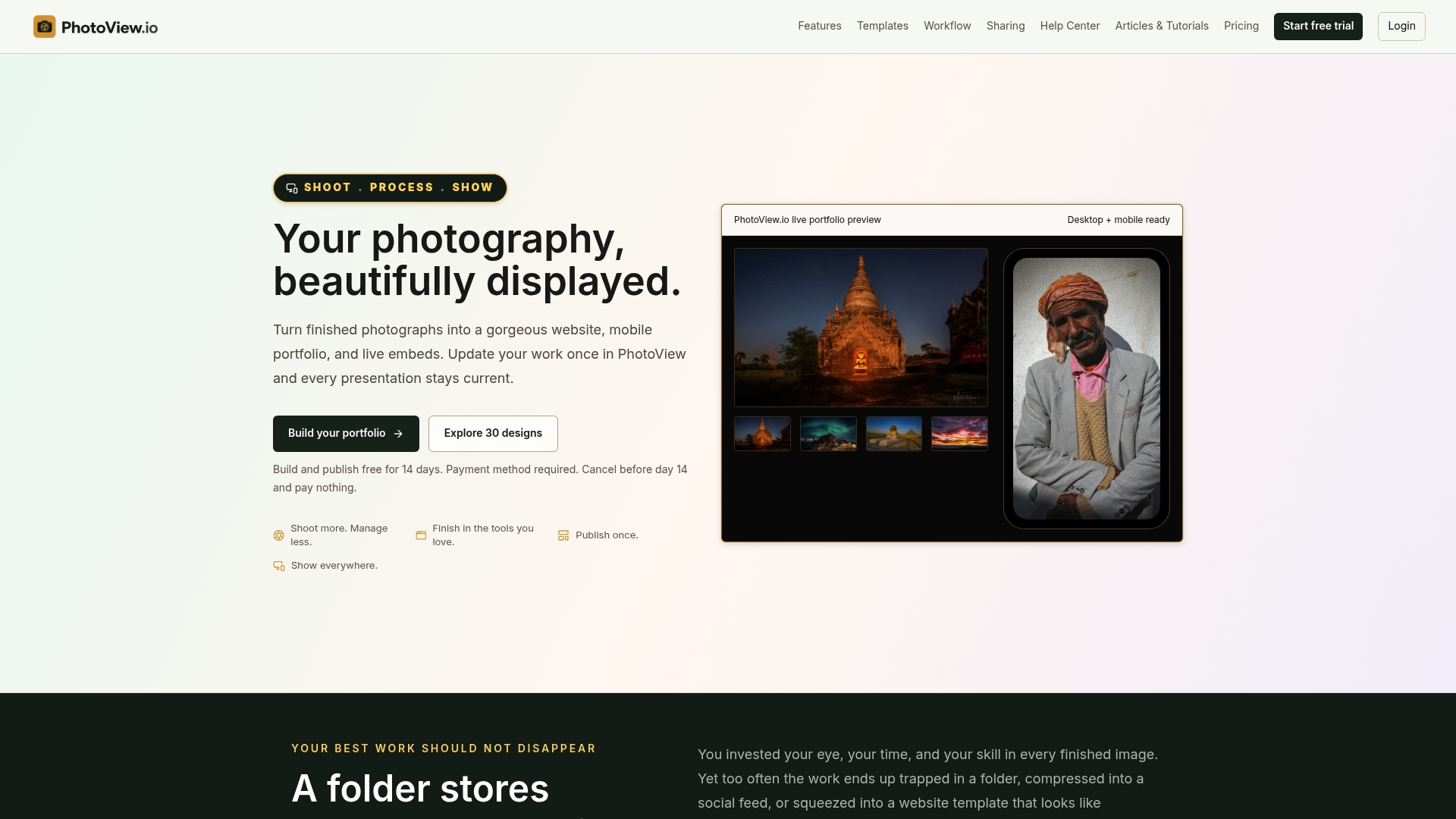
To try it against your own checklist:
- Start a trial and upload a real gallery, not sample images.
- Publish directly from Lightroom and confirm the workflow saves you a step.
- Embed a gallery on an existing page and check how it looks on mobile.
PhotoView’s plans scale by storage and features, with details and pricing available on their website. Visit Photoview to compare plans and start testing today.
Sources
For deeper comparisons, G2’s list of Picflow alternatives shows how buyers evaluate design and user experience across competing products. Tagrly’s practitioner comparison lays out the three-category taxonomy used throughout this article. For a closer look at storage and feature trade-offs, see the editor comparison of Picflow and picdrop. Photographers weighing presentation tools more broadly may also find this overview of digital showcase tools for professionals useful context.
- Top 10 Picflow Alternatives & Competitors in 2026
- Tagrly vs. Picflow: A 2026 Alternatives Comparison · Tagrly
- Picflow vs picdrop (2026): Which Is Better?
FAQ
Is there a free client gallery for photographers?
Several gallery-and-delivery platforms offer a free tier with limited storage, often around 2 GB according to one editor comparison, which suits occasional small shoots but fills quickly with RAW files. Photographers delivering regular client work typically outgrow a free tier within a few projects.
Is there a better alternative to Shutterfly?
Shutterfly is built primarily for print products and consumer photo sharing, not professional client proofing or portfolio presentation. Photographers needing branded galleries, Lightroom publishing, or live website embeds generally look toward dedicated gallery-and-delivery or proofing platforms instead.
What is Picflow?
Picflow is a client proofing and gallery delivery tool photographers use to share finished or in-progress work with clients for feedback and approval. Reviewers group it alongside other proofing and delivery platforms when comparing features like storage limits and collaboration tools, as seen in G2’s alternatives listing.
What are some good alternatives to Pixieset?
The right alternative depends on the job: photographers wanting stores and polished embeds should look at other gallery-and-delivery platforms, while teams needing heavier collaboration should consider active proofing tools instead. Product aggregator listings group several named options by capability, which is a useful starting point before running your own trial.
How do I choose between a proofing tool and a gallery platform?
Choose based on the job, not the feature list: pick a gallery-and-delivery platform for final client handoff and pick an active proofing tool when a project needs multiple rounds of feedback and formal approval. Practitioner guidance on Picflow alternatives recommends testing both shapes on real tasks, like uploading a RAW set and running an approval round, before committing to either.