
Photographers: Portfoliobox Alternatives That Keep Your Lightroom Workflow
Find Portfoliobox alternatives that prioritize photographer workflows — Lightroom publishing, private client proofing, live embeds, and a realistic 1–2...

Photographers: Portfoliobox Alternatives That Keep Your Lightroom Workflow
We’d point you first toward PhotoView if you need Lightroom publishing, private client galleries, and live embeds in one dashboard, since that combination is where photography-first workflows tend to break down on general builders. The trade-off is real: design simplicity on some platforms comes at the cost of workflow depth, and workflow depth sometimes asks more of you up front. Below, we walk through nine other serious contenders so you can match the platform to your actual priorities.
TL;DR:
- PhotoView offers seamless Lightroom publishing and Smart Folder syncing, allowing edits to update online without manual re-uploads or rebuilding pages.
- Platforms like Squarespace focus on design and e-commerce but lack photography-specific proofing and workflow integrations, making them less suitable for editing-heavy portfolios.
- Storage costs, media limits, and overage fees vary widely; testing full-resolution galleries and large files during trials provides the clearest performance picture.
- Support quality can differ significantly, with smaller, photography-focused platforms often offering faster, more specialized assistance compared to larger, general-purpose builders.
- Prioritizing metadata control and exportability over design is essential for scalability, to avoid costly re-tags or migration issues when expanding bookings or sales.
PhotoViewKeep Your Photography Workflow ConnectedPhotoView brings Lightroom publishing, private galleries, and live website embeds together, helping photographers manage presentations from one dashboard.
- ✓Lightroom publishing and Smart Folders
- ✓Private client galleries
- ✓30+ responsive portfolio templates
- ✓Live website embeds
Table of Contents
- Nine Portfoliobox Alternatives Worth Testing
- How Portfolio Platforms Stack Up on the Things Photographers Actually Care About
- A Checklist for Validating a Platform Before You Commit
- Where PhotoView Fits the Decision Criteria
- Can You Build and Edit Your Portfolio From a Phone?
- Does Site Speed and Uptime Actually Vary Between Platforms?
- How Responsive Is Support When You Actually Need It?
- Which Platforms Connect to Your Other Marketing Tools?
- What I’d Actually Prioritize If I Were Choosing Today
- Try PhotoView for Your Next Portfolio
- FAQ
Nine Portfoliobox Alternatives Worth Testing
Choosing a portfolio platform usually comes down to one question: do you want a site that looks good with minimal setup, or one that fits into how you already shoot, edit, and deliver work? That question shapes everything else, including price tolerance and how much time you’re willing to spend on maintenance.
PhotoView is built around that second question. It publishes directly from Lightroom, syncs Smart Folders so new edits appear without a manual re-upload, and lets you keep private galleries for client proofing alongside public portfolio pages. Because updates happen once in PhotoView and sync across your website, mobile view, and any live embeds, you spend less time rebuilding pages every time your work changes. The service offers multiple subscription plans with a range of pricing options and a Custom tier for photographers with larger storage needs.
- Best for: photographers who shoot in Lightroom and need private proofing galleries alongside a public portfolio.
- Standout: direct Lightroom publish and Smart Folders syncing, so a new edit shows up online without a separate export step.
- Migration note: importing existing images and video is straightforward since galleries are organized by folder structure, which maps well to how most photographers already keep their libraries.
Squarespace leans the other way: it’s a designer-first builder with polished templates and built-in commerce tools, which makes it a strong fit if you want a beautiful site fast and don’t need photography-specific proofing features.
- Best for: photographers who want a sharp-looking all-in-one site without assembling it from parts.
- Standout: template quality and integrated e-commerce for print or product sales.
- Migration note: exporting content out later is limited, so treat your Squarespace build as a long-term home rather than a waypoint.
Format was built specifically for photographers, with gallery templates and client-proofing tools baked in.
- Best for: photographers who want portfolio-specific layouts without configuring a general builder to behave like one.
- Standout: proofing features designed around photographer workflows rather than retrofitted onto a generic site tool.
- Migration note: gallery structures translate reasonably well to other photography-focused platforms if you switch later.
Wix trades specialization for flexibility: a drag-and-drop editor and a large app marketplace mean you can bolt on almost any feature, at the cost of a steeper learning curve for getting a clean, photography-first layout.
- Best for: photographers who want granular control over page layout and are willing to assemble features through apps.
- Standout: the breadth of the template library and marketplace add-ons.
- Migration note: heavily customized Wix pages can be time-consuming to rebuild elsewhere, so factor that into any future switch.
Adobe Portfolio is the quickest option if you’re already paying for Adobe Creative Cloud, since it’s included and connects directly to your existing Adobe assets.
- Best for: Creative Cloud subscribers who want a simple portfolio without a separate subscription.
- Standout: direct integration with the Adobe ecosystem for fast setup.
- Migration note: the feature set is intentionally lean, so photographers who outgrow it typically move to a dedicated photography platform.
Webflow gives you near-complete control over layout and markup, plus a content management system that scales well for SEO.
- Best for: photographers or small studios that want pixel-level design control and strong technical SEO.
- Standout: CMS flexibility paired with clean, editable page structure.
- Migration note: the learning curve is steeper than most portfolio-specific tools, so budget real setup time before launch.
Carrd is the opposite extreme: a simple, single-page builder that’s fast to set up and inexpensive to run.
- Best for: photographers who need a one-page landing site or a minimal portfolio rather than a full gallery system.
- Standout: low cost and speed to publish.
- Migration note: Carrd isn’t built for large galleries, so plan on moving to a full platform once your body of work grows.
Carbonmade keeps things simple with straightforward gallery management aimed at creatives generally, not photographers specifically.
- Best for: photographers who want an easy, no-frills creative portfolio without a heavy content management system.
- Standout: simple gallery flows that avoid unnecessary configuration.
- Migration note: the simplicity that makes setup fast also limits how much you can customize later.
PhotoShelter targets professional and commercial photographers who need serious asset management alongside a public-facing site.
- Best for: commercial photographers who need licensing and sales infrastructure, not just display.
- Standout: digital asset management built for high-volume professional libraries.
- Migration note: the feature depth is aimed at commercial workflows, so solo photographers without licensing needs may find it heavier than necessary.
SmugMug combines photo hosting with built-in print fulfillment, which suits photographers who sell prints directly from their site.
- Best for: photographers who want print sales integrated into their gallery pages.
- Standout: lab integrations that handle fulfillment without a separate storefront tool.
- Migration note: galleries built around SmugMug’s print integrations may need reconfiguring if you move to a platform without the same lab partnerships.
How Portfolio Platforms Stack Up on the Things Photographers Actually Care About
Comparing platforms by price alone misses most of what determines whether a site works for your business. Here’s what to look at during a trial.
Templates and design flexibility. Test how a template behaves on a phone screen before judging it on a laptop, since most client views now happen on mobile. Check whether you can override layout per gallery (a wedding gallery and a commercial product shoot rarely want the same grid), and look for genuine responsive behavior rather than a template that just shrinks.
Workflow integrations and proofing. If you shoot in Lightroom, direct publishing saves a meaningful chunk of your editing-to-delivery time, since you skip exporting, renaming, and re-uploading. Private galleries with password protection and download controls matter just as much. Photographers handling client proofing need the ability to share a protected link without putting unfinished work in public search results, a point explored in more depth in this guide to proofing without exposure.
Storage and media handling. Confirm whether a platform charges by storage tier or imposes a flat cap, and ask specifically about video file limits and bandwidth overage costs, since those fees can surprise you months after signup. RAW and TIFF support matters if you deliver unprocessed files to commercial clients.
SEO and scalability. Editable metadata, clean URLs, and page speed control decide whether your portfolio actually gets found. A beautiful site that loads slowly or buries your alt text loses to a plainer one that’s indexed properly.
Pricing shape. Free tiers almost always cap storage or gallery count tightly enough that you’ll outgrow them within a few months of active shooting, so treat a free tier as a test drive, not a long-term plan.
- Test responsive behavior on an actual phone, not just a resized browser window.
- Ask whether gallery-level download controls exist before you commit to a platform for client proofing.
- Check storage overage costs in writing, since they rarely appear on the main pricing page.
Pro Tip: Upload a real, full-resolution gallery during any trial, not a handful of sample images, since compression and load behavior only show up at scale.
A Checklist for Validating a Platform Before You Commit
Before you migrate anything, write down your actual priorities: client proofing, e-commerce, SEO control, and the file types you need to support (RAW, TIFF, video). That list becomes your test plan.
- Template test: build one real gallery in your top two candidate platforms and compare load time and mobile rendering side by side.
- Upload test: push a full-size batch of images, including at least one large video file, to see how the platform compresses and serves it.
- Lightroom export test: if you shoot in Lightroom, try publishing directly or exporting a batch and timing how long the full cycle takes.
- Client-share test: create a private gallery, set a password or expiration, and send it to yourself or a colleague to confirm download controls work as described.
- SEO and metadata test: check whether you can edit alt text, page titles, and URLs per gallery, not just at the site level.
- Exportability test: ask support directly whether you can export your full image library and metadata if you ever leave.
When you talk to sales or support, ask pointed questions: What happens to my files if I cancel? Is there a cap on bandwidth, and what’s the overage fee? Can I control image compression on upload? A vague or evasive answer to any of these, especially “there’s no way to export,” is a red flag worth weighing heavily.
Realistic migration timeline: budget at least one to two weeks for a careful move, covering gallery reorganization, metadata re-entry, and a final review pass before you point your domain at the new site. Independent portfolio guidance consistently points to testing templates, uploads, and client-sharing features as the checks that matter most before switching, a recommendation this process is built around.
Where PhotoView Fits the Decision Criteria
The platform is built around addressing workflow gaps that general-purpose site builders leave open for photographers. It offers features including Lightroom publishing, Smart Folder syncing, a variety of responsive portfolio templates, live embeds that update existing websites without rebuilding, private sharing for client proofing alongside public galleries, and support for mixed-media galleries combining still images and video.
The platform’s positioning is that you update your work once, and it carries across your website, mobile view, and any embedded pages, maintaining visual consistency without requiring manual rebuilding each time your portfolio changes. This design intent can be evaluated during a trial.
For a deeper look at how gallery-first platforms compare on design priorities, see our guide to choosing a portfolio-first platform, and if you’re deciding whether you need a portfolio site, a proofing gallery, or both, this comparison of portfolio sites versus proofing galleries walks through that distinction directly.

Can You Build and Edit Your Portfolio From a Phone?
Most modern portfolio platforms, PhotoView included, support editing from a phone or tablet, but the depth of what you can do varies widely. Uploading new images, rearranging a gallery, or adjusting a caption works smoothly on mobile across most of the platforms covered here. Heavier tasks, like applying a new template, adjusting detailed layout settings, or configuring e-commerce options, generally still work better on a desktop browser with more screen real estate.
If you’re shooting on location and want to push a quick gallery update before a client meeting, check specifically whether a platform’s mobile editing supports gallery reordering and caption edits, since those are the tasks you’re most likely to need in the field. Full redesigns are rarely a mobile task on any platform, so don’t expect to rebuild your homepage from your phone between shoots.

Does Site Speed and Uptime Actually Vary Between Platforms?
Yes, and it matters more than most photographers expect, since a slow-loading gallery costs you client impressions before a single image even renders. Platforms that host and optimize images automatically, compressing for web delivery without visibly degrading quality, tend to perform more consistently than DIY setups where you’re uploading full-resolution files without any processing step.
Uptime is harder to verify from the outside, since most portfolio builders don’t publish detailed uptime guarantees the way enterprise hosting providers do. The practical move is to test load speed yourself during a trial: open your gallery on both wifi and mobile data, and time how long it takes for a full-resolution image to appear. That test tells you more than any marketing claim about expected performance.
How Responsive Is Support When You Actually Need It?
Support quality is one of the hardest things to judge before you commit, since most platforms look responsive during a sales conversation and the real test comes later. Photography-focused platforms tend to have smaller, more specialized support teams who understand Lightroom workflows and gallery-specific questions, while general-purpose builders often route you through broader help desks covering every type of website, not just portfolios.
Community resources matter too. Larger platforms like Wix and Squarespace have extensive user forums and third-party tutorials simply because of their size, while smaller, photography-specific tools may offer more direct access to support staff but fewer crowd-sourced answers. During a trial, send a real support question, something specific about gallery setup or file handling, and time the response. That’s a better signal than any support page copy.
Which Platforms Connect to Your Other Marketing Tools?
Integration needs to vary a lot depending on how you market your work. If you sell prints, look for built-in e-commerce or direct integrations with print labs, a strength of platforms like SmugMug. If social proof matters to your business, check whether a platform makes it easy to pull recent work into Instagram or Pinterest campaigns without manual re-uploading. For email marketing, most portfolio platforms don’t build this in directly, so you’ll likely connect a separate tool regardless of which site builder you choose.
The practical question to ask isn’t “does this platform integrate with everything,” since none of them do. It’s “does this platform integrate with the two or three tools I already use every week.” A photographer running print sales and Instagram promotion has a very different integration checklist than one who mainly needs a static portfolio for referral clients.
What I’d Actually Prioritize If I Were Choosing Today
Most photographers chase design first and workflow second, and I think that’s backwards. A gorgeous template you have to fight every time you update it costs you more time over a year than a slightly plainer one that syncs automatically from your editing software. Design matters, but it’s the thing you notice once; workflow friction is the thing you feel every single week.
My rule of thumb: if you plan to scale toward bookings, licensing, or print sales, prioritize metadata control and exportability before you fall in love with a template. You can always redesign a page. Rebuilding a client list or re-tagging a thousand images because a platform locked you in is a much costlier mistake, and it’s the one I see photographers make most often when they choose a site based purely on how the homepage looks in a demo.
— Mitch Russo
Try PhotoView for Your Next Portfolio
If the priorities above sound like yours, Lightroom publishing that doesn’t add an extra export step, private galleries for client proofing, and a site that updates everywhere the moment you update it, PhotoView is built around exactly that combination.
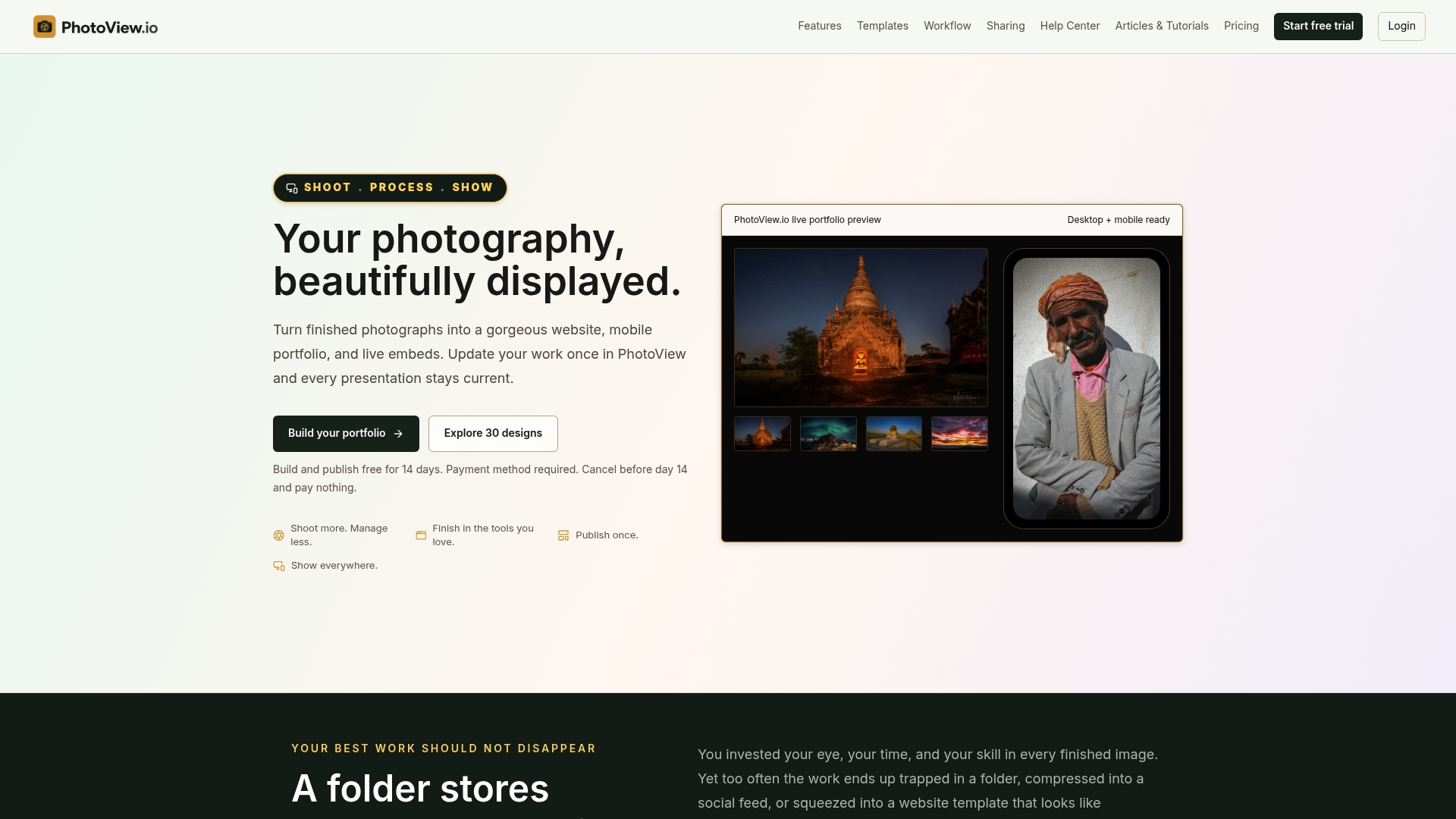
Plans start at a low monthly price for entry-level users, with higher tiers available for more advanced needs, and annual payment options also offered. You can browse the full template library to see how your work would look before committing, or go straight to Photoview to compare plans and start building.
FAQ
Is Portfoliobox really free?
Portfoliobox offers a free tier, but like most free portfolio plans, it comes with limits on storage, gallery count, or branding removal. For photographers planning to grow a client base or sell work, a paid tier on any platform typically becomes necessary within the first year.
What is the best free portfolio site?
There’s no single best free portfolio site since the right choice depends on whether you prioritize design templates, photography-specific proofing, or simple one-page layouts. Carrd and Adobe Portfolio are commonly used free or low-cost starting points, though both come with feature limits that photographers with growing client work tend to outgrow.
How good is Portfoliobox?
Portfoliobox works reasonably well as a general-purpose portfolio builder with straightforward templates and an accessible free tier. It lacks photography-specific workflow features like direct Lightroom publishing, which is where platforms built specifically for photographers, including PhotoView, tend to offer a more direct path from editing to publishing.
What are the top alternatives to consider beyond the big names?
Beyond platforms like Squarespace, Wix, and Format, photographers also compare Carbonmade, PhotoShelter, SmugMug, Webflow, Carrd, and Adobe Portfolio depending on whether they need asset management, print sales, or a quick single-page site. The right shortlist depends on your priorities: workflow integration, design flexibility, or commerce features.
How long does it take to migrate a portfolio to a new platform?
A careful migration typically takes one to two weeks, covering image upload, gallery reorganization, metadata re-entry, and a final review before switching your domain over. Testing templates, uploads, and client-sharing features during a trial beforehand helps avoid surprises once you commit to the move.