
Skip Wix: Hybrid Stacks for Photographers Publishing From Lightroom
Compare Wix alternatives for photographers and pick by what earns money: Lightroom live publishing, proofing, or print fulfillment.

Skip Wix: Hybrid Stacks for Photographers Publishing From Lightroom
For portfolio-first presentation, Format and Squarespace lead the pack, while Pixieset and SmugMug win on client galleries and print sales. PhotoView is the strongest choice for photographers who publish straight from Lightroom and want live embeds that update everywhere at once. Most working photographers end up pairing two of these tools rather than picking just one.
TL;DR:
- Photographers should prioritize platforms that align with their revenue streams, such as SmugMug or Zenfolio for print sales, and Pixieset for client galleries.
- Native Lightroom publishing integration, fast mobile gallery loading, and easy content export are critical factors, especially for photographers who update work frequently.
- PhotoView offers live portfolio embedding, single-update publishing, and responsive templates starting at $3.99 per month, ideal for Lightroom-centric workflows.
- Moving off Wix generally requires manual rebuilding of site structure and careful domain migration, as Wix lacks a straightforward export feature.
- Support quality and response time are key indicators of platform reliability, with dedicated photography support teams providing faster, more accurate help.
PhotoViewphotoview.ioPublish Lightroom Work EverywherePhotoView helps photographers curate galleries, publish responsive portfolios, and keep website embeds updated from one organized dashboard.Explore PhotoView
Table of Contents
- Why Look at Wix Alternatives for Photographers?
- Photography Feature Comparison: Templates, Galleries, and SEO
- Platform-by-Platform Reviews for Photographers
- How to Choose the Right Platform for Your Photography Business
- How PhotoView Fits Into a Photographer’s Daily Workflow
- How We Compared These Photography Website Builders
- Connecting Lightroom, Photoshop, and Capture One to Your Website
- What Photography-Specific Customer Support Actually Looks Like
- Real Photographer Use Cases Across These Platforms
- Migrating From Wix: What the Process Actually Involves
- Recommended Stacks for Photographers Choosing a Path Forward
- Start Publishing With PhotoView Instead of Fighting Your Website
- Sources
- FAQ
Why Look at Wix Alternatives for Photographers?
Wix built its reputation on drag-and-drop flexibility, but that flexibility has a cost. Comparative reviews consistently note that Wix’s variable template quality produces heavier code, which drags down page speed and mobile rendering on image-heavy portfolios. For a wedding photographer whose entire pitch depends on a gallery loading fast on a client’s phone at a coffee shop, that lag is a real problem, not a minor annoyance.
Photographer forums back this up with specifics. Discussions among working photographers show mobile speed, gallery user experience, and print fulfillment reliability are the top three reasons people start looking at alternatives in the first place. None of those three are cosmetic complaints. They go straight to whether a site converts a visitor into a booked client or a print sale.
Here’s the ranked shortlist, built around those exact priorities.
- PhotoView — Best for photographers who publish directly from Lightroom and want live portfolio embeds that stay current without rebuilding a site. Every plan includes all 30+ responsive templates, Smart Folders, and private sharing, so the entry price isn’t a stripped down version of the product.
- Format — Best for photographers chasing editorial or commercial work where the portfolio itself needs to look like a magazine spread. Format’s visual presentation ceiling is hard to match among portfolio-first builders.
- Squarespace — Best for photographers who want one platform to handle portfolio, blog, and ecommerce with strong SEO defaults built in place already.
- Pixieset — Best for wedding and event photographers whose business runs on proofing galleries and client-facing delivery.
- SmugMug — Best for photographers who monetize prints heavily and need dependable fulfillment integration.
- Pixpa — Best for side-hustle photographers who want a low-cost, all-in-one platform without a steep learning curve.
- WordPress — Best for photographers who want full control over SEO and design and don’t mind managing hosting and plugins themselves.
- Adobe Portfolio — Best for Creative Cloud subscribers who want a free, simple portfolio bundled with a subscription they already pay for.
Pricing shape varies more than people expect. PhotoView runs from $3.99 per month on the Starter plan up to $11.99 per month on Premier, with annual billing bringing meaningful savings at every tier. Format and Squarespace sit in a comparable monthly range but often reserve advanced ecommerce or storage for higher tiers. Pixpa positions itself as the budget all-in-one option, while SmugMug and Zenfolio price toward the professional print-seller who needs volume fulfillment rather than a casual hobbyist.
The pattern that matters most: platform fit tracks your revenue stream more than your taste in templates. If prints pay your bills, SmugMug or Zenfolio make more sense than a portfolio-only tool. If client sessions and proofing pay your bills, Pixieset earns its keep. If your portfolio’s only job is winning new commercial or editorial clients, presentation quality and publishing speed matter more than gallery commerce features. That single question, what actually generates revenue, should drive your first cut more than any feature checklist.
Photography Feature Comparison: Templates, Galleries, and SEO
Photography-specific needs don’t map cleanly onto generic website builder comparisons. A wedding photographer cares about proofing workflows a landscape photographer never touches, and a fine art photographer cares about print fulfillment a corporate headshot photographer ignores entirely. The table below scores each platform on the dimensions that actually decide whether a photographer’s workflow gets faster or slower.
| Platform | Best For | Templates & Design | Client Galleries / Proofing | Print Sales / Ecommerce | Lightroom Integration | Mobile Performance | Pricing Shape |
|---|---|---|---|---|---|---|---|
| PhotoView | Lightroom publishing + live embeds | 30+ responsive templates, all plans | Private sharing, multiple galleries | Limited native ecommerce | Native Lightroom publish | Built for mobile-first galleries | $3.99 to $11.99/mo |
| Format | Editorial and commercial portfolios | High visual ceiling | Basic client proofing | Limited | Third-party | Strong | Entry to pro tiers |
| Squarespace | All-in-one business site | Strong, consistent library | Basic | Native, well-built | Third-party | Strong | Entry to pro tiers |
| Pixieset | Wedding and event delivery | Simple portfolio pages | Robust proofing and galleries | Native print fulfillment | Third-party | Strong | Entry to pro tiers |
| SmugMug | Print-focused photographers | Photo-focused templates | Client galleries included | Native print fulfillment | Third-party | Strong | Entry to pro tiers |
| Pixpa | Budget all-in-one | Broad, beginner-friendly | Basic galleries | Basic ecommerce | Limited | Moderate | Low entry price |
| Zenfolio | Enterprise print sales | Standard templates | Client ordering workflows | Native, pro-level fulfillment | Limited | Moderate | Entry to pro tiers |
| WordPress | Full control, self-hosted | Unlimited via themes | Third-party plugins | Third-party plugins | Third-party plugins | Depends on setup | Hosting cost varies |
| Adobe Portfolio | Free Creative Cloud add-on | Minimal, clean | None native | None | Limited | Moderate | Free with Creative Cloud |
| Fotoowl AI Gallery | AI-assisted event galleries | Template-based | AI-assisted proofing | Limited | Limited | Moderate | Entry-level |
| Editor X | Design-precision layouts | High, granular control | None native | Third-party | Limited | Strong | Entry to pro tiers |
| Fabrik | Fast portfolio setup | Curated, automated | None native | None | Limited | Moderate | Entry-level |
| Framer | Motion-rich presentation | High, animation-focused | None native | None | Limited | Strong | Entry to pro tiers |
| GoDaddy | Fast general setup | Basic | None native | Basic ecommerce | None | Moderate | Low entry price |
| Hostinger | Budget hosting for WordPress | Depends on theme | Third-party plugins | Third-party plugins | Third-party plugins | Depends on setup | Low-cost hosting |
| IONOS | Scalable affordable hosting | Depends on builder | Third-party | Third-party | Limited | Depends on setup | Low-cost hosting |
A few patterns stand out once you line these up side by side. Portability is the dimension photographers most often overlook until they’re stuck. Some newer builders now advertise code export as a differentiator, which tells you portability has become a real evaluation axis rather than an afterthought. WordPress remains the most portable by nature since you own the files outright, while closed platforms generally lock your design into their ecosystem.
Mobile performance also splits the field more than most photographers expect going in. Platforms purpose-built around galleries and image delivery, including PhotoView, Pixieset, and SmugMug, tend to render large images faster than general-purpose builders retrofitted for photo use. That’s not a coincidence. When gallery rendering is the whole product, the engineering priorities shift accordingly.
Platform-by-Platform Reviews for Photographers
PhotoView: built around Lightroom publishing and live embeds
PhotoView’s whole design philosophy centers on one idea: update your work once, and have it show up correctly everywhere you present it. That means a Lightroom publish workflow that pushes edited photos straight to your portfolio, live embeds that keep an existing website’s galleries current without a rebuild, and Smart Folders that organize incoming media automatically.
Every plan, from Starter at $3.99 per month up to Premier at $11.99 per month, includes all 30+ responsive templates and core publishing tools. That’s a meaningful contrast to platforms that gate their best templates behind top-tier pricing. Annual billing brings the Starter plan down to $39.99 per year, Growth to $59.99 per year, Studio to $79.99 per year, and Premier to $119.99 per year, which works out to real savings for photographers committing beyond a monthly trial.
Pros: Native Lightroom publishing removes a manual export step most platforms still require. Live embeds mean you can keep an existing site’s structure while PhotoView handles gallery updates behind the scenes.
Cons: Print sales and ecommerce are not the platform’s focus, so photographers whose primary revenue is print fulfillment will want a dedicated commerce tool alongside it. The template library, while broad, leans toward portfolio presentation rather than blog-heavy content marketing.
Best for: Travel, fine art, wedding, and commercial photographers who want centralized media management and don’t want to touch their live site every time they finish an edit.
Format: the editorial portfolio standard
Format built its name on photographers who need their portfolio to function like a printed magazine spread. Its visual presentation ceiling is genuinely high among portfolio-first tools, which is why commercial and editorial photographers gravitate toward it when pitching agencies or publications.
Pros: Design quality holds up under scrutiny from art directors and photo editors. Portfolio-specific layout options go deeper than most general-purpose builders offer.
Cons: Client gallery and proofing tools are basic compared to platforms built around wedding and event delivery. Ecommerce features feel like an add-on rather than a core strength.
Best for: Photographers whose primary job is winning new commercial or editorial assignments, where presentation quality closes the deal.
Squarespace: the balanced all-in-one
Squarespace earns its place because it rarely does any one thing poorly. Its template library, built-in SEO tools, and ecommerce features work together well enough that many working photographers never need a second platform. The structured data and SEO defaults also help photographers who depend on organic search traffic to find new clients, not just referrals.
Pros: SEO tools are stronger out of the box than most competitors in this category. Template consistency means fewer surprises when you switch designs later.
Cons: Client gallery and proofing tools lag behind specialists like Pixieset. Customization beyond the template system requires more technical comfort than some photographers want.
Best for: Photographers who want portfolio, blog, and store on one platform without piecing together multiple subscriptions.
Pixieset: the client delivery specialist
Pixieset exists almost entirely to solve one problem: getting finished photos into a client’s hands with a proofing and selection process that feels professional. Wedding and event photographers rely on it because gallery delivery, proofing, and print fulfillment are the actual product, not an afterthought bolted onto a portfolio builder.
Pros: Proofing workflow is purpose-built for the session-to-delivery pipeline wedding and event photographers run constantly. Print fulfillment integration removes a logistics headache many photographers would rather not manage themselves.
Cons: Portfolio pages for marketing your own work are simple compared to Format or PhotoView. Design flexibility takes a back seat to functional delivery.
Best for: Wedding and event photographers whose business runs on repeat client galleries rather than a public-facing portfolio.
SmugMug: print sales with dependable fulfillment
SmugMug has stayed relevant for years because print fulfillment and photo-focused storage work reliably at scale. Photographers who sell prints as a core revenue stream, not a side offering, tend to trust SmugMug because the commerce and delivery mechanics rarely break down.
Pros: Print fulfillment integration handles volume without the manual overhead of a smaller commerce plugin. Storage is genuinely photo-focused rather than repurposed generic file hosting.
Cons: Design flexibility trails behind Format or PhotoView for photographers who care most about portfolio presentation. The interface feels utilitarian rather than polished for pure marketing purposes.
Best for: Photographers whose income depends heavily on print sales and who need fulfillment they don’t have to think about.
Pixpa: the budget all-in-one
Pixpa positions itself squarely for photographers starting out or running photography as a side business. It bundles portfolio, galleries, and basic ecommerce at a price point that undercuts most competitors on this list.
Pros: Low entry price with a feature set broad enough to cover most beginner needs. Setup is straightforward for photographers without technical experience.
Cons: Design flexibility and template polish don’t match Format or Squarespace. Advanced client delivery features are thinner than dedicated proofing platforms.
Best for: Side-hustle photographers and hobbyists transitioning toward paid work who need one affordable platform to cover the basics.
Zenfolio: enterprise-style print commerce
Zenfolio leans hard into print sales and client ordering at a scale that suits photographers running a genuine print business rather than occasional sales. Its fulfillment options go deeper than casual print integrations found elsewhere.
Pros: Client ordering workflows handle complex print packages and volume orders well. Fulfillment options scale for photographers running print sales as a primary business line.
Cons: Templates feel dated next to design-forward competitors. The learning curve for setting up commerce workflows is steeper than plug-and-play alternatives.
Best for: Photographers running print commerce as a serious revenue stream who need order management to match.
WordPress: unlimited control, unlimited responsibility
WordPress remains the ceiling for customization and SEO because you’re not bound to a proprietary template system at all. With the right theme and plugin stack, a self-hosted WordPress site can outperform any closed platform on this list for search visibility and design control.
Pros: No platform lock-in since you own your files and can migrate hosts freely. SEO ceiling is the highest available when configured properly.
Cons: You’re responsible for hosting, security updates, and plugin conflicts, which eats into shooting and editing time. Client gallery and proofing functionality requires third-party plugins that add ongoing cost and complexity.
Best for: Photographers comfortable managing technical infrastructure who want maximum long-term control over their site.
Adobe Portfolio: free, simple, and limited
Adobe Portfolio comes bundled free with a Creative Cloud subscription, which makes it an easy default for photographers already paying for Photoshop or Lightroom. It’s minimal by design.
Pros: No additional cost if you already subscribe to Creative Cloud. Setup takes minutes with clean, simple templates.
Cons: Client galleries, proofing, and ecommerce are essentially absent. Design flexibility is the most limited of any platform on this list.
Best for: Photographers who want a simple portfolio without paying for a separate subscription and don’t need client delivery tools.
The remaining field: design-forward and hosting-focused options
Framer and Editor X appeal to photographers who want motion, animation, and granular responsive control, trading a steeper learning curve for a genuinely unique presentation. Fabrik offers curated templates and quick automatic portfolio assembly for photographers who want to be live fast without much configuration. Fotoowl AI Gallery targets event photographers with AI-assisted gallery organization and proofing, useful for high-volume shoots like weddings and conferences.
On the hosting side, GoDaddy, Hostinger, and IONOS aren’t photography-specific tools at all. They’re general-purpose hosting and site builders that pair with WordPress or lightweight builders for photographers on a strict budget who are comfortable handling more setup themselves. None of the three offer photography-specific features like proofing or Lightroom publishing natively, which is exactly why they work best as the hosting layer under WordPress rather than a standalone solution.
How to Choose the Right Platform for Your Photography Business
The fastest way to pick correctly is to match the platform’s strength to the job that actually pays your bills. A photographer who books commercial clients off a strong portfolio has completely different priorities than one who delivers 400 wedding photos to a bride every weekend.
- Identify your primary revenue driver. Is it new client acquisition through a portfolio, repeat client delivery through galleries, or print sales through ecommerce? This single answer eliminates half the list immediately.
- Test the mobile experience first, not last. Upload a real gallery of 40 to 60 high-resolution images and view it on your own phone over cellular data, not just office Wi-Fi. Slow-loading galleries lose clients before they see your best work.
- Time how long it takes to publish a finished edit. If you shoot in Lightroom, count the clicks from “Export” to “Live on my site.” Platforms with native publishing integrations should take under a minute; anything requiring manual re-upload adds friction you’ll feel every single week.
- Ask support a real question before you commit. Send a specific technical question, like how to set up a private client gallery, and time the response. A platform’s support quality during a free trial tells you what to expect after you’ve paid.
- Check the export and portability terms. Ask directly whether you can export your content and design if you switch platforms later. Some newer builders now advertise code export as a selling point precisely because lock-in has become a real concern for photographers who’ve been burned before.
Pro Tip: Run two platforms side by side during their free trials with the same 20 to 30 images. You’ll notice load time, template quality, and upload friction differences within the first ten minutes, long before you’d catch them from reading reviews alone.
Watch for red flags during any trial: transaction fees on print sales that eat into your margin, proofing interfaces that confuse clients rather than guide them, and vague answers from support about data export. Any platform that hedges on whether you can leave with your content intact is telling you something important about how it treats customers.
How PhotoView Fits Into a Photographer’s Daily Workflow
PhotoView’s feature set solves a specific, recurring frustration: photographers finish an edit, then have to manually update their portfolio, their embedded gallery, and sometimes a client’s private link, one at a time. PhotoView collapses that into a single update point.
Three workflows show this clearly:
- Solo portfolio photographers edit in Lightroom, hit publish, and their live site updates automatically without touching a CMS or re-uploading files manually.
- Photographers with an existing website use live embeds to drop a PhotoView gallery directly into their current site, so the design they already built stays intact while PhotoView handles the content behind it.
- Photographers juggling multiple client shoots use Smart Folders and private sharing to keep session galleries organized and secure without building a separate delivery system for every client.
Every plan tier includes the full template library, so a photographer on the Starter plan at $3.99 per month gets the same 30+ responsive templates as someone on Premier. The difference between tiers comes down to storage volume, not feature access, which matters for photographers who shoot in volume but don’t want to pay for premium design options they’d get anyway on a cheaper plan.
Mitch Russo, whose photography portfolio runs on the platform, represents the kind of working photographer PhotoView is built around: someone who wants their finished work presented consistently across a website, mobile, and embedded contexts without rebuilding anything each time a new shoot wraps.
How We Compared These Photography Website Builders
These rankings come from a mix of published product documentation, comparative reviews, and hands-on trial accounts across each platform’s free tier or trial period where available. The comparison prioritized dimensions photographers actually care about day to day: template quality and design flexibility, client gallery and proofing workflows, print sales and ecommerce depth, Lightroom and workflow integrations, mobile rendering performance, pricing shape across entry and professional tiers, portability and export options, and built-in SEO controls.
A few limitations are worth naming honestly. Pricing and feature sets on any SaaS platform shift over time, sometimes without much notice, so treat the specific figures here as accurate at the time of writing and verify current pricing directly on each platform before committing. Feature rollouts, particularly around AI-assisted tools and ecommerce, move fast enough that a platform’s weak point today may close within a year.
Connecting Lightroom, Photoshop, and Capture One to Your Website
Lightroom publishing gets most of the attention because it’s the most common photographer workflow, but it’s far from the only integration that matters. Photoshop-edited files, whether composites or heavily retouched commercial work, need a clean path to your portfolio too, and Capture One shooters, common among commercial and studio photographers, often work entirely outside the Adobe ecosystem.
Platforms vary significantly here. PhotoView’s native Lightroom publish workflow handles the most common case directly, letting photographers push finished edits without a separate export and upload step. For Photoshop or Capture One output, the practical workflow across most platforms, PhotoView included, is exporting finished files and uploading them through the platform’s standard media import, since deep native integrations with Capture One remain rare across the entire category, not just one platform.
WordPress sits at the other extreme: with the right plugin stack, you can build custom integrations for nearly any editing tool, but that flexibility means setup time and ongoing plugin maintenance that photographers on tighter schedules may not want to take on. Squarespace and Format both rely on standard file upload rather than deep tool-specific integration, which works fine for photographers who don’t mind a manual export step between editing and publishing.
The practical takeaway: if Lightroom is your primary editor, prioritize native publish integration since it saves real time every week. If you shoot mostly in Capture One or rely heavily on Photoshop compositing, the export-and-upload workflow is close to universal across this category, so integration depth matters less than upload speed and image quality preservation.
What Photography-Specific Customer Support Actually Looks Like
Support quality separates the platforms built for photographers from the general-purpose builders that added photo features later. Photography-specific platforms tend to staff support with people who understand what a “proofing gallery” or “Lightroom catalog” actually means, which cuts down on frustrating back-and-forth explaining basic terminology.
General-purpose hosting and builder platforms, including GoDaddy, Hostinger, and IONOS, typically route support through broader technical queues that handle everything from email hosting to ecommerce, not just photography workflows. That’s not necessarily worse, but it does mean a question about gallery proofing UX might get a less specific answer than the same question asked a platform built around photography from day one.
The practical test during any trial: ask a specific, non-generic question. Something like “How do I set an expiration date on a private client gallery?” reveals a lot fast. A knowledgeable, specific answer within a few hours signals a support team that actually understands photographer workflows. A generic, copy-paste response, or a multi-day wait, signals what you can expect once you’re a paying customer facing a real deadline.
Response time matters more for photographers than most other website builder customers because deadlines are often externally imposed. A wedding gallery needs to go live before an anniversary, a commercial portfolio needs to be ready before a pitch meeting. Platforms that understand this urgency tend to build faster support channels, including live chat, specifically because photographers ask time-sensitive questions.
Real Photographer Use Cases Across These Platforms
Different photographers gravitate toward different platforms because their actual day-to-day jobs differ so much. A commercial photographer pitching agencies needs their portfolio to look flawless on a first impression. A wedding photographer delivering 500 images to a couple needs proofing and download tools that just work.
Editorial and commercial photographers building portfolios to win assignments tend to favor Format specifically because its presentation ceiling matches what photo editors expect from a professional pitch. The portfolio itself functions as the sales pitch, so design quality directly affects bookings.
Wedding and event photographers, by contrast, spend most of their platform time in the delivery phase rather than the marketing phase. Pixieset’s proofing and gallery tools solve the specific problem of getting hundreds of images to a couple in a way that feels organized rather than overwhelming, which is why it dominates that specific niche.
Travel and fine art photographers who publish frequently and want their site to reflect new work immediately tend toward platforms with fast publishing workflows. This is where PhotoView’s Lightroom publish integration shows its value most clearly: a photographer returning from a three-week trip can push an entire new gallery live without manually rebuilding a page, and if they’ve embedded that gallery on an existing personal site, it updates there too without extra work.
Photographers running print businesses as a serious revenue stream lean toward SmugMug or Zenfolio because the fulfillment mechanics behind a print sale, from order processing to shipping coordination, are handled natively rather than bolted on through a third-party plugin.
Migrating From Wix: What the Process Actually Involves
Moving off Wix isn’t a single click, and any platform that implies otherwise is oversimplifying. Wix doesn’t offer a clean, universal export of your site design, so migration usually means rebuilding the front end while salvaging what you can from your existing content.
The content itself, images, captions, and blog text, is the easiest part to migrate. Most photographers download their full-resolution image library directly from Lightroom or their original storage rather than trying to extract compressed web versions from Wix, since re-exporting from source files preserves quality far better than any platform-to-platform image transfer would.
Design and layout require the most manual work. Because Wix uses a proprietary design system, there’s no direct one-to-one mapping to another platform’s templates. Photographers typically pick a new template on their destination platform, whether that’s Format, Squarespace, or PhotoView, and rebuild page structure to match their previous site’s organization rather than trying to force an exact visual replica.
Domain and SEO continuity matter more than most photographers realize going in. Keeping your existing domain name and setting up proper redirects from old Wix URLs to new pages preserves search rankings that took months or years to build. Skipping this step is the single most common mistake in platform migrations, and it can quietly tank organic traffic for months while search engines re-index the new site.
Client-facing galleries need special attention during migration. If you’re moving from Wix to a platform like Pixieset or PhotoView specifically for better gallery delivery, plan the cutover around active client sessions. Migrate historical, already-delivered galleries on your own schedule, but never mid-way through an active client delivery, since a broken link during a live wedding gallery delivery creates exactly the kind of frustration that costs referrals.

Recommended Stacks for Photographers Choosing a Path Forward
Three stacks cover most photographers well. A portfolio-first stack pairs Format or PhotoView with nothing else, ideal if your business runs entirely on new client acquisition rather than repeat delivery. A hybrid stack pairs a design-first portfolio like PhotoView with a dedicated delivery tool like Pixieset, which reflects how most working photographers actually operate once their business includes both marketing and client sessions. A client-delivery-first stack built around Pixieset or SmugMug fits photographers whose revenue comes almost entirely from sessions and print orders rather than portfolio-driven bookings.
Start smaller than you think you need. Pick the platform that serves your highest-revenue activity first, then add a second tool only once that gap becomes a genuine bottleneck, not a hypothetical one.
Pro Tip: Run your top two contenders’ free trials in the same week with identical images. Differences in publish speed and mobile rendering show up fast when you compare them directly instead of days apart from memory.
Start Publishing With PhotoView Instead of Fighting Your Website
Format, Squarespace, and Pixieset each do one part of the photographer’s job well, but none of them let you update a Lightroom edit and see it reflected everywhere your work lives, your site, your embeds, your private client links, without touching each one separately. That’s the specific gap PhotoView closes: publish once, and it shows up consistently across your website, mobile, and any embedded gallery, all while keeping your unique visual style intact.
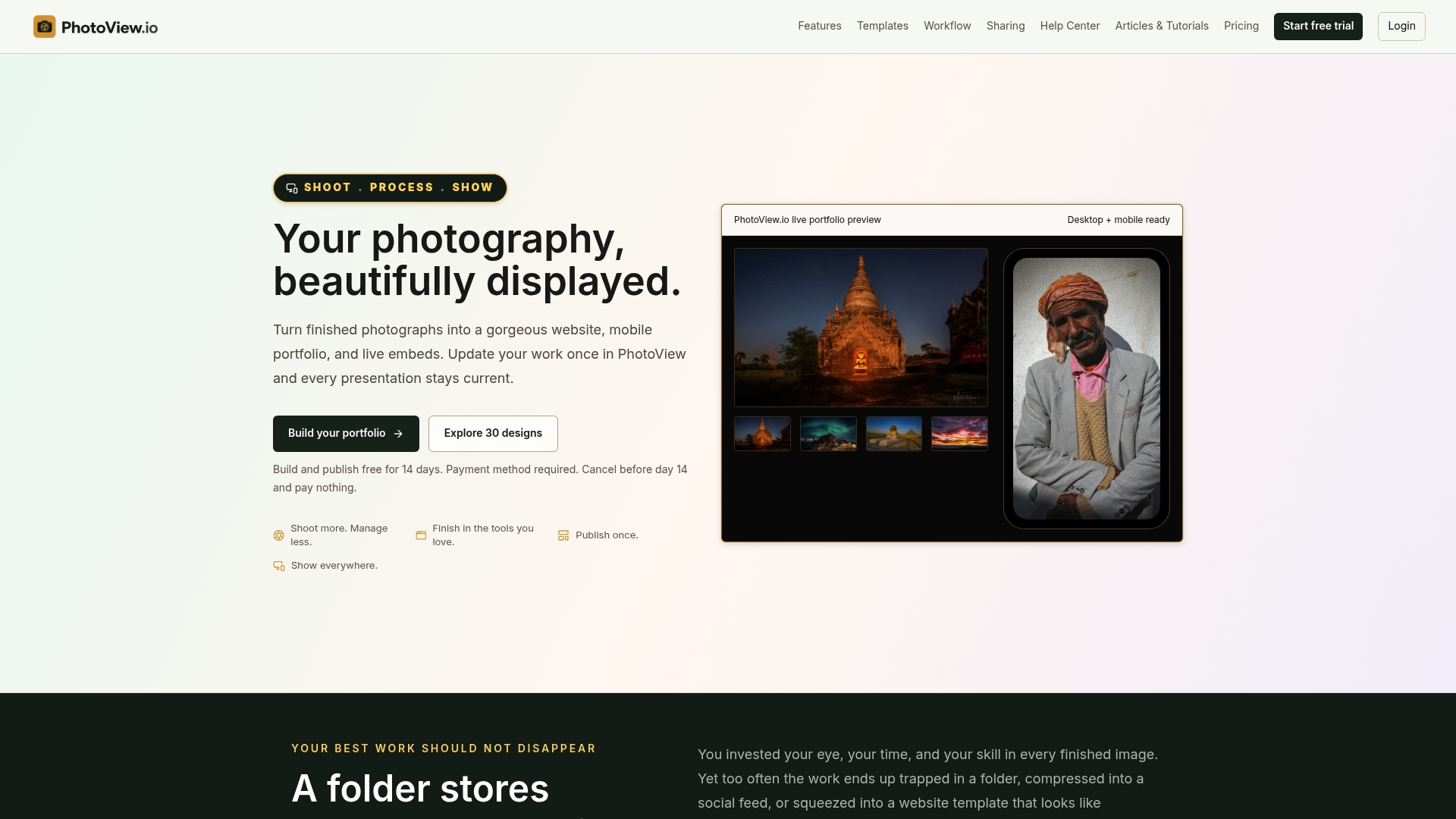
Every plan includes all 30+ responsive templates, so you’re never paying more just to unlock better design. Starter begins at $3.99 per month, Growth at $5.99 per month, Studio at $7.99 per month, and Premier at $11.99 per month, with lower annual rates available on every tier. If you already have a website you love and just want your galleries current without a rebuild, the live embed solution plugs straight into your existing pages. If you’re starting fresh with mobile visitors in mind, the mobile-ready portfolio option is built for exactly that.
If your workflow already runs through Lightroom, see how direct publishing works with the Lightroom portfolio solution, or browse the full portfolio publishing solutions to find your fit and start a free trial today.
Sources
FAQ
What Is the Best Website Platform for Photographers?
There’s no single best platform; the right choice depends on whether your revenue comes from bookings, print sales, or client session delivery. PhotoView fits photographers who publish frequently from Lightroom and want live embeds, while Pixieset and SmugMug fit photographers focused on client galleries and print fulfillment.
What Should I Use Instead of Wix?
Format, Squarespace, and PhotoView are the most common Wix alternatives for photographers, each suited to a different priority: presentation, all-in-one convenience, or Lightroom-driven publishing. Many photographers pair a portfolio-first tool with a dedicated client-gallery platform like Pixieset rather than relying on one single all-in-one solution.
How Much Does PhotoView Cost Compared to Other Platforms?
PhotoView’s Starter plan runs $3.99 per month or $39.99 billed annually, scaling up to Premier at $11.99 per month or $119.99 annually. Every tier includes the full template library and core publishing features, so higher tiers add storage rather than gating design options.
What Is the 20/60/20 Rule in Photography?
It’s a curation guideline rather than a fixed industry standard, and photographers apply it loosely depending on their genre and portfolio goals.
How Many Photographers Earn Over $300,000 a Year?
Specific income distribution figures for photographers at that level aren’t reliably documented in available industry data. Income varies enormously by specialty, with commercial, wedding, and fine art photographers at the high end typically building revenue through print sales, licensing, or repeat commercial contracts rather than a single income source.