
Photography Portfolios: Curate 15 to 30 Images From Lightroom to Web
Organize a photography portfolio with focused client galleries, a 15 to 30 image edit, clear sequencing, and a repeatable Lightroom to web workflow.

Photography Portfolios: Curate 15 to 30 Images From Lightroom to Web
Organize your portfolio by separating work into tightly focused galleries by genre or client type, keeping each one to 15 to 30 images, sequencing them so the strongest work leads and closes, and publishing through a workflow fast enough that you’ll actually keep it updated. Platforms like Photoview exist to support exactly that kind of structure. Digital preservation guidance also recommends backing up every image you keep, since a portfolio is only as good as the archive behind it.
TL;DR:
- Name galleries for services clients search for, avoid overlapping categories, and use a 15 to 20 image master gallery to introduce your best work.
- For galleries designed to win bookings, aim for 15 to 25 images; compare thumbnails and cut shots that do not serve prospective clients.
- Sustain the quality of your opening image through the first three, then vary the middle and finish with a distinct, memorable photograph.
- Use a public, searchable portfolio for discovery, but send pitch prospects a tailored private gallery or PDF with fewer than 20 relevant images.
- Review galleries every three to six months, replacing weaker images as soon as stronger work arrives instead of waiting for the next scheduled update.
PhotoViewKeep Your Portfolio Ready to SharePhotoView helps you curate finished photos, publish responsive portfolios, and keep website embeds updated from one dashboard.Explore PhotoView
Table of Contents
- How to group work: galleries, albums, and portfolio types
- Selecting and curating images: how many to show and how to cut
- Sequencing and storytelling: ordering images for impact
- File organization, metadata, and backups for a living portfolio
- Presentation formats: online galleries, PDFs, and client-specific deliveries
- Workflow example using PhotoView.io: import, curate, and publish
- How to write photo descriptions and captions that hold attention
- How to use analytics to track portfolio performance
- Treat your portfolio as a living business asset
- Where PhotoView.io fits into this workflow
- FAQ
- Sources
How to group work: galleries, albums, and portfolio types
Before you touch a single edit, decide how prospective clients will search for you. A bride planning a wedding and a brand manager looking for product work are not browsing the same gallery, and they shouldn’t have to dig through the other person’s images to find what they need.
Group by client need first, genre second. A wedding photographer might split work into ceremony, portraits, and reception coverage. A commercial shooter might separate product, lifestyle, and corporate headshots into distinct sets. Each gallery should answer one question: “Can you do the specific thing I need?”
Consider running a master gallery, a tight edit of your absolute best work across all categories, alongside specialized galleries that go deeper into each service. The master gallery is your front door. The specialized galleries are where a serious inquiry turns into a booking.
Naming matters more than photographers give it credit for. “Portfolio” tells a visitor nothing. “Destination Wedding Photography” or “Studio Product Photography” tells them exactly what you do and helps your galleries surface in relevant searches.
A few grouping principles worth following:
- Separate by what a client is hiring you for, not by how you personally categorize your artistic interests.
- Keep a master gallery of your strongest 15 to 20 images as a universal entry point.
- Name each gallery with the service or genre a client would type into a search bar.
- Avoid overlapping categories that force the same image into three different galleries.
Selecting and curating images: how many to show and how to cut
Curation is where most portfolios fail, not because the photographer lacks good work, but because they can’t bear to cut the mediocre work sitting next to it. Industry guidance consistently points to 15 to 30 images for a single-genre portfolio, with 15 to 25 working best when the goal is converting a viewer into a booking.
A repeatable curation routine removes the guesswork:
- Pull your initial selects, everything you’d consider “good,” without judging yet.
- View that set as thumbnails or small prints rather than full-screen images. Shrinking them strips away the emotional attachment you have to a shot and lets you judge composition and flow the way a client actually will, a technique favored by professional curators.
- Cut anything that doesn’t serve the viewer. Ask whether a stranger would stop scrolling on this image, not whether you remember the moment fondly.
- Polish the survivors: consistent color grading, consistent cropping logic, and a final check for technical flaws.
Before you even get to editing, the 20-60-20 shoot framework can cut your post-production workload. That mix tends to produce more usable, varied selects and fewer redundant near-duplicates clogging your edit.
Pro Tip: Shrink your shortlist to thumbnail size before making final cuts. Weak compositions and awkward crops that hide at full resolution become obvious at a glance.
Sequencing and storytelling: ordering images for impact
The order of your images shapes how long someone stays on your site. Open with your single strongest photograph, not your most recent or most technically difficult. Sustain that quality through the first three images since that’s typically where a visitor decides whether to keep scrolling.
The middle of a gallery is where you can vary pace: a wide establishing shot followed by a tight detail, a quiet frame after a dramatic one. Close on something memorable, often a different kind of strong image than your opener, so the gallery ends with its own distinct impression rather than fading out.
Keep your color grading and compositional choices consistent across a sequence. A viewer should feel like one photographer shot everything, not like they’ve wandered into three different portfolios stitched together.
A few sequencing patterns worth borrowing:
- For a wedding gallery, open on the couple’s best portrait, build through ceremony and candid reception moments, and close on a quiet, emotional final frame.
- For a commercial pitch, lead with your cleanest product shot, follow with lifestyle context, and finish with a hero image that could run as a full-page ad.
- For an editorial submission, open with the image an editor would use as a cover, then let the middle carry narrative detail shots.
Internal resources on portfolio examples and presentation ideas can give you a visual reference for how this plays out across different genres.
File organization, metadata, and backups for a living portfolio
A portfolio you can’t update quickly is a portfolio that goes stale. Build your archive around a folder tree that scales: Master archive, then Year, then Client or Project, then subfolders for selects and finals. That structure keeps a decade of work navigable instead of a pile of loose folders with inconsistent names.

Descriptive file names and embedded keywords matter more than photographers assume. Federal digital preservation guidance specifically recommends descriptive filenames and embedded metadata so files remain identifiable and searchable years later, independent of whatever software you’re using today.
Tags and smart filtering tools let you build a client-specific gallery in minutes rather than hunting through folders by hand, which also makes private galleries practical to maintain.
Your backup strategy should follow the same discipline as your organization:
- Keep three copies of every image, on two different types of media, with one copy stored offsite or in the cloud.
- For archives spanning many years, work through them decade-by-decade rather than trying to overhaul everything at once.
- Test your restore process annually. A backup you’ve never restored from is a backup you don’t actually know works.
For archives spanning 30 years or more, organizing decade-by-decade while following a 3-2-1 backup strategy makes the project manageable instead of overwhelming, and an annual restore test confirms the backup will actually work when you need it.
Presentation formats: online galleries, PDFs, and client-specific deliveries
Different situations call for different delivery formats. A public portfolio works for general discovery, someone finding you through search or social media. A private gallery or a tailored PDF works better when you’re pitching a specific client who needs to see only the work relevant to their project.
Public galleries should be built for responsiveness: images that resize cleanly across devices, consistent aspect ratios within a gallery, and support for mixed media when video strengthens the story, particularly for wedding and commercial work.
A targeted PDF or private gallery link for a pitch should be short, usually under 20 images, and curated specifically for that client’s industry or need rather than pulled generically from your public site.
Practical formatting choices to keep in mind:
- Use a public, searchable portfolio for general visibility and new client discovery.
- Use a private gallery or client-specific link when pitching a brand or planning a wedding, so the prospect only sees relevant work.
- Keep aspect ratios consistent within a single gallery to avoid an inconsistent, cluttered scroll.
- Include video selectively, only where it adds information a still can’t, since mixed-media galleries work best with intention rather than as a default addition.
Workflow example using PhotoView.io: import, curate, and publish
A practical way to see this structure in action: import your Lightroom selects, sort them into Smart Folders by client or genre, cut ruthlessly down to your 15 to 30 image target, choose a template that fits the work, and publish, either as a live embed on an existing site or as a private share link for a specific client.
Smart Folders and direct Lightroom publishing shorten the gap between finishing an edit and having it live, which matters if you’re committing to updating a gallery every three to six months rather than letting it drift for years.
This is one practical implementation of the workflow, not the only one, but it demonstrates the core idea: curation and presentation should share the same system instead of living in separate tools that require manual re-uploading every time something changes.
- Import selects directly from Lightroom without a separate export step.
- Sort into Smart Folders by client, genre, or project.
- Publish to a template suited to the work, then share via live embed or private link.
How to write photo descriptions and captions that hold attention
A caption should tell a viewer something they can’t get from the image alone: where it was shot, what made the moment difficult to capture, or why it mattered to the client. Skip generic labels like “Wedding Photo 12” since they add nothing and do nothing for how your gallery reads.
Keep descriptions short, usually one or two sentences, and specific. “Golden hour portrait session, Catalina Island” tells a visitor more in five words than a paragraph of vague enthusiasm. For commercial work, a caption naming the brand or use case (a product shot for a skincare launch, for example) helps a prospective client picture their own project in your hands.
Captions also carry practical weight beyond engagement. They give search engines text to index around an image, which can help a gallery surface for the specific service or location named in the caption. For client-facing galleries, a short line about the deliverable, “Full-day coverage, 450 edited images delivered,” sets expectations before a client even reaches out.
Avoid repeating the same caption structure for every image in a gallery. Variation keeps the viewer reading instead of skimming past text that all sounds interchangeable.
How to use analytics to track portfolio performance
Once a portfolio is live, the next question is whether it’s actually working. Basic analytics, time on page, which galleries get the most views, and where visitors drop off, tell you far more than instinct alone.
If one gallery consistently holds attention longer than others, that’s a signal about which type of work resonates with the clients finding you, and it’s worth leading with that gallery more prominently. If a gallery gets traffic but produces no inquiries, the images may be strong but the sequencing or captions might not be closing the sale.
Track performance on a regular cadence rather than checking once and forgetting about it. Pair that review with your image-replacement habit: when analytics show a gallery underperforming, that’s your cue to re-curate rather than wait for the next scheduled refresh.
Treat your portfolio as a living business asset
A portfolio isn’t a finished project. It’s closer to a storefront window that needs rearranging as your best work changes. Aggressive editing and frequent refreshes do more for booking rates than adding more images ever will.
A simple quarterly routine covers it: review each gallery, replace anything weaker than your current best work immediately rather than waiting, and check which images are actually converting inquiries into bookings.
— Mitch Russo
Where PhotoView.io fits into this workflow
Once your galleries are curated and sequenced, the remaining challenge is keeping them live without rebuilding a website every time your best work changes. That’s the specific problem we built PhotoView.io to solve: update your work once, and it reflects everywhere it’s published, across your main site, mobile, and any embedded galleries.
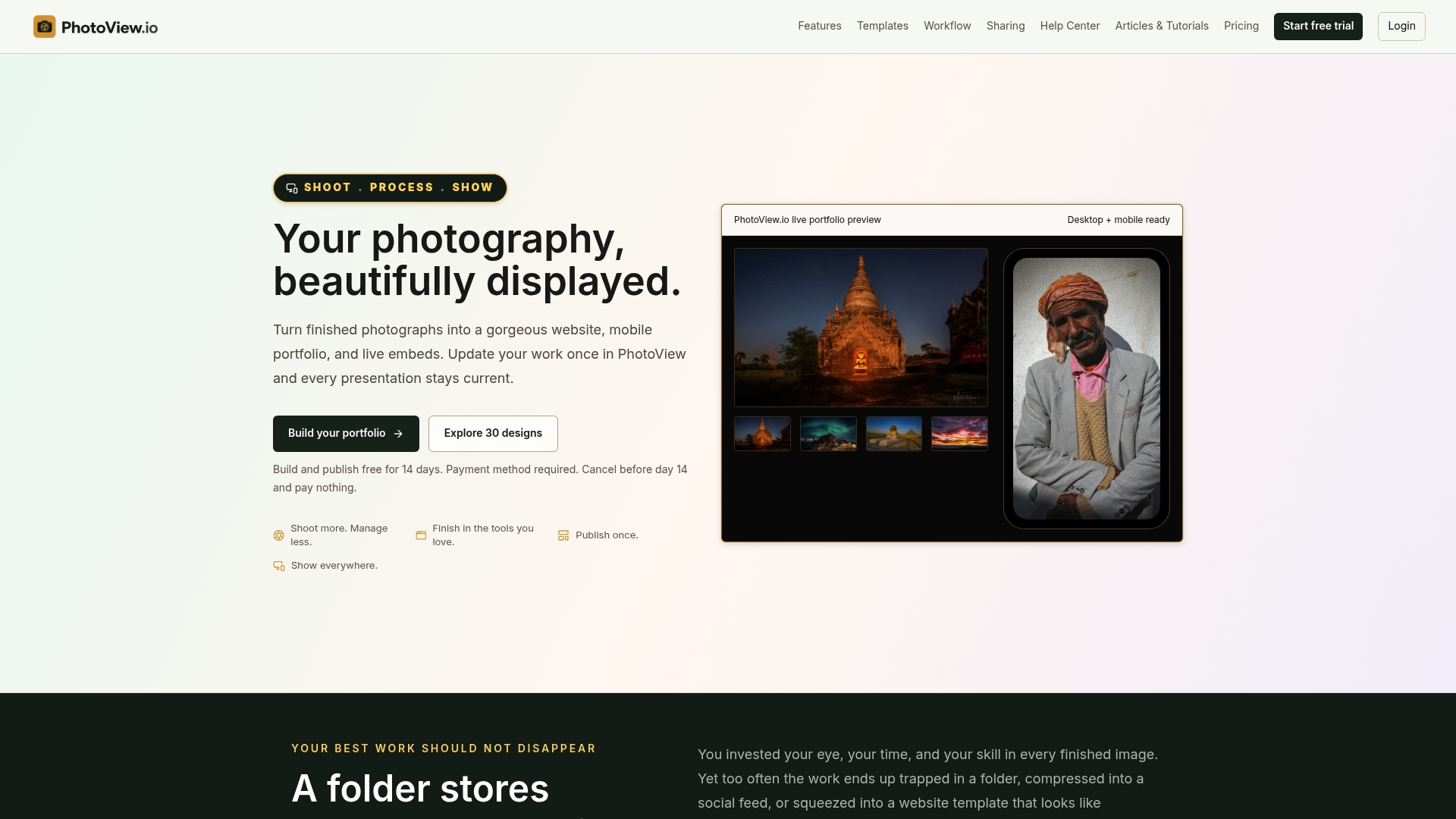
Our platform includes direct Lightroom publishing, Smart Folders for fast client-specific galleries, private sharing options, and support for mixed photo and video galleries, all included across plans. It tends to work best for photographers who publish often enough that a slow update process becomes an obstacle to booking new work.
Plans start at $3.99 per month for Starter and scale up through various tiers depending on storage needs, with custom plans available for high-volume archives. Explore our portfolio publishing solutions or see how Lightroom publishing works to get your next gallery live.
FAQ
What is the “20/60/20 rule” in photography?
The 20-60-20 rule works two ways: as a compositional guideline where 60% of the frame emphasizes the subject with 20% supporting elements and 20% background, and as a shoot-management strategy where 20% of shots are safe setups, 60% are creative variations, and 20% are experimental risks. Used as a shoot plan, it tends to produce more varied, usable selects for your final edit.
How should I structure a photography portfolio?
Separate your work into galleries by genre or client type, such as weddings, commercial, or portraits, rather than mixing everything into one feed. Keep each gallery to 15 to 30 images, lead with your strongest shot, and close on another strong image to leave a lasting impression.
How do I organize 30 years of accumulated photos?
Work through a large archive decade-by-decade rather than tackling it all at once, sorting each decade into a folder tree by year and project. Pair that process with a 3-2-1 backup strategy and an annual restore test to confirm your files are genuinely safe.
How often should I update my photography portfolio?
Active professionals generally benefit from reviewing and updating a portfolio every three to six months, replacing weaker images as soon as stronger ones become available rather than waiting for a scheduled refresh. This steady turnover keeps the overall quality of a gallery rising rather than stagnating.
Does portfolio quality affect how much photographers earn?
Portfolio quality has a direct relationship to booking speed, and photographers with strong portfolios and established client relationships tend to command higher rates. A tightly curated, well-sequenced portfolio signals professionalism before a client even reaches out, which can shorten the path from inquiry to booking.
Sources
- How to Build a Photography Portfolio That Actually Gets You Hired - Photography Talk
- What Is the 20-60-20 Rule in Photography? (And Should You Use It?)
- How to organize 30 years of photos - Lenses Pro
- Digital Preservation for Personal Archiving — Photos (U.S. National Archives/NARA guidance)