
Photography Portfolio Software: Publish Once, Keep Embeds Current
Find photography portfolio software that keeps Lightroom publishing fast and website embeds current. Test real workflows before choosing a platform.

Photography Portfolio Software: Publish Once, Keep Embeds Current
We recommend PhotoView as the best photography portfolio software for photographers who want minimal site maintenance and fast Lightroom publishing. It fits travel, wedding, and commercial photographers who publish photos and video together. Our strongest differentiator is simple: publish from Lightroom once, and your portfolio, mobile presentation, and live website embeds stay current from one dashboard.
TL;DR:
- During a trial, publish from Lightroom, change an image, and time how quickly the live gallery updates without another upload.
- Photographers who deliver client work should test private galleries on phones, including password access, expiration dates, and download permissions, before choosing a plan.
- Video photographers should confirm that photos and video share one gallery and that playback works well on mobile before subscribing.
- PhotoView starts at $3.99 per month and includes all 30+ templates in every plan; free tiers suit hobby portfolios without client delivery.
- Estimate storage by multiplying average finished file size by planned online image count, then add room for video and future shoots before comparing tiers.
PhotoViewKeep Your Portfolio CurrentPublish from Lightroom and keep portfolio pages, mobile presentations, and live website embeds updated from one dashboard.Visit PhotoView
Table of Contents
- What should you look for in a photography portfolio platform?
- How do you evaluate portfolio platforms step by step?
- What do the main feature categories mean for your portfolio?
- What should you expect from pricing, trials, and free tiers?
- Which workflows and integrations save the most time?
- How can you publish your first portfolio in one afternoon?
- A workflow-first view on portfolio software
- How PhotoView matches the checklist
- FAQ
- Useful sources
What should you look for in a photography portfolio platform?
Feature lists look alike on every pricing page. What separates platforms is how they behave when you actually work. Use these signals to check any claim quickly:
- Template quality and responsive behavior: open a demo on your phone, not just your laptop.
- Lightroom and workflow integration: look for publishing from inside Lightroom and folders that update themselves, such as Smart Folders.
- Storage, video support, and delivery: confirm that video and high-resolution images load quickly for a visitor on a slow connection.
- Client gallery controls: private sharing, password options, and download permissions should be easy to find.
- Publishing and embeds: a gallery you can embed in an existing site saves you from updating two places.
- Pricing and storage limits: the plan should state what it stores in plain numbers, not vague “unlimited” language.
- Security and hosting reliability: your portfolio is your storefront, so downtime costs you inquiries.
A platform that does well on these points can serve you well. One that skips key features may show the gap in real use.
How do you evaluate portfolio platforms step by step?
Run the evaluation during a trial, with your own images, on your own schedule. A demo built by the vendor tells you very little about your workflow.
- Name your primary use case. Client delivery and portfolio marketing need different features. Pick the one that pays your bills and weight your decision toward it.
- Estimate your storage. Multiply your average finished file size by the number of images you plan to keep online, then add a buffer for video. Match that total to plan tiers rather than guessing.
- Time your publishing. Upload and publish from Lightroom, then measure how long it takes for the update to go live. Repeat with a small change to see how fast edits propagate.
- Test client gallery features. Check download permissions, expiring links, and how a client views a private gallery on a phone.
- Inspect templates on mobile. Look at image quality, load speed, and whether metadata and SEO fields are editable.
- Follow a trial checklist. During the trial, publish a gallery, connect a domain, embed a gallery on a test page, and share a private link with a friend.
Pro Tip: Keep a simple log of minutes spent on each task. The platform that costs you the fewest minutes per update is the one you will keep using.
What do the main feature categories mean for your portfolio?
Marketing language hides practical differences. Here is what each category means once you start publishing.
- Templates and presentation: layout choices shape how a visitor reads your work. A tight grid suits a broad commercial range, while a full-bleed sequence suits a single travel story.
- Lightroom and workflow integration: one-click publishing means your edits reach the web without exporting, renaming, and re-uploading. Manual export workflows work, but every update repeats the same chores.
- Storage and media types: if you shoot video or deliver motion alongside stills, confirm that both live in the same gallery. Mixed media is where many portfolios start to feel patched together.
- Publishing and embeds: an embeddable live gallery reduces maintenance because you update the gallery once and every page that shows it updates too.
- Privacy and client galleries: password protection, expiration dates, and download controls decide whether you can use one platform for portfolio and delivery.
- Pricing and trials: divide the annual price by the gigabytes included, or by the number of client deliverables you handle, to compare plans honestly.
- Ease of use: bulk tagging, collections, and Smart Folders matter more than they sound. They decide whether organizing a large image collection takes a manageable amount of time or much longer.
Skip any feature you would not touch in a normal month. Pay for the ones that remove steps from work you already do.
What should you expect from pricing, trials, and free tiers?
Most platforms price by storage, by feature tier, or by a blend of both. Read what each tier stores before you read what it unlocks.
- Watch trial limits: reduced storage, capped publishing, or watermarks can hide how the product behaves at full scale.
- Model your annual spend: count your image total, add video, and price the plan that covers it for a full billing period, not just a short-term cost.
- Know when free is enough: a free tier may suit a hobby portfolio with a modest image collection and no client delivery.
- Know when paid pays off: client delivery, high-resolution files, and video usually justify a subscription.
Our plans start at $3.99 per month for Starter, and all templates are included in every plan. Current plans and annual pricing are listed on our pricing page.
Which workflows and integrations save the most time?
Speed comes from removing hand-offs. A good test is to build one small portfolio end to end and note every manual step.
- Prepare a portfolio in Lightroom with titles and captions.
- Publish it from Lightroom to your platform of choice.
- Open the gallery link on your phone and a laptop and check how both render.
- Change one image in Lightroom and see whether the live gallery updates without further uploads.
Smart Folders and auto-sync cut maintenance during busy seasons, because new work lands in the right gallery without extra sorting. If you already have a site, embed a live gallery on one page and confirm that edits flow through. Social sharing automation can handle scheduling and posting, though captions and final approval often stay manual. For a full walkthrough, see our guide to publishing portfolios from Lightroom.
Pro Tip: Test your update path, not just your first upload. A platform that publishes beautifully once but resists later edits will cost you far more over a year.

How can you publish your first portfolio in one afternoon?
You can finish a first portfolio efficiently if you prepare your images first.
- Curate a selection of images and write short captions and metadata. Our guide to curating from Lightroom to web shows how.
- Choose a template that matches your specialty and set the gallery layout.
- Connect Lightroom or import your files, then add titles and alt text.
- Create a client gallery and set privacy and download controls.
- Connect a custom domain, or test the published address first, and check mobile responsiveness.
- Send a sample private gallery link to a friend to confirm that client access works.
Keep your first portfolio small. A tight set of strong images gives a better first impression than a large, mixed collection, and it is easier to refine.
A workflow-first view on portfolio software
I have watched photographers lose weekends to site maintenance that had nothing to do with photography. They rebuilt galleries by hand, re-exported files, and updated the same images on three pages. The fix was rarely a prettier template. It was a workflow where Lightroom publishes once and the live embeds follow. Choose the tool that removes repeat work, and judge it by how your own images move through it. Start a trial, publish one gallery, and time every step.
— Mitch Russo
How PhotoView matches the checklist
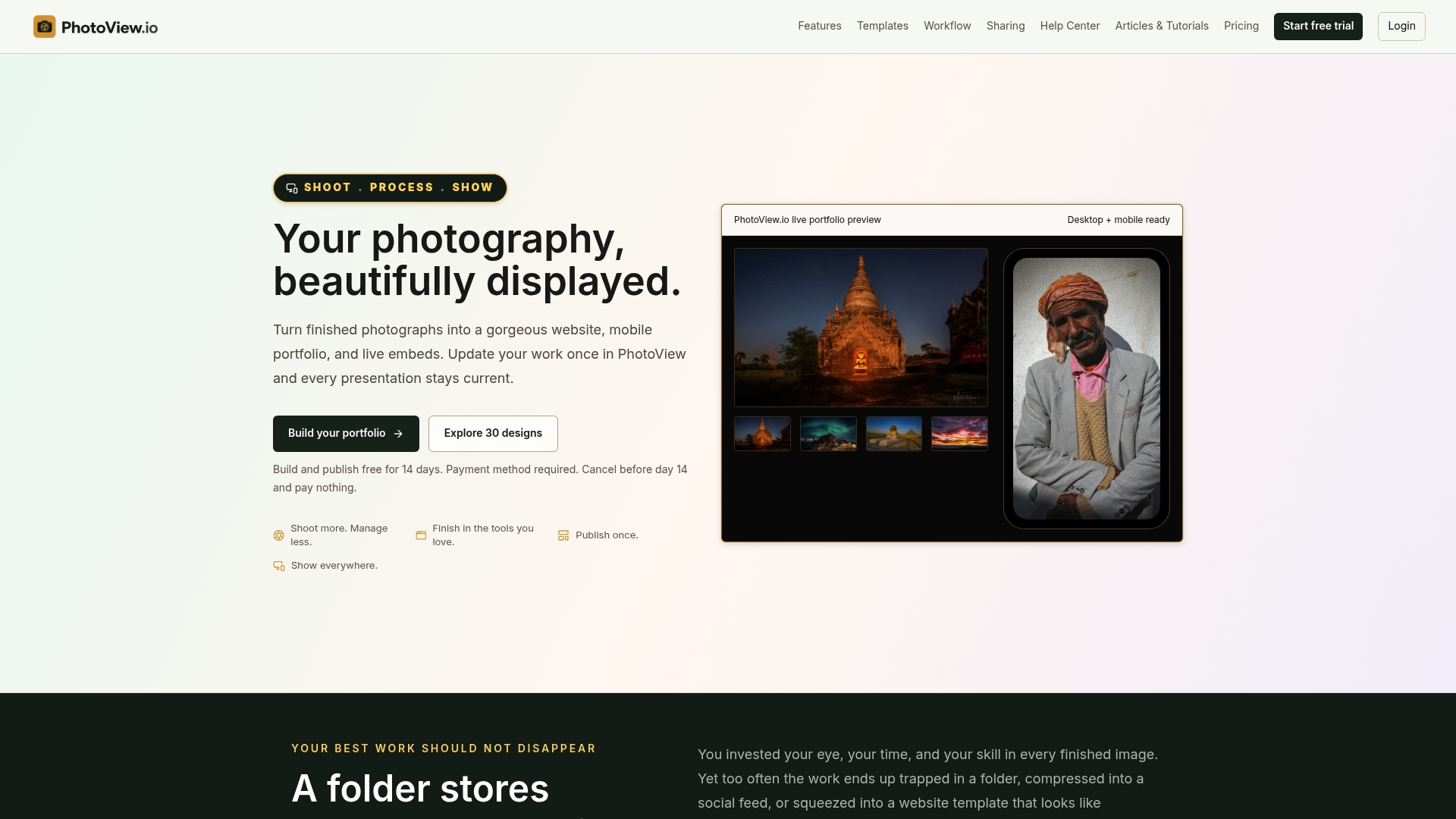
If speed from Lightroom to a live portfolio is your priority, we built PhotoView around that exact path. Here is how we map to the checklist above:
- Lightroom publishing: publish a portfolio directly from Lightroom without exporting files by hand.
- 30+ responsive templates: every template is included in every plan, so you can change your look without upgrading.
- Smart Folders: organize new work automatically as you shoot.
- Private sharing: deliver private galleries to clients with controlled access.
- Custom domains and live embeds: keep your own web address and let embedded galleries stay current.
Start simply: import 15–30 images, publish one gallery from Lightroom, and create one private client gallery. You will quickly see whether the workflow suits you. Choose a plan when you are ready to publish.
FAQ
How long should a portfolio platform trial last?
A trial can give you time to publish a gallery, test your domain, and share a private link. Use that window to run the full evaluation checklist with your own images.
Does Lightroom publishing replace manual exports?
Yes, for most portfolio updates. When a platform publishes directly from Lightroom, you skip exporting and re-uploading, and changes reach your live galleries faster.
Can a portfolio platform host video as well as photos?
Many can, but support varies. Confirm that video and stills sit in the same gallery and that playback works well on mobile before you commit to a plan.
How do I estimate how much storage I need?
Multiply your average finished file size by the number of images you plan to keep online. Add a buffer for video and future shoots, then pick the plan that covers the total.
Useful sources
- PhotoView Tops Best Online Photo Galleries for Portfolio Photographers
- The Best Photo Gallery Platform for Portfolio-First Photographers
- Lightroom Publishing: Portfolio Platforms for Photographers
- Photo and video storage for a portfolio that stays organized